• HOME
  • NEWS
  • EXPLORE
    • CAREER
      • Companies
      • Jobs
    • EVENTS
    • iGEM
      • News
      • Team
    • PHOTOS
    • VIDEO
    • WIKI
  • BLOG
  • COMMUNITY
    • FACEBOOK
    • INSTAGRAM
    • TWITTER
Sunday, May 10, 2026
BIOENGINEER.ORG
No Result
View All Result
  • Login
  • HOME
  • NEWS
  • EXPLORE
    • CAREER
      • Companies
      • Jobs
        • Lecturer
        • PhD Studentship
        • Postdoc
        • Research Assistant
    • EVENTS
    • iGEM
      • News
      • Team
    • PHOTOS
    • VIDEO
    • WIKI
  • BLOG
  • COMMUNITY
    • FACEBOOK
    • INSTAGRAM
    • TWITTER
  • HOME
  • NEWS
  • EXPLORE
    • CAREER
      • Companies
      • Jobs
        • Lecturer
        • PhD Studentship
        • Postdoc
        • Research Assistant
    • EVENTS
    • iGEM
      • News
      • Team
    • PHOTOS
    • VIDEO
    • WIKI
  • BLOG
  • COMMUNITY
    • FACEBOOK
    • INSTAGRAM
    • TWITTER
No Result
View All Result
Bioengineer.org
No Result
View All Result
Home NEWS Science News Chemistry

Food scraps get a bold new life

Bioengineer by Bioengineer
May 25, 2021
in Chemistry
Reading Time: 3 mins read
0
IMAGE
Share on FacebookShare on TwitterShare on LinkedinShare on RedditShare on Telegram

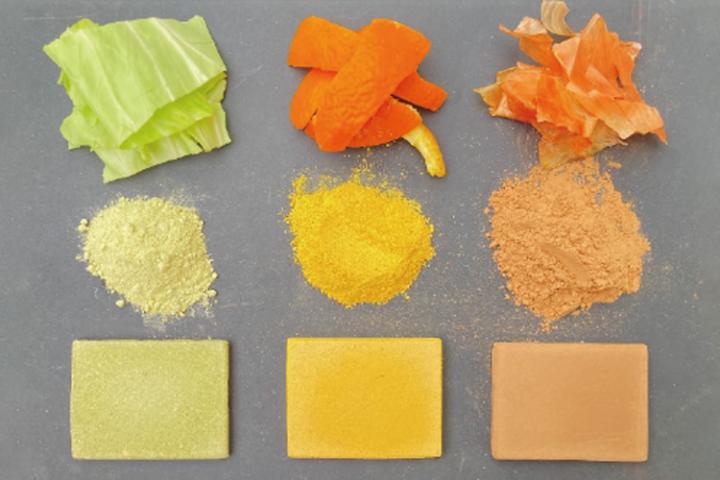
IMAGE

Credit: Institute of Industrial Science, the University of Tokyo

Tokyo, Japan – Most people don’t think much about the food scraps they throw away; however, investigators from the Institute of Industrial Science at The University of Tokyo have developed a new method to reduce food waste by recycling discarded fruit and vegetable scraps into robust construction materials.

Worldwide industrial and household food waste amounts to hundreds of billions of pounds per year, a large proportion of which comprises edible scraps, like fruit and vegetable peels. This unsustainable practice is both costly and environmentally unfriendly, so researchers have been searching for new ways to recycle these organic materials into useful products.

“Our goal was to use seaweed and common food scraps to construct materials that were at least as strong as concrete,” explains Yuya Sakai, the senior author of the study. “But since we were using edible food waste, we were also interested in determining whether the recycling process impacted the flavor of the original materials.”

The researchers borrowed a “heat pressing” concept that is typically used to make construction materials from wood powder, except they used vacuum-dried, pulverized food scraps, such as seaweed, cabbage leaves, and orange, onion, pumpkin, and banana peels as the constituent powders. The processing technique involved mixing the food powder with water and seasonings, and then pressing the mixture into a mold at high temperature. The researchers tested the bending strength of the resulting materials and monitored their taste, smell, and appearance.

“With the exception of the specimen derived from pumpkin, all of the materials exceeded our bending strength target,” says Kota Machida, a senior collaborator. “We also found that Chinese cabbage leaves, which produced a material over three times stronger than concrete, could be mixed with the weaker pumpkin-based material to provide effective reinforcement.”

The new, robust materials retained their edible nature, and the addition of salt or sugar improved their taste without reducing their strength. Furthermore, the durable products resisted rot, fungi, and insects, and experienced no appreciable changes in appearance or taste after exposure to air for four months.

Given that food waste is a global financial burden and environmental concern, it is crucial to develop methods for recycling food scraps. Using these substances to prepare materials that are strong enough for construction projects, but also maintain their edible nature and taste, opens the door to a wide range of creative applications from the one technology.

###

The work will be published in the proceedings of The 70th Annual Meeting of The Society of Materials Science, Japan as “Development of Novel Construction Material from Food Waste”

About Institute of Industrial Science (IIS), the University of Tokyo

Institute of Industrial Science (IIS), the University of Tokyo is one of the largest university-attached research institutes in Japan.

More than 120 research laboratories, each headed by a faculty member, comprise IIS, with more than 1,000 members including approximately 300 staff and 700 students actively engaged in education and research. Our activities cover almost all the areas of engineering disciplines. Since its foundation in 1949, IIS has worked to bridge the huge gaps that exist between academic disciplines and realworld applications.

Media Contact
Yuya Sakai
[email protected]

Original Source

https://www.iis.u-tokyo.ac.jp/en/news/3567/

Tags: Agricultural Production/EconomicsAgricultureCivil EngineeringEcology/EnvironmentFood/Food ScienceIndustrial Engineering/ChemistryMaterialsMechanical EngineeringPollution/RemediationResearch/Development
Share12Tweet8Share2ShareShareShare2

Related Posts

Miniature Sensor Uses Light to Detect Touch — Chemistry

Miniature Sensor Uses Light to Detect Touch

May 8, 2026
Iron Minerals Determine Whether Dissolved Organic Matter Fuels Microbes or Becomes Long-Term Carbon Storage — Chemistry

Iron Minerals Determine Whether Dissolved Organic Matter Fuels Microbes or Becomes Long-Term Carbon Storage

May 8, 2026

Kate Evans Appointed Associate Lab Director for Biological and Environmental Systems Science at ORNL

May 8, 2026

Advancing Multiscale Modeling and Overcoming Operational Challenges in Autothermal COâ‚‚-to-Methanol Reactors

May 8, 2026
Please login to join discussion

POPULAR NEWS

  • Research Indicates Potential Connection Between Prenatal Medication Exposure and Elevated Autism Risk

    840 shares
    Share 336 Tweet 210
  • New Study Reveals Plants Can Detect the Sound of Rain

    727 shares
    Share 290 Tweet 181
  • Scientists Investigate Possible Connection Between COVID-19 and Increased Lung Cancer Risk

    68 shares
    Share 27 Tweet 17
  • Salmonella Haem Blocks Macrophages, Boosts Infection

    61 shares
    Share 24 Tweet 15

About

We bring you the latest biotechnology news from best research centers and universities around the world. Check our website.

Follow us

Recent News

Evaluating Digoxin Use in Patients with Symptomatic Rheumatic Heart Disease

Evaluating the Effectiveness and Safety of Digitalis Glycosides in Treating Heart Failure

Urdu Fall Risk Questionnaire Adapted for Elderly

Subscribe to Blog via Email

Enter your email address to subscribe to this blog and receive notifications of new posts by email.

Join 82 other subscribers
  • Contact Us

Bioengineer.org © Copyright 2023 All Rights Reserved.

Welcome Back!

Login to your account below

Forgotten Password?

Retrieve your password

Please enter your username or email address to reset your password.

Log In
No Result
View All Result
  • Homepages
    • Home Page 1
    • Home Page 2
  • News
  • National
  • Business
  • Health
  • Lifestyle
  • Science

Bioengineer.org © Copyright 2023 All Rights Reserved.