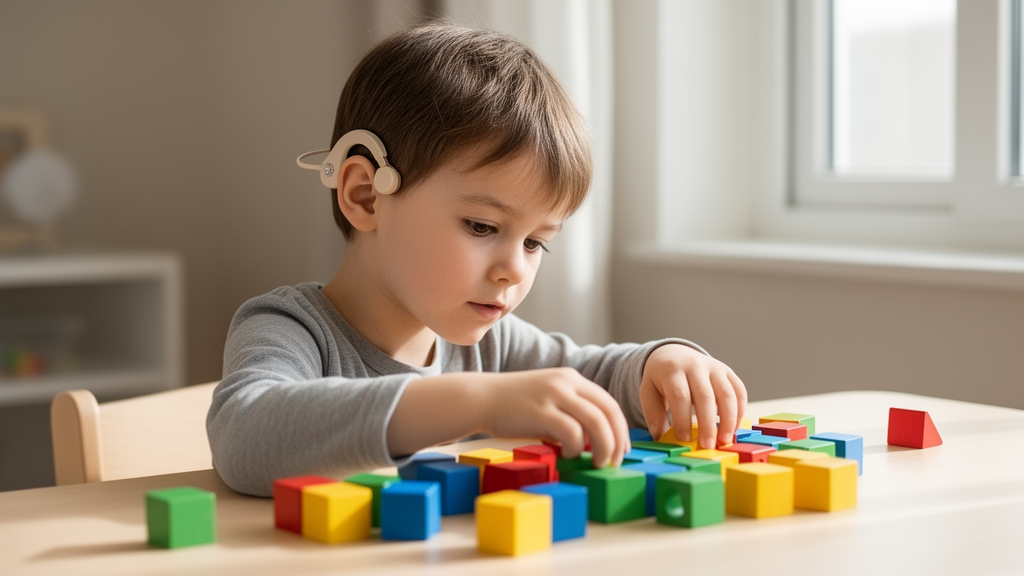
Children with autism spectrum disorder who use cochlear implants demonstrate spoken language communication and adaptive behavior outcomes that are broadly comparable to those observed in children with autism spectrum disorder and typical hearing, according to a comparative clinical study. Although exploratory analyses revealed variation across several developmental domains, researchers detected no statistically significant differences in primary measures between cochlear implant users with autism and their typically hearing autistic peers.
The exploratory investigation was undertaken because cochlear implantation is known to benefit pediatric patients with severe hearing loss, including children who also have autism spectrum disorder. However, clinical identification of autism is often delayed in children with hearing impairment, creating a need to better characterize their developmental trajectories. To address this question, researchers evaluated language, communication, and adaptive behavior profiles in children with autism spectrum disorder using cochlear implants by benchmarking them against two distinct comparison cohorts: children with autism spectrum disorder who have typical hearing and typically developing children who use cochlear implants.
Conducted as a single-institution comparative study in Japan by researchers from the University of Osaka and Kanazawa University, the investigation analyzed three clinical groups totaling 43 pediatric participants. The sample comprised 15 children diagnosed with autism spectrum disorder who used cochlear implants, 13 children with autism spectrum disorder and typical hearing, and 15 typically developing children who used cochlear implants. Demographic assessments confirmed that the three study cohorts did not differ significantly with respect to participant age or sex.
To measure functional abilities across the cohorts, the investigators utilized two standardized evaluation instruments. Spoken language communication was assessed using the Language and Communication Scale for School-Age Children. Adaptive behavior and daily living skills were independently evaluated using the Japanese version of the Vineland Adaptive Behavior Scales, Second Edition.
In spoken language communication evaluations, overall Language and Communication Scale for School-Age Children indices were significantly higher in typically developing cochlear implant users than in either of the two groups of children with autism spectrum disorder. While exploratory analyses initially suggested potential differences across multiple language-related subtests, only the Contextual Listening and Social Context subtests remained statistically significant after the research team applied multiple-comparison corrections.
Evaluations of adaptive functioning showed that Adaptive Behavior Composite scores on the Vineland Adaptive Behavior Scales, Second Edition, were significantly higher in typically developing cochlear implant users compared to the typically hearing autism group. No other pairwise between-group comparisons for the composite score reached statistical significance. When evaluating specific Vineland-II subdomains, only the Community Use subdomain maintained statistical significance following multiple-comparison correction, while the cochlear implant autism group and typically hearing autism group demonstrated broadly similar overall adaptive behavior profiles.
The authors emphasized that their findings should be interpreted cautiously in light of key study limitations, including the modest sample size, single-center setting, and cross-sectional observational design. They noted that exploratory analyses suggested subtle variation across specific language and adaptive domains that warrants further inquiry. Consequently, the research team highlighted the necessity for subsequent investigations featuring larger pediatric samples and longitudinal follow-up to more thoroughly characterize long-term communication and behavioral outcomes in children with autism spectrum disorder who receive cochlear implants.
The comparative design provided valuable perspective by evaluating children with autism spectrum disorder who use cochlear implants against two distinct clinical benchmark groups. By contrasting this cohort with typically developing cochlear implant users and children with autism spectrum disorder and typical hearing, the researchers described communication and adaptive behavior profiles across clinical contexts. While typically developing implant users demonstrated higher overall language indices and adaptive composite scores, autistic cochlear implant users achieved outcomes broadly comparable to typically hearing autistic peers.
The distinction between exploratory observations and corrected significance provides essential context for interpreting these profiles. Although exploratory analyses indicated divergence across several language subtests and adaptive domains, multiple-comparison corrections restricted statistically significant differences to Contextual Listening, Social Context, and Community Use. These findings show that after correction, group differences remained confirmed only in Contextual Listening and Social Context on the language measure, and only in Community Use among adaptive subdomains, while no other pairwise comparisons reached statistical significance between the cochlear implant autism group and typically hearing autistic peers.
Understanding these developmental profiles addresses longstanding clinical challenges associated with pediatric hearing loss and autism spectrum disorder. Although cochlear implantation benefits children with severe hearing impairment, including those diagnosed with autism spectrum disorder, identifying autism is often delayed in children with hearing impairment. By examining spoken language communication through the Language and Communication Scale for School-Age Children alongside adaptive behavior measured by the Japanese version of the Vineland Adaptive Behavior Scales, Second Edition, the study provides descriptive evidence characterizing this pediatric group.
Because this exploratory investigation was conducted within a single institution using a cross-sectional design and a sample of 43 participants, the authors noted that findings should be interpreted cautiously. Cross-sectional data evaluate developmental status at one time point without tracking progression over time. The researchers concluded that further studies with larger samples and longitudinal designs are needed to better characterize developmental outcomes in children with autism spectrum disorder who use cochlear implants.
Subject of Research: Language, communication, and adaptive behavior outcomes in pediatric cochlear implant users with autism spectrum disorder
Article Title: Language and adaptive behavior in children with autism spectrum disorder and cochlear implants: insights from a Japanese clinical sample
Article References: Suwa, K., Hanamoto, M., Ohta, Y., Mohri, I., Tachibana, M., Kagitahi-Shimono, K., Inohara, H., & Kobayashi, H. (2026). Language and adaptive behavior in children with autism spectrum disorder and cochlear implants: insights from a Japanese clinical sample. Frontiers in Audiology and Otology, 4, 1956584. https://doi.org/10.3389/fauot.2026.1956584
Image Credits: AI Generated
DOI: 10.3389/fauot.2026.1956584
Keywords: cochlear implants, autism spectrum disorder, hearing impairment, severe hearing loss, adaptive behavior, spoken language communication, Language and Communication Scale for School-Age Children, Vineland Adaptive Behavior Scales, Contextual Listening, Social Context, Community Use, Adaptive Behavior Composite, pediatric audiology, auditory implants, cross-sectional study, Japanese clinical sample
News Source: Ophelia Keating. (November 16, 2026). Autistic Children With Cochlear Implants Show Broadly Comparable Developmental Outcomes. Scienmag.