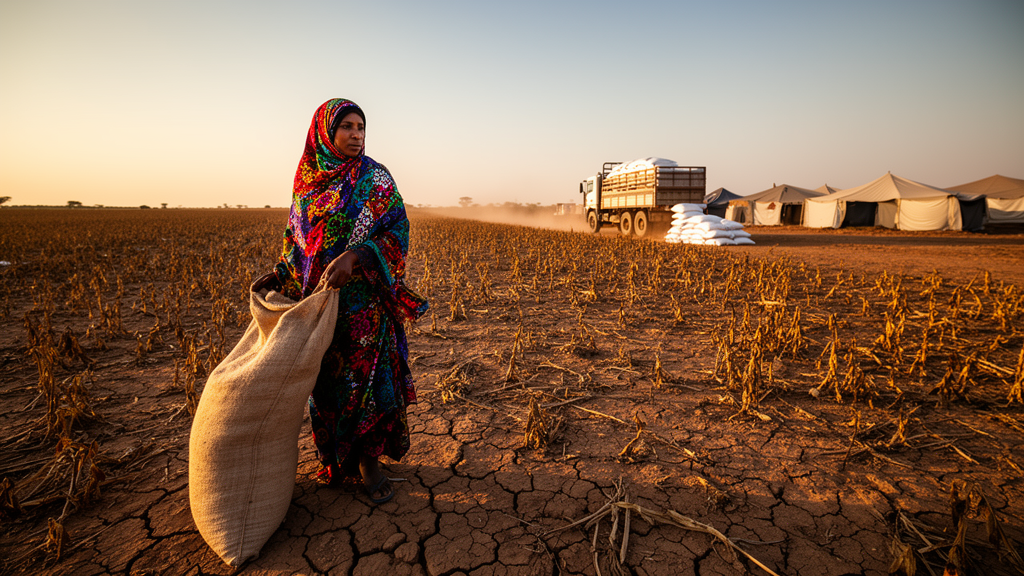
Somalia’s food security has been shaped over three decades by an uncomfortable trio of pressures: recurring conflict, erratic climate shocks and a heavy reliance on foreign assistance. A new econometric study published in Agriculture & Food Security analyzes annual time-series data from 1990 to 2020 and reports that, in the long run, food aid, average rainfall and conflict are each significantly associated with lower food security, while humanitarian aid shows a significant positive association. Average temperature, by contrast, shows no statistically significant effect in the long run.
The study, authored by Amir Mohamud Mohamed and Abdulfatah Mohamed Abdullahi, measures food security using the Food Production Index, a proxy chosen because Somalia’s limited and unreliable data make multidimensional indices such as the Global Food Security Index difficult to apply consistently. Food aid and humanitarian aid serve as proxies for foreign assistance, average rainfall and average temperature capture climate conditions, and conflict enters the model as a dummy variable taking the value 1 in years when conflict occurred and 0 otherwise. The underlying data were drawn from the Organization of Islamic Cooperation’s SESRIC statistics and the Climate Change Knowledge Portal.
Methodologically, the authors rely on an Autoregressive Distributed Lag (ARDL) bounds testing approach, which is well suited to small samples and to variables that are stationary at level or after first differencing. Unit root testing with the Augmented Dickey-Fuller and Phillips-Perron tests indicated that most variables were non-stationary at levels and became stationary after first differencing, and a Zivot-Andrews test allowing for a single endogenous structural break confirmed stationarity properties once breaks were accounted for. The identified break years, including 2001-2002, 2005-2007 and 2014, coincide with episodes of political instability, drought and shifts in aid flows. The F-bounds test statistic of 3.443 exceeded the 5 percent upper critical value, supporting the existence of a long-run relationship among the variables.
The long-run estimates are striking. A 1 percent increase in food aid is associated with a 0.030 percent decrease in food security, and a 1 percent increase in average rainfall with a 0.284 percent decrease. A one-unit rise in the conflict variable corresponds to a 0.074 percent decline. Humanitarian aid moves in the opposite direction: a 1 percent increase is associated with a 0.041 percent rise in food security. In the short run, the picture narrows considerably. Rainfall and conflict remain statistically significant, with a 1 percent rainfall increase linked to a 0.107 percent fall and a one-unit conflict increase to a 0.079 percent decline, while food aid, humanitarian aid and temperature are statistically insignificant over short horizons.
The model’s error-correction coefficient is negative and statistically significant at -1.020, indicating rapid adjustment back toward long-run equilibrium after a disturbance, and the R-squared value of 0.634 means the included variables explain roughly 63.4 percent of the variation in food security. Residual diagnostics passed tests for normality, serial correlation, heteroscedasticity and functional form, and CUSUM and CUSUM-square stability tests showed the model parameters remained within 5 percent critical boundaries across the sample period.
Robustness checks using Fully Modified Ordinary Least Squares, Dynamic Ordinary Least Squares and Canonical Cointegrating Regression broadly corroborate the headline results, though with some differences in significance. Food aid is negative and statistically significant in all three estimators, with a 1 percent increase associated with declines of 0.0347 percent under FMOLS, 0.059 percent under DOLS and 0.037 percent under CCR. Conflict is negative and significant under FMOLS and CCR, with one-unit increases linked to declines of 0.118 percent and 0.123 percent respectively. Humanitarian aid is positive and significant only under DOLS, where a 1 percent increase corresponds to a 0.100 percent rise, and rainfall and temperature lose significance across all three robustness models. The authors argue that the similar coefficient magnitudes and directions across methods strengthen the credibility of the core findings despite these differences.
The negative food aid result demands careful interpretation, and the authors are explicit that it does not mean food aid causes food insecurity. Food aid is largely reactive, rising during severe crises, so the observed association may partly reflect an underlying crisis dynamic. Drawing on the Disincentive and Market-Distortion Theory of Barrett and Maxwell, they explain that repeated in-kind food inflows into thin, poorly integrated markets can depress local prices, compress farm margins, reallocate labor away from farming and crowd out private traders when storage, transport and credit systems are weak, gradually eroding domestic production capacity even as short-run consumption needs are met. Timing, targeting, modality and institutional quality all condition these effects, which is why the study recommends reforming food aid toward cash transfers, vouchers and food-for-work or cash-for-work schemes, supported by digital tracking and accountability measures.
The negative rainfall association is equally counterintuitive and rooted in Somalia’s specific geography. Crop production is concentrated along the Juba and Shabelle rivers, where irrigated farming of maize, sorghum, sesame and vegetables is highly vulnerable to flooding; intense and poorly managed rainfall events destroy crops, damage irrigation canals, erode fertile soils and disrupt planting and harvesting cycles. Most of the country is arid or semi-arid rangeland dominated by pastoral and agropastoral livelihoods, where rainfall variability matters more than total rainfall, and extreme or erratic events can increase livestock disease, degrade grazing land and trigger displacement. The authors therefore interpret the negative long-run association as reflecting the destructive nature of rainfall shocks, particularly floods, rather than insufficient water availability, noting that sharp rainfall drops in 2000, 2011 and 2016 matched documented drought and famine periods.
Conflict emerges as the most consistent negative force, significant in both the long run and the short run and in the FMOLS and CCR robustness models. The authors characterize persistent insecurity as a permanent structural constraint rather than a temporary disturbance: it displaces farming households, restricts access to land and inputs, raises transaction costs, fragments supply chains and drives price instability, while also impeding the delivery of assistance itself. The 2011 Somalia famine illustrates the interaction, as drought triggered the crisis but conflict-related restrictions, including the expulsion of humanitarian agencies from areas controlled by Islamist groups, amplified it beyond what climatic conditions alone would have produced.
The study has clear limitations that the authors acknowledge. Key determinants such as foreign direct investment, labor, capital, food prices, employment, population growth and trade openness were excluded from the model, and future research is encouraged to incorporate them. Context matters for the aid findings as well: prior work cited in the paper found food aid improved nutrition outcomes only where institutional conditions were strong, and earlier Somali research reported negative long-run effects of food aid on crop production alongside insignificant humanitarian aid effects. The policy implications drawn from the new estimates are correspondingly structural: reform food aid modalities, prioritize conflict prevention and governance strengthening, integrate humanitarian aid with multi-year resilience funding, scale up small-scale irrigation and drought-resistant seeds, and invest in climate monitoring and early warning systems. With Somalia’s average temperature having risen by roughly 1 degree Celsius over the past 30 years and more than half the population depending on humanitarian assistance, the study’s central message is that food security in fragile states hinges less on the volume of aid delivered than on how, when and in what form it arrives, and on whether the conflict driving the crises is addressed at its roots.
Subject of Research: The effects of foreign aid, climate variables and conflict on food security in Somalia from 1990 to 2020
Article Title: Navigating aid and climate pressures to achieve food security in Somalia
Article References: Mohamed, A. M., & Abdullahi, A. M. (2026). Navigating aid and climate pressures to achieve food security in Somalia. Agriculture & Food Security, 15(1), Article 38. https://doi.org/10.1186/s40066-026-00625-9
Image Credits: AI Generated
DOI: 10.1186/s40066-026-00625-9
Keywords: Somalia, food security, foreign aid, food aid, humanitarian aid, climate variability, rainfall, conflict, ARDL, econometrics, food production index, time-series analysis
News Source: Alan Morgan. (October 29, 2026). Food aid may backfire as conflict and erratic rainfall erode Somalia’s food security. Scienmag.