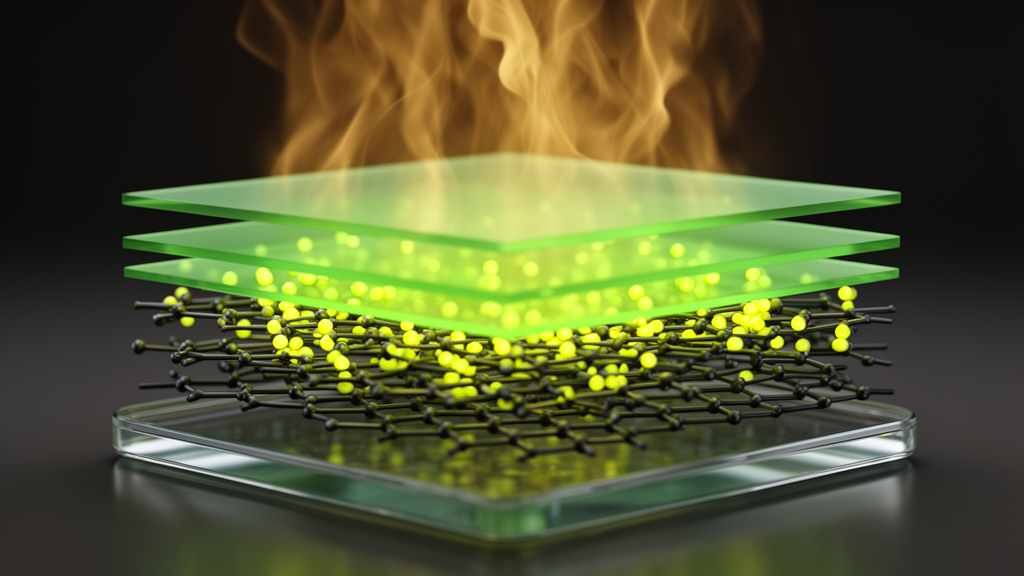
A new photodetector built from one of the world’s most familiar dyes, boosted with atom-thin sheets of carbon, could point the way toward cheap, lightweight light sensors. Researchers fabricated thin films of polyvinyl alcohol (PVA) doped with fluorescein dye and, in a second formulation, with both fluorescein and graphene nanosheets, then measured how well each material conducted heat and converted light into electrical current. The graphene-enhanced films outperformed their dye-only counterparts on nearly every metric, from thermal conductivity to quantum efficiency, while remaining simple enough to be cast from water-based solutions at modest temperatures. The work, reported in a peer-reviewed study, illustrates how inexpensive organic and carbon-based materials can be engineered into functional optoelectronic devices without exotic fabrication equipment.
The motivation for the research lies in a long-standing challenge in photonics: many high-performance photodetectors rely on organo-metallic dyes and crystalline semiconductors that are costly to produce and difficult to process. Photodetectors themselves are far more than laboratory curiosities. They underpin technologies ranging from secure space-to-space and intersatellite communication links to ozone-layer monitoring, pollution control, water disinfection, flame detection, biological and chemical agent sensing, and missile warning systems. Organic photodetectors, which use organic semiconductors to convert light into electrical signals, offer attractive alternatives because their detection wavelengths can be tuned, they can be manufactured at low cost, they are compatible with lightweight and flexible devices, and they are easy to process. Potential applications include low-cost imaging, health monitoring, and near-infrared sensing, and there is growing interest in building such devices from biocompatible materials.
The research team selected PVA as the host polymer because of its unusual combination of practical virtues. The synthetic polymer dissolves readily in water, is available in a range of molecular weights, is semi-crystalline, is non-toxic, and forms high-quality films when blended with other materials. Doping PVA with other substances is known to significantly modify its microstructural, optical, and electrical properties, and analyzing those changes allows researchers to infer features of the material’s electronic band structure. Into this benign matrix the researchers mixed fluorescein, a dark orange-red powder from the xanthene dye family whose molecular formula is C20H12O5 and whose optical and thermal properties shift with its environment. Previous work had shown that fluorescein behaves as an organic semiconductor, making it a promising candidate for light-detecting devices.
The second active ingredient, graphene nanosheets, brought formidable electronic credentials to the composite. Graphene exhibits exceptionally high carrier mobility, ballistic transport, the quantum Hall effect at room temperature, and strong mechanical and chemical stability, and it is lightweight, cheap, and suitable for large-scale production. Graphene-based photodetectors are known for ultrafast response times and broad spectral bandwidths, but they suffer from a critical weakness: a lack of wavelength selectivity, because graphene absorbs light broadly across the spectrum. By embedding graphene nanosheets in a dye-loaded polymer, the team aimed to combine the dye’s selective visible-light absorption with graphene’s superb charge transport, while keeping fabrication simple.
Fabrication followed a solution-casting route. PVA was dissolved in distilled water at 90 degrees Celsius under magnetic stirring for 30 minutes. For the dye-only blend, fluorescein was added at a fixed ratio and the mixture was stirred for 30 minutes and then ultrasonicated for 45 minutes. For the graphene formulation, PVA was combined with both graphene nanosheets and fluorescein, stirred for 45 minutes, and ultrasonicated for 60 minutes. The solutions were poured into Petri dishes and dried overnight at 40 degrees Celsius, yielding smooth films. Elemental analysis of the fluorescein-PVA copolymer closely matched the expected composition, with carbon measured at 64.2 percent against an estimated 64.12 percent and hydrogen at 6.77 percent against an estimated 6.45 percent, confirming successful incorporation of the dye into the polymer matrix.
Microscopy confirmed the quality of the films. Atomic force microscopy over 2-by-2-micrometer scans showed very smooth surfaces, with average roughness of approximately 36 nanometers for the fluorescein-PVA film and 35 nanometers for the graphene-fluorescein-PVA film. The dye-only film displayed few bright regions, which the authors interpret as limited conducting domains, whereas adding graphene produced a noticeable rise in the number of such domains. Scanning electron microscopy revealed no pinholes or porosity, notable surface uniformity, and an absence of defects; dark regions in the images corresponded to fluorescein dye particles and bright regions to polymer chains, indicating that the dye was well incorporated into the PVA matrix.
Thermal characterization was performed with the transient plane source technique, using a Hot Disc TPS 500 analyzer whose nickel double-spiral sensor, enclosed in Kapton insulation, acts as both heat source and dynamic temperature thermometer. Sandwiched between pairs of 4-micrometer-thick sample discs, the sensor received 300 milliwatts of power for 10 seconds at room temperature, generating 200 resistance readings from which thermal properties were extracted; the earliest readings were discarded to avoid errors from the sensor’s initial thermal mass, and the analysis removes the influence of contact resistance. The measured thermal conductivity of pure PVA was 0.133 watts per meter-kelvin, rising to 0.554 for fluorescein-PVA and 0.84 for the graphene-fluorescein-PVA composite. Specific heat climbed from 1.967 megajoules per cubic meter-kelvin for PVA to 6.865 for the dye blend and 11.140 for the graphene composite, while thermal diffusivity increased from 0.068 to 0.080 and then slightly decreased to 0.075 square millimeters per second. The authors attribute the conductivity gains to the vibrations of C-H bonds in the insulating polymer and dye, and, in the graphene composite, to free electrons that transfer heat very quickly; the high volumetric heat capacity of the graphene sample in turn lowers its diffusivity, which is conductivity divided by volumetric heat capacity.
The photodetector devices themselves were 2-micrometer-thick films of fluorescein-PVA and graphene-fluorescein-PVA, each with a 1-square-centimeter effective area, fitted with deposited silver electrodes on an aluminum-patterned substrate. Ultraviolet-visible spectroscopy from 300 to 800 nanometers showed strong absorption in the visible region with a prominent peak near 500 nanometers, and higher absorbance for the graphene composite, attributed to structural changes such as increased film density rather than chemical modification. Reflectance decreased with graphene addition, and analysis via the Kubelka-Munk function indicated enhanced structural order and crystallinity. Tauc analysis of the absorption data yielded a direct optical band gap that decreased from 4.03 electron-volts for the dye-only film to 3.97 electron-volts with graphene. Current-voltage measurements in the dark were linear, while forward bias revealed rectifying behavior consistent with a junction between the active layer and the silver electrode, with low reverse currents and high reverse resistance across all devices.
Under illumination from a tungsten-halogen solar simulator with an AM 1.5G filter at intensities of 25, 50, 75, and 100 milliwatts per square centimeter, both devices showed increasing current and conductivity with light intensity, driven by photoexcitation of additional charge carriers. Switching tests over three cycles of 25-second pulses at zero bias demonstrated stable, reproducible operation. The dye-only device reached peak photocurrent in roughly 390 milliseconds, while the graphene device responded faster, at about 350 milliseconds, a speedup credited to the nanosheets’ enhanced electrical conductivity. Responsivity rose from 8.5 milliamperes per milliwatt for the dye-only detector to 12.1 for the graphene version, implying roughly 80 to 110 milliamperes per milliwatt at 500 nanometers. External quantum efficiency reached 28.8 percent for the graphene device versus 20.22 percent for the dye-only device at 25 milliwatts per square centimeter under a forward bias of 5 volts, with efficiency declining at higher intensities for both, though the graphene device retained higher values throughout.
The authors attribute the graphene device’s superior photoresponse to a combination of factors: improved charge transfer, increased carrier concentrations, and greater carrier mobility. Graphene nanosheets act as effective electron acceptors, creating polarons and facilitating the separation of photo-generated excitons into free electrons and holes under illumination. They also serve as conductive pathways for charge carriers, improving transport, reducing recombination, and boosting photocurrent, and may alter the electronic structure of the PVA matrix in ways that increase carrier mobility and absorption. The study is a laboratory-scale demonstration with devices measured under controlled conditions, and the reported response times are similar to values in the existing literature. Even so, the combination of water-processable fabrication, non-toxic ingredients, improved thermal conduction for heat dissipation, and competitive photoresponse suggests that humble fluorescein, when paired with graphene nanosheets, deserves attention in the ongoing search for affordable organic light sensors.
Subject of Research: Organic photodetectors made from fluorescein dye, graphene nanosheets, and polyvinyl alcohol, characterized for thermal and optoelectronic performance
Article Title: Enhanced performance of organic light photodetectors based on poly (vinyl alcohol) supported with fluorescein dye and graphene nanosheets: fabrication, characterization, and thermometric measurements
Article References: Ibrahim, H. K., Abdullah, R. M., Musa, A. I., Badran, H. A., Radhi, F. S., Abul-Hail, R. C., Fakher Al-Fahed, R. K., & Ajeel, K. I. (2026). Enhanced performance of organic light photodetectors based on poly (vinyl alcohol) supported with fluorescein dye and graphene nanosheets: fabrication, characterization, and thermometric measurements. Results in Physics, Article 108772. https://doi.org/10.1016/j.rinp.2026.108772
Image Credits: AI Generated
DOI: 10.1016/j.rinp.2026.108772
Keywords: organic photodetectors, graphene nanosheets, fluorescein dye, polyvinyl alcohol, thermal conductivity, optical band gap, quantum efficiency, photoresponsivity, nanocomposites, optoelectronics, thin films, Enhanced
News Source: Neil Sanderson. (October 23, 2026). Fluorescein Dye and Graphene Nanosheets Boost Organic Photodetector Performance and Heat Conduction. Scienmag.