• HOME
  • NEWS
  • EXPLORE
    • CAREER
      • Companies
      • Jobs
    • EVENTS
    • iGEM
      • News
      • Team
    • PHOTOS
    • VIDEO
    • WIKI
  • BLOG
  • COMMUNITY
    • FACEBOOK
    • INSTAGRAM
    • TWITTER
Monday, May 11, 2026
BIOENGINEER.ORG
No Result
View All Result
  • Login
  • HOME
  • NEWS
  • EXPLORE
    • CAREER
      • Companies
      • Jobs
        • Lecturer
        • PhD Studentship
        • Postdoc
        • Research Assistant
    • EVENTS
    • iGEM
      • News
      • Team
    • PHOTOS
    • VIDEO
    • WIKI
  • BLOG
  • COMMUNITY
    • FACEBOOK
    • INSTAGRAM
    • TWITTER
  • HOME
  • NEWS
  • EXPLORE
    • CAREER
      • Companies
      • Jobs
        • Lecturer
        • PhD Studentship
        • Postdoc
        • Research Assistant
    • EVENTS
    • iGEM
      • News
      • Team
    • PHOTOS
    • VIDEO
    • WIKI
  • BLOG
  • COMMUNITY
    • FACEBOOK
    • INSTAGRAM
    • TWITTER
No Result
View All Result
Bioengineer.org
No Result
View All Result
Home NEWS Science News Chemistry

First ever observation of ‘time crystals’ interacting

Bioengineer by Bioengineer
August 17, 2020
in Chemistry
Reading Time: 2 mins read
0
IMAGE
Share on FacebookShare on TwitterShare on LinkedinShare on RedditShare on Telegram

IMAGE

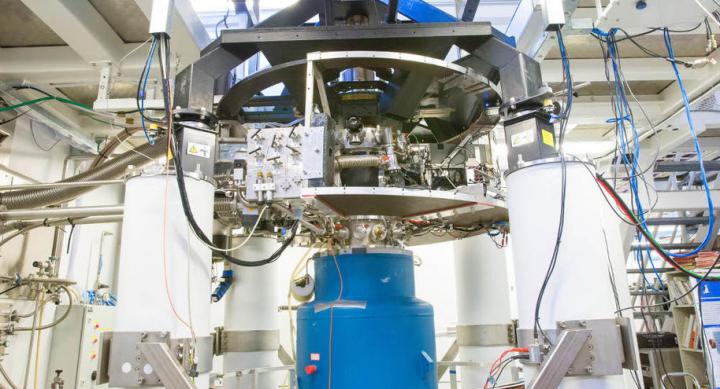
Credit: Aalto University/Mikko Raskinen

For the first time ever, scientists have witnessed the interaction of a new phase of matter known as “time crystals”.

The discovery, published in Nature Materials, may lead to applications in quantum information processing because time crystals automatically remain intact – coherent – in varying conditions. Protecting coherence is the main difficulty hindering the development of powerful quantum computers.

Dr Samuli Autti, lead author from Lancaster University, said: “Controlling the interaction of two time crystals is a major achievement. Before this, nobody had observed two time crystals in the same system, let alone seen them interact.

“Controlled interactions are the number one item on the wish list of anyone looking to harness a time crystal for practical applications, such as quantum information processing.”

Time crystals are different from a standard crystal – like metals or rocks – which is composed of atoms arranged in a regularly repeating pattern in space.

First theorised in 2012 by Nobel Laureate Frank Wilczek and identified in 2016, time crystals exhibit the bizarre property of being in constant, repeating motion in time despite no external input. Their atoms are constantly oscillating, spinning, or moving first in one direction, and then the other.

An international team of researchers from Lancaster, Yale, Royal Holloway London, and Aalto University in Helsinki observed time crystals by using Helium-3 which is a rare isotope of helium with one missing neutron. The experiment was carried out in Aalto University.

They cooled superfluid helium-3 to within one ten thousandth of a degree from absolute zero (0.0001K or -273.15°C). The researchers then created two time crystals inside the superfluid, and allowed them to touch.

The scientists observed the two time crystals interacting and exchanging constituent particles flowing from one time crystal to the other one, and back – a phenomenon known as the Josephson effect.

Time crystals have great potential for practical applications. They could be used to improve current atomic clock technology – complex timepieces that keep the most accurate time that we can possibly achieve. They could also improve technology such as gyroscopes, and systems that rely on atomic clocks, such as GPS.

###

Media Contact
Gillian.whitworth
[email protected]

Related Journal Article

http://dx.doi.org/10.1038/s41563-020-0780-y

Tags: Atomic/Molecular/Particle PhysicsChemistry/Physics/Materials SciencesComputer ScienceInternetMaterialsNanotechnology/MicromachinesParticle PhysicsSuperconductors/Semiconductors
Share12Tweet8Share2ShareShareShare2

Related Posts

Miniature Sensor Uses Light to Detect Touch — Chemistry

Miniature Sensor Uses Light to Detect Touch

May 8, 2026
Iron Minerals Determine Whether Dissolved Organic Matter Fuels Microbes or Becomes Long-Term Carbon Storage — Chemistry

Iron Minerals Determine Whether Dissolved Organic Matter Fuels Microbes or Becomes Long-Term Carbon Storage

May 8, 2026

Kate Evans Appointed Associate Lab Director for Biological and Environmental Systems Science at ORNL

May 8, 2026

Advancing Multiscale Modeling and Overcoming Operational Challenges in Autothermal CO₂-to-Methanol Reactors

May 8, 2026
Please login to join discussion

POPULAR NEWS

  • Research Indicates Potential Connection Between Prenatal Medication Exposure and Elevated Autism Risk

    840 shares
    Share 336 Tweet 210
  • New Study Reveals Plants Can Detect the Sound of Rain

    727 shares
    Share 290 Tweet 181
  • Scientists Investigate Possible Connection Between COVID-19 and Increased Lung Cancer Risk

    68 shares
    Share 27 Tweet 17
  • Salmonella Haem Blocks Macrophages, Boosts Infection

    61 shares
    Share 24 Tweet 15

About

We bring you the latest biotechnology news from best research centers and universities around the world. Check our website.

Follow us

Recent News

Evaluating Digoxin Use in Patients with Symptomatic Rheumatic Heart Disease

Evaluating the Effectiveness and Safety of Digitalis Glycosides in Treating Heart Failure

Urdu Fall Risk Questionnaire Adapted for Elderly

Subscribe to Blog via Email

Success! An email was just sent to confirm your subscription. Please find the email now and click 'Confirm' to start subscribing.

Join 82 other subscribers
  • Contact Us

Bioengineer.org © Copyright 2023 All Rights Reserved.

Welcome Back!

Login to your account below

Forgotten Password?

Retrieve your password

Please enter your username or email address to reset your password.

Log In
No Result
View All Result
  • Homepages
    • Home Page 1
    • Home Page 2
  • News
  • National
  • Business
  • Health
  • Lifestyle
  • Science

Bioengineer.org © Copyright 2023 All Rights Reserved.