Surgeons in Mauritania have reported the country’s first documented experience with flexible ureteroscopy and laser lithotripsy, a minimally invasive technique that fragments kidney and ureteral stones from inside the urinary tract without any incision. In a retrospective, single-center study published in the African Journal of Urology, a team at Chiva Clinic in Nouakchott analyzed the first 20 consecutive patients treated with the technique between May and December 2025. The overall stone-free rate was 90 percent, the mean operative time was 66 minutes, and the average hospital stay was just 24 hours, at an estimated mean procedural cost of 43,200 Mauritanian ouguiya, or roughly 920 euros, per session.
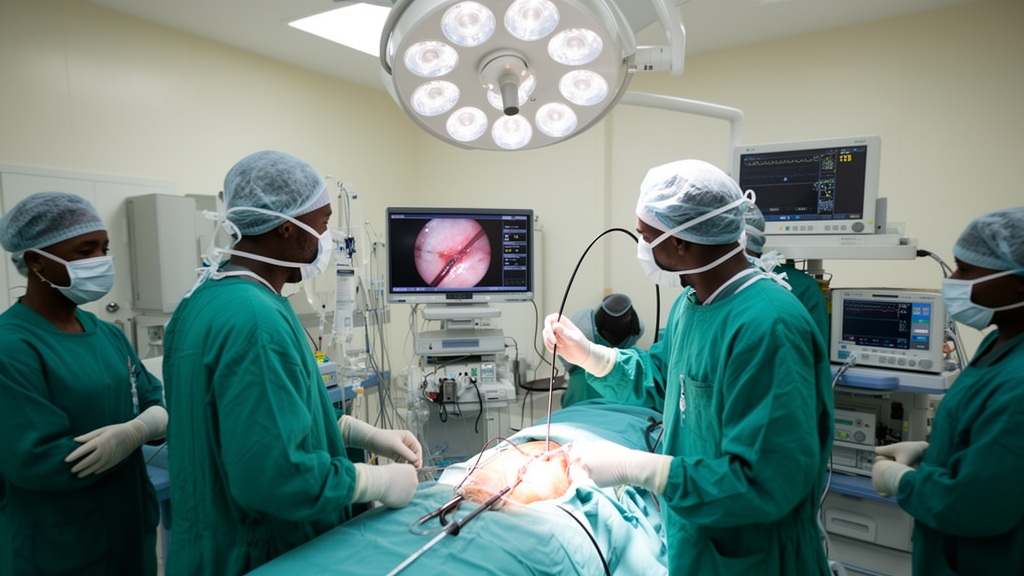
The technique, often abbreviated fURS-L, relies on a long, steerable endoscope that travels through the urethra and bladder and up the ureter into the kidney. Once the stone is visualized, a holmium laser fiber is advanced through the instrument’s working channel and delivers pulses that fragment the calculus. Small fragments can be dusted into fine particles that pass spontaneously, or larger pieces can be grasped with a retrieval basket. The procedure is considered a reference technique for upper urinary tract stones in international guidelines, but its adoption in low-resource countries has been hampered by the price of equipment, logistical constraints, and shortages of specialized training.
The Mauritanian cohort consisted of 20 patients with renal or proximal ureteral stones deemed suitable for retrograde intrarenal surgery after preoperative computed tomography assessment. The mean age was 42.8 years, with a range of 17 to 65 years, and men outnumbered women by a ratio of 2.5 to 1. Flank pain was the dominant presenting symptom, reported by 19 of the 20 patients, while one patient came to surgery after extracorporeal shock wave lithotripsy failed. Three patients had diabetes mellitus, one had hypertension, and two had a solitary kidney, a detail that underscores the clinical stakes of choosing an approach with limited morbidity.
The stone anatomy in the series reflected a substantial burden of disease. Fifteen patients, or 75 percent, had stones located within the kidney itself, three had stones at the ureteropelvic junction, and two had stones in the proximal lumbar ureter. Most patients were operated under spinal anesthesia, with only two requiring general anesthesia, and a safety guidewire was placed systematically at the start of every procedure.
The technical setup reveals the economic ingenuity behind the program. Fragmentation was performed with a 40-watt holmium:YAG laser, with surgeons generally favoring low-energy, high-frequency settings for dusting smaller stones and higher-energy fragmentation with basket extraction for larger burdens exceeding two centimeters. The flexible ureteroscope itself was a 7.5 French device marketed as single-use, but because disposable scopes are prohibitively expensive for mostly uninsured patients, the team reused each instrument after high-level disinfection and sterilization with Cidex, typically for up to five patients or more as long as deflection, visibility, and integrity remained acceptable. The authors flag this reuse as a crucial contextual factor when comparing their costs with health systems that discard such devices after one procedure.
Clinical outcomes were favorable for an introductory series. The mean operative time of 66 minutes ranged from 45 to 120 minutes, and the mean hospital stay was 24 plus or minus 3 hours. Only two postoperative complications occurred, both urinary tract infections classified as Clavien-Dindo grade II and successfully treated with antibiotics, yielding a complication rate of 10 percent. No readmissions, ureteral injuries, sepsis requiring intensive care, or late complications were recorded during available follow-up, and no patient planned for the laser procedure required conversion to open surgery. A descriptive review of the chronological case sequence suggested that operative times tended to lengthen in the earliest cases, consistent with a learning curve, although the small sample prevented reliable conclusions about improvement over time.
The 90 percent stone-free rate compares well with regional and international benchmarks, though the authors urge caution in such comparisons. Their figure exceeds the 81.2 percent reported by Niang and colleagues in Senegal and sits slightly below the 92.8 percent reported by Berthe and colleagues in Mali. In a meta-analysis cited by the team, Aboumarzouk and colleagues reported stone-free rates of 95.7 percent for stones measuring two to three centimeters and 84.6 percent for stones larger than three centimeters. Importantly, stone-free status in the Mauritanian series was assessed with renal ultrasonography and plain abdominal radiography about four weeks after surgery, generally after removal of the internal stent, rather than with postoperative computed tomography, the reference standard. The authors acknowledge this cheaper imaging strategy may underestimate small residual fragments, particularly from radiolucent stones, and may have inflated their rate relative to CT-based series.
The economic analysis is the study’s most distinctive contribution, though the authors are careful about its limits. The mean direct procedural cost of a single session in this private-sector setting was 43,200 MRU per patient, approximately 920 euros. This figure incorporates depreciation of the laser generator spread over its expected usable life, the laser fiber and ancillary materials, and the cost of the flexible ureteroscope distributed across its repeated disinfected uses. The team emphasizes that the analysis covers procedural costs only, includes no comparator group, and constitutes no formal cost-effectiveness analysis. International cost comparisons in their Table 3 must likewise be read cautiously given differences in health systems, reimbursement, equipment purchasing, and costing methods across countries.
Context shaped every clinical decision in the cohort. Mauritania is described as among the Saharan countries with a high endemic prevalence of urolithiasis, estimated at 28.1 percent, and open surgery and medical evacuation abroad remain common fallbacks with substantial economic and social costs. Miniaturized percutaneous nephrolithotomy, which a multicenter study by Ibis and colleagues found achieved higher single-session stone-free rates and fewer auxiliary procedures than retrograde intrarenal surgery for renal stones of 20 to 30 millimeters, was simply not available at the institution during the study period. For mostly uninsured patients unable to afford evacuation abroad, the laser procedure offered a minimally invasive alternative with short hospitalization, limited morbidity, and a potentially lower overall financial burden, even if the indication for larger stones reflected local constraints as much as pure clinical preference.
The authors list their limitations candidly: the retrospective, single-center design; the small sample drawn from the learning curve of a newly introduced technique; the absence of systematic postoperative CT; inconsistently recorded laser settings, fluoroscopy times, and irrigation pressures; unavailable stone density measurements from heterogeneous imaging centers; missing stone composition analysis; and the lack of percutaneous technique for comparison. Even so, they conclude that flexible ureteroscopy with laser lithotripsy is feasible, effective, and safe for renal and proximal ureteral stones in Mauritania, and that despite its high initial cost it may prove a cost-effective option in the medium and long term by shortening hospital stays, reducing complications, and avoiding open surgery or medical evacuation. They argue that expanding the technology alongside specialized training, resource sharing, and institutional support could meaningfully improve care for upper urinary tract stone disease in their country and offer a reference point for other sub-Saharan health systems weighing a first step into modern endourology.
Subject of Research: First national case series of flexible ureteroscopy with laser lithotripsy for urinary stones in Mauritania, reporting clinical outcomes and procedural costs in a resource-limited setting.
Article Title: Flexible ureteroscopy with laser lithotripsy in Mauritania: first national experience, clinical outcomes, and economic impact in a resource-limited setting
Article References: MOUFTAH, B., KHATRATY, C. S., ABDI, M., M’BALLA, M. E., & JDOUD, C. (2026). Flexible ureteroscopy with laser lithotripsy in Mauritania: first national experience, clinical outcomes, and economic impact in a resource-limited setting. African Journal of Urology, 32(1), Article 68. https://doi.org/10.1186/s12301-026-00614-1
Image Credits: AI Generated
DOI: 10.1186/s12301-026-00614-1
Keywords: flexible ureteroscopy, laser lithotripsy, kidney stones, Mauritania, urology, retrograde intrarenal surgery, holmium laser, stone-free rate, resource-limited setting, health economics, single-center retrospective study, sub-Saharan Africa
News Source: Ophelia Keating. (October 28, 2026). First 20 Laser Stone Surgeries in Mauritania Show 90% Stone-Free Rate at About 920 Euros per Patient. Scienmag.