A three-dimensional finite-element analysis found that loading direction and prosthetic configuration had greater effects on calculated stress and strain around 4-mm ultra-short dental implants than crown material. In the modeled posterior setting, oblique loading increased stress in single-crown restorations, while a splinted two-crown arrangement produced lower calculated values under the modeled oblique conditions. These are computational results and do not establish that any implant configuration is clinically safer, more reliable or superior.
The researchers developed three-dimensional finite-element models of single-crown restorations and a splinted two-crown configuration supported by 4-mm ultra-short implants. The models included zirconia and composite-resin crowns subjected to vertical loading and loading inclined by 30 degrees, each tested with and without a simulated food bolus between the crown and the opposing surface. The bolus was assigned a Young’s modulus of 10 MPa and a Poisson’s ratio of 0.30.
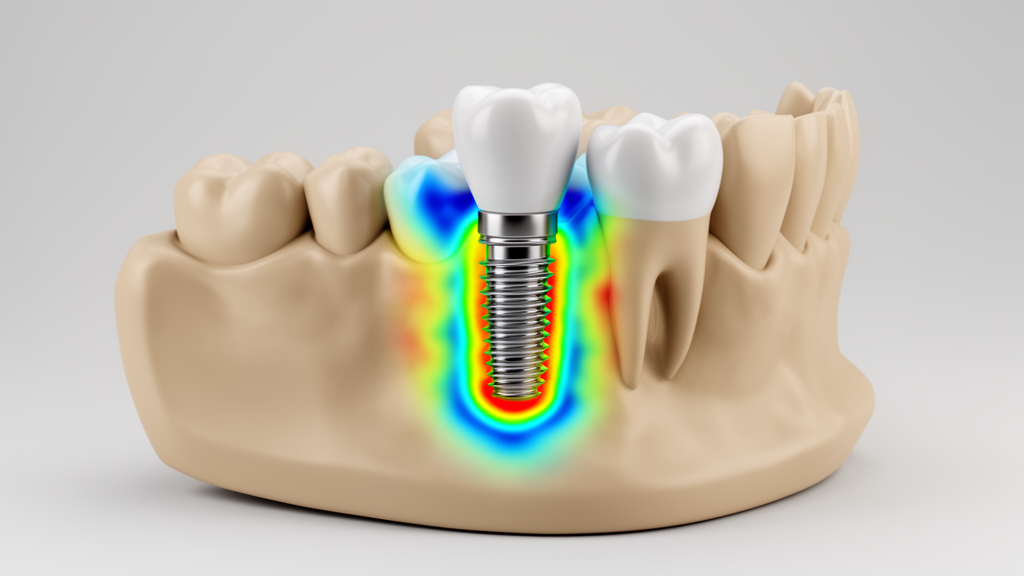
Primary outcomes were volume-weighted mean von Mises stress and equivalent elastic strain within a fixed 0.50-mm peri-implant volumetric region of interest. Without a simulated bolus, changing the single-crown load from vertical to oblique increased stress in the cortical-bone region of interest from approximately 10.01 to 43.02 MPa. In the trabecular-bone region, the corresponding values rose from about 4.95 to 12.35 MPa.
Interposing the simulated food bolus reduced the oblique-loading values to approximately 19.57 MPa in the cortical region and 5.63 MPa in the trabecular region. The results therefore show lower calculated stress under the modeled oblique conditions when a bolus was present, although the study evaluated only one specified bolus representation. In the splinted two-crown models, cortical-region stress under oblique loading ranged from 8.63 to 10.43 MPa.
These calculated peri-implant stress and strain outcomes were lower than those in the single-crown configuration under oblique loading. Splinting cannot, however, be treated as an independent causal factor in that comparison because the two configurations carried different total loads. Crown material made little difference in the single-crown models, which produced nearly identical region-of-interest outcomes for zirconia and composite resin.
A modest, configuration-specific material difference appeared under oblique loading in the splinted two-crown model. The researchers assessed numerical convergence using three nominal local mesh-refinement levels, and all primary outcomes met a 5% acceptance threshold. No patients were evaluated, and the analysis did not measure biological healing, implant failure or clinical outcomes.
Experimental and clinical validation would be required before the model could support claims of biomechanical reliability or clinical superiority.
Subject of Research: Finite-element assessment of peri-implant stress under different occlusal loading conditions
Article Title: Effect of occlusal loading and crown material on stress and strain distribution in bone around 4-mm ultra-short implants: a 3D-FEA
Article References: Renno, F., Gasparro, R., Mariniello, M., Aliberti, A., Garcia-Godoy, F., Lanzotti, A., & Ausiello, P. (2026). Effect of occlusal loading and crown material on stress and strain distribution in bone around 4-mm ultra-short implants: a 3D-FEA. Scientific Reports. https://doi.org/10.1038/s41598-026-76024-8
Image Credits: AI Generated
DOI: 10.1038/s41598-026-76024-8
Keywords: dental implants, finite-element analysis, occlusal loading, peri-implant bone, zirconia crowns, composite resin, bone stress, dental biomechanics, Effect, occlusal, loading, crown
News Source: Denise Maddox. (October 26, 2026). Finite-element study maps stresses around 4-mm ultra-short dental implants. Scienmag.