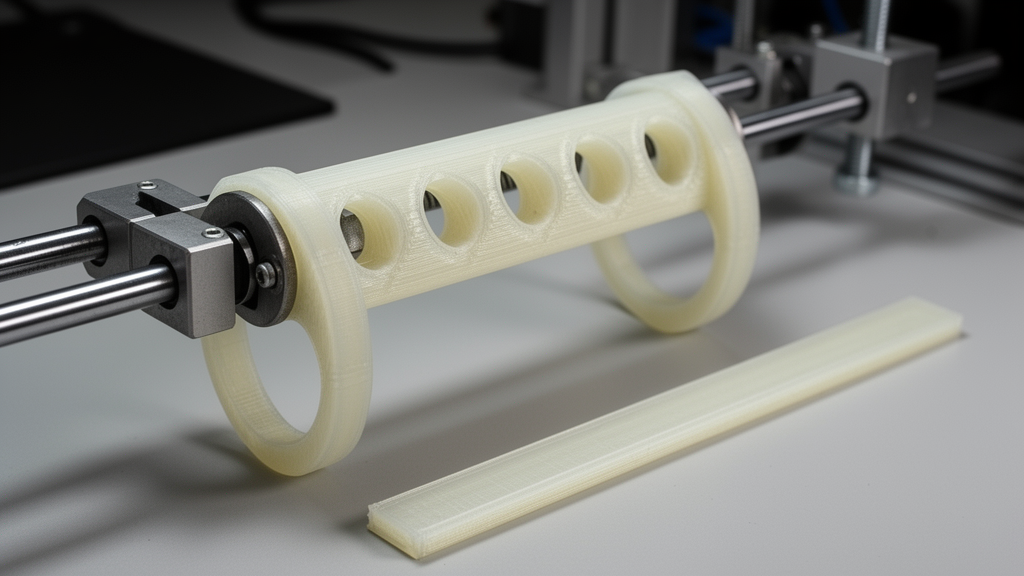
Increasing wall thickness or the number of openings markedly improved the peak bending-load capacity of polylactic acid (PLA) specimens produced by fused deposition modeling, according to an experimental and finite-element study. In the designs examined, raising wall thickness from 2 to 4 millimetres at a constant number of openings increased peak load capacity by as much as 170%. Increasing the opening count from one to three at a constant wall thickness produced a peak-load increase of 118%.
To investigate how geometry affected flexural performance, the researchers manufactured test specimens from PLA filament using fused deposition modeling, abbreviated FDM. The specimens included five wall thicknesses—2, 2.6, 2.7, 3.8 and 4 millimetres—and were evaluated in configurations with one, two or three openings. Bending tests measured the loads and deflections associated with each specimen’s structural response. Within the tested range, the largest reported gains in peak-load capacity occurred when wall thickness increased while the number of openings remained fixed.
The study combined physical experiments with finite-element modelling in ABAQUS. The computational analysis was used to examine failure mechanisms in the different specimen geometries. Its predicted deflection and force values were consistent with the experimental findings, providing a numerical account of the structures’ behaviour under bending loads. This agreement does not mean that every possible FDM component will respond identically: the results are tied to the specimen designs, PLA material and test conditions included in the investigation.
Thermogravimetric analysis examined the thermal behaviour of the PLA. The analysis showed no mass loss up to approximately 250–280 °C, while higher temperatures produced mass loss associated with thermal combustion of the polymer chains. Scanning electron microscopy revealed secondary-phase particles dispersed throughout the matrix rather than a completely homogeneous polymer structure. These observations characterize the tested material, but the reported thermal range and microscopic features were not shown to be universal across all PLA filaments or printed parts.
Together, the experiments and simulations identify wall thickness and opening count as influential design variables for the flexural performance of the investigated FDM-produced PLA specimens. Thicker walls and additional openings were each associated with higher peak bending-load capacity, while the finite-element results broadly matched the measured behaviour. The research therefore offers quantified evidence for two ways of altering geometry in this test program, without establishing whether the same percentage gains will occur in components of other shapes, under different loading conditions, or with different PLA formulations.
Subject of Research: Effects of wall thickness and opening count on the flexural performance of FDM-produced PLA specimens
Article Title: Effect of wall thickness and openings on the flexural properties of PLA produced by additive manufacturing
Article References: Karalar, M., Türe, M. O., Motameni, A., Korkut, F., & Evis, Z. (2026). Effect of wall thickness and openings on the flexural properties of PLA produced by additive manufacturing. Scientific Reports. https://doi.org/10.1038/s41598-026-67674-9
Image Credits: AI Generated
DOI: 10.1038/s41598-026-67674-9
Keywords: PLA, additive manufacturing, FDM, flexural performance, bending loads, wall thickness, openings, finite-element analysis, ABAQUS, polymer mechanics, Effect, wall
News Source: Denise Maddox. (October 26, 2026). Thicker walls and more openings raise bending loads in PLA specimens. Scienmag.