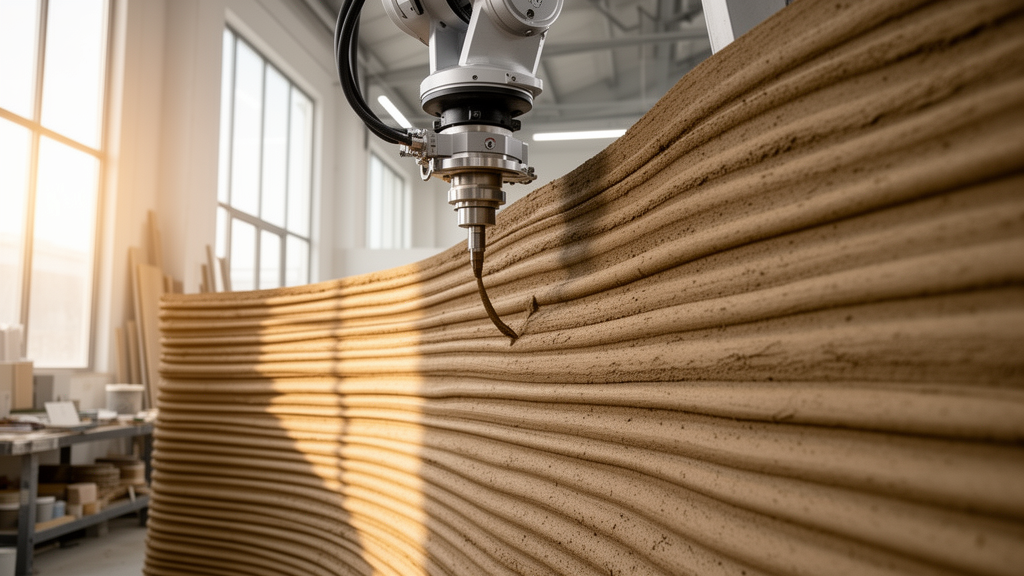
Engineers have developed hybrid 3D printable mortars by substituting substantial fractions of Portland cement with fine excavation earth and industrial fly ash, achieving up to a 32 percent reduction in climate change potential compared to baseline formulations. Additive manufacturing in construction promises enhanced geometric flexibility, shortened project timelines, and reduced material waste, yet standard printable mixtures rely heavily on clinker-rich Portland cement, which generates significant carbon dioxide emissions during manufacture. To address this environmental drawback, investigators evaluated composite matrices incorporating between 30 percent and 50 percent Portland cement, 50 percent to 70 percent fine earth particles, and 0 to 10 percent fly ash, balancing fresh-state extrusion behavior, structural buildability, mechanical capacity, and life cycle environmental performance.
The study utilized high-early-strength Portland cement corresponding to ASTM Type III, produced in Cantagalo, Brazil, characterized by an absolute density of 3.16 grams per cubic centimeter and composed primarily of calcium oxide and silicon dioxide. Fly ash was sourced as a byproduct from a thermal power plant in Capivari de Baixo, Santa Catarina, exhibiting a quasi-spherical particle morphology, a smooth surface, an absolute density of 2.15 grams per cubic centimeter, and an amorphous silica-alumina halo detected via X-ray diffraction between 15 and 30 degrees two-theta. The earthen component was reclaimed from pavement excavation residues in Seropedica, Rio de Janeiro, and mechanically sieved to isolate the fine fraction passing a 212-micrometer mesh. Helium pycnometry established the earth density at 2.56 grams per cubic centimeter, while chemical and mineralogical analyses demonstrated that it comprised irregular, rough-surfaced particles predominantly of quartz alongside clay minerals including kaolinite, microcline, and dickite, without an amorphous phase.
In the initial experimental phase, investigators examined the physicochemical and rheological interactions of six binder pastes combining fine earth, cement, fly ash, and water at a fixed water-to-binder ratio of 0.50 to prevent bleeding. Rotational rheometry conducted with a vane spindle revealed that a control paste made solely of fine earth and water exhibited high initial static yield stress at five minutes due to colloidal forces, electrostatic interactions, and van der Waals attractions between clay platelets. However, this pure earth paste showed no progressive structuration over a two-hour resting window because clay minerals do not undergo chemical hydration reactions. In contrast, hybrid pastes containing Portland cement demonstrated continuous time-dependent rigidification driven by the formation of calcium silicate hydrate phases, with fine earth acting as a physical catalyst that accelerated flocculation and shortened the critical time parameter.
Isothermal calorimetry conducted at 25 degrees Celsius over seven days confirmed that replacing Portland cement with fine earth increased heat flow during the induction period and brought forward the onset of the acceleration peak. This acceleration was attributed to an increase in the effective water-to-cement ratio, facilitating rapid clinker dissolution and hydrate precipitation, supported by the high specific surface area of clay particles providing extensive nucleation sites. Pastes containing 70 percent earth accumulated more hydration heat over the first seven hours than lower-earth blends, after which total heat output aligned with cement concentration. Thermogravimetric analysis of 28-day paste samples indicated that bound water decomposition below 200 degrees Celsius and calcium hydroxide consumption between 400 and 500 degrees Celsius remained largely unchanged across formulations, demonstrating limited pozzolanic activity from both the earth and fly ash within 28 days.
To formulate printable mortars in the second investigation phase, natural quartz sand with an absolute density of 2.67 grams per cubic centimeter was introduced at a sand-to-fines ratio of 1.25, alongside a polycarboxylate-based superplasticizer at 1.5 percent by binder mass and a water-to-fines ratio of 0.55. Five distinct mortar mixtures were prepared: EM50, EM60, and EM70 containing 50, 60, and 70 percent fine earth by mass of fines, and EM50F10 and EM60F10 containing 10 percent fly ash combined with 50 and 60 percent earth, respectively. Flow table testing demonstrated that increasing earth content caused a rapid decline in spread diameter over time, indicating a loss of workability that limits the available printing window but enhances immediate shape stability. Incorporating spherical fly ash particles counteracted this stiffening through a ball-bearing lubricating effect, reducing dynamic yield stress and maintaining wider spread diameters across resting intervals up to 120 minutes.
Cone penetration tests using an automated mechanical testing system verified the critical influence of mix proportions on the structuration rate of fresh mortars. As the fine earth content expanded from 50 percent in EM50 to 70 percent in EM70, the structuration rate rose from 8.6 to 33.1 pascals per minute, an almost fourfold increase that substantially improves green strength and vertical layer buildability. Concurrently, the critical time parameter dropped from 122.6 minutes in EM50 down to 36.4 minutes in EM70, narrowing the open processing time during which the mortar remains pumpable and extrudable through printing nozzles. The addition of 10 percent fly ash in EM60F10 effectively lowered the structuration rate relative to earth-dominated mixtures, helping to prevent nozzle blockages and mitigating the formation of weak inter-layer cold joints that arise when previously deposited filaments dry excessively before the next layer arrives.
Uniaxial compressive strength tests conducted after curing demonstrated that substituting Portland cement with fine earth substantially decreases hardened load-bearing capacity. Compressive strength fell from 19.2 megapascals in the EM50 formulation to 5.6 megapascals in EM70, representing a 71 percent reduction caused by the lower binder reactivity of raw earth and a more porous composite microstructure. However, when comparing mixtures with similar cement content, substituting part of the earth with fly ash increased compressive strength by approximately 13 percent, likely due to enhanced particle packing.
Validation of practical printability was conducted with a Cartesian robotic gantry system fitted with a progressive cavity pump, using the intermediate EM60 mixture due to its balanced workability, setting trajectory, and strength profile. The mixture extruded continuously without filament tearing or cross-sectional segregation, maintaining dimensional stability under self-weight through early deposition cycles. During a buildability trial, the material supported vertical deposition up to 16 successive layers, achieving a measured height of 272 millimeters against an intended target of 288 millimeters due to plastic settlement in the basal filament before structural collapse occurred. Using these parameters, the authors fabricated modular components to assemble a free-standing parametric arch with a span of 1.00 meter and a midspan rise of 0.50 meters, confirming the viability of earth-cement composites for modular interlocking structures.
A cradle-to-gate life cycle assessment covering raw material supply, transport, and mortar mixing per cubic meter evaluated 14 standardized environmental impact indicators under European standard EN 15804 plus A2. Climate change potential declined from 355.13 kilograms of carbon dioxide equivalent per cubic meter in the EM50 mortar to 243.09 kilograms in EM60F10, reflecting a 32 percent reduction that falls substantially below typical literature values of 500 to 583 kilograms reported for conventional 3D printable cementitious composites. Reductions were also registered in ozone depletion, ionizing radiation, photochemical ozone formation, acidification, eutrophication, and fossil resource depletion, directly tracking the displacement of clinker production. Conversely, freshwater ecotoxicity and land use indicators remained elevated across all mixtures, driven by upstream supply chains for extraction and processing of natural sand aggregates and mixing water.
Eco-efficiency metrics pairing environmental impacts against functional engineering performance underlined fundamental technical trade-offs between mechanical strength and buildability. When evaluated by greenhouse gas emissions per unit of thixotropic structuration rate, the EM70 mixture proved most efficient at 6.8 kilograms of carbon dioxide equivalent per pascal per minute, followed by EM60F10 at 17.7, owing to rapid structuration combined with low embodied emissions. Conversely, evaluating emissions per unit of compressive strength reversed the ranking, with EM50 achieving the best score of 18.5 kilograms of carbon dioxide equivalent per megapascal, compared to 22.6 for EM60F10 and 40.4 for EM70. The investigators noted that the absence of parameter sensitivity analyses in the life cycle model represents an interpretive limitation, concluding that hybrid earth-cement-fly ash formulations require deliberate optimization depending on whether an application demands high structural load resistance or enhanced low-carbon buildability for non-load-bearing architectural components.
Subject of Research: Sustainable 3D printable cementitious mortars incorporating fine earth and fly ash
Article Title: Hybrid 3D printable mixtures incorporating fine earth, Portland cement, and fly ash: a sustainable alternative to cement-intensive systems
Article References: Tinoco, M. P., Paiva, R. D. L. M., de Andrade, L. D., Reales, O. A. M., & Toledo Filho, R. D. (2025). Hybrid 3D printable mixtures incorporating fine earth, Portland cement, and fly ash: a sustainable alternative to cement-intensive systems. Low-carbon Materials and Green Construction, 3(1), Article 27. https://doi.org/10.1007/s44242-025-00089-3
Image Credits: AI Generated
DOI: 10.1007/s44242-025-00089-3
Keywords: 3D concrete printing, additive manufacturing, Portland cement, fine earth, fly ash, rheology, thixotropy, cone penetration, flow table test, uniaxial compressive strength, life cycle assessment, embodied carbon, green construction, waste valorization, sustainable materials, circular economy, material characterization
News Source: Denise Maddox. (November 19, 2026). Fine Earth and Fly Ash Replace Cement in Printable Construction Mortars. Scienmag.