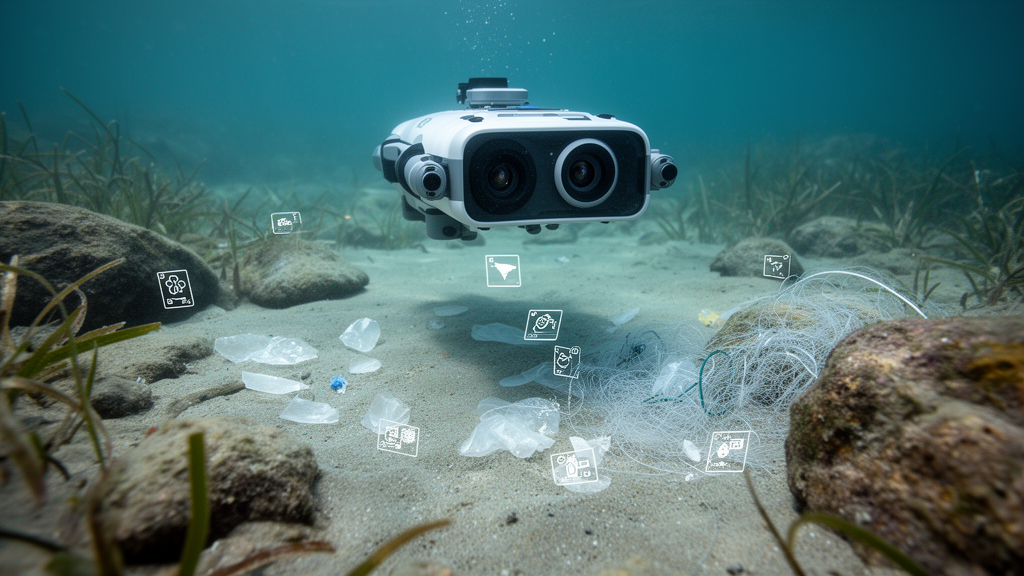
Visual monitoring of underwater marine debris remains a fundamental technical challenge for ocean conservation, subsea infrastructure maintenance, and automated cleanup robotics. Standard optical sensors deployed on autonomous underwater vehicles and remotely operated platforms struggle to reliably distinguish submerged litter from complex seafloor topography due to severe wavelength-dependent light attenuation, backscattering, blurring, and low color contrast. While deep learning detectors trained on terrestrial imagery have achieved substantial success in generic object localization, aquatic visual scenes frequently degrade color appearance and obscure boundaries. Addressing these environmental limitations typically involves retrofitting vehicles with expensive heterogeneous hardware such as acoustic sonar systems, stereo cameras, or depth sensors. However, external physical instruments introduce considerable hardware costs, calibration complexity, and payload weight, while remaining entirely incompatible with pre-existing monocular image archives. To overcome this practical bottleneck, computer vision researchers have designed MSFD-YOLO, an open-source, dual-branch detection architecture built upon YOLOv11 that extracts deterministic morphometric cues directly from monocular RGB video without requiring supplementary physical sensing equipment.
The foundational component of the newly developed architecture is the Morphometric Structural Cue Map, a synthetic six-channel companion representation calculated deterministically from the luminance landscape of the source image. Although the underlying design borrows terminology by analogy from terrestrial geomorphometry, the computational process generates no physical depth, elevation, or bathymetric measurements. Instead, the framework converts an input three-channel RGB frame into an intensity field using standard ITU-R BT.601 coefficients and smooths sensor noise using a three-by-three Gaussian convolution kernel with symmetric reflection padding. From this filtered luminance baseline, classical fixed-parameter differential operators derive six structural layers: smoothed base luminance, gradient energy calculated via horizontal and vertical Sobel filters, gradient orientation derived via two-argument arctangent transformations, second-order surface curvature determined by discrete Laplacian filtering, local irregularity computed through five-by-five neighborhood standard deviation, and fine residual detail obtained by subtracting a fifteen-by-fifteen local mean. Each resulting channel undergoes independent min-max normalization into a uniform dynamic range from zero to one before channel-wise stacking into a single six-channel tensor, delivering explicit boundary, roughness, and contour priors that remain perfectly spatially aligned with raw RGB inputs.
Rather than relying on early concatenation at the raw input stage or late voting near final bounding-box heads, MSFD-YOLO introduces a symmetric two-stream backbone that executes mid-level cross-branch aggregation. Two structurally identical branches process the three-channel appearance input and the six-channel structural cue tensor independently across five successive downsampling stages designated P1 through P5. By allowing both processing paths to develop specialized feature abstractions through the initial three stages, the architecture prevents shallow cross-stream interference while maintaining separate parameter weights. At the intermediate P4 and P5 pyramid stages, feature maps from both streams are concatenated along their channel dimensions and compressed through dedicated enhancement blocks. This mid-fusion strategy provides downstream neck and detection heads with a unified semantic representation, avoiding the excessive computational footprint of redundant parallel heads while effectively merging high-level visual appearance with explicit boundary geometry.
To accommodate the severe scale variations and arbitrary orientations characteristic of discarded underwater refuse, the system incorporates two redesigned architectural modules: C3K2-MDE and C2-DFA. The C3K2-MDE module expands the effective receptive field across deep network stages by replacing standard three-by-three bottleneck convolutions with a dilation-wise residual unit. This sub-network branches intermediate feature channels into three parallel convolutions possessing dilation rates of one, three, and five, synthesizing effective receptive fields of three, seven, and eleven pixels without increasing spatial resolution or parameter counts. Simultaneously, the framework substitutes standard rigid self-attention in the baseline C2PSA block with C2-DFA, a deformable feature aggregation module. By employing a lightweight offset network composed of depthwise convolutions and projection layers, C2-DFA predicts dynamic two-dimensional coordinate displacements. Bilinear interpolation resamples features across these learned offsets, enabling the attention mechanism to adaptively focus on non-rigid, crumpled, or tangled debris items rather than uniform sampling grids.
The training protocol further optimizes localization accuracy through an adapted bounding-box regression loss function. Conventional object detection pipelines frequently employ Complete Intersection over Union, which incorporates an explicit penalty enforcing aspect-ratio consistency between predicted and ground-truth bounding boxes. In marine debris datasets, however, individual categories such as plastic bottles, nets, and discarded containers exhibit extreme intra-class aspect-ratio variance caused by fragmentation, crushing, and viewing angle. Consequently, the Complete Intersection over Union penalty frequently generates misleading gradient directions during backpropagation. MSFD-YOLO resolves this mismatch by implementing Distance Intersection over Union loss, which eliminates the aspect-ratio term entirely while directly penalizing the normalized Euclidean distance between the center points of the predicted and target bounding boxes. Combined with binary cross-entropy for category classification and distribution focal loss for box probability estimation, this formulation accelerates optimization convergence and produces significantly tighter localization around irregularly shaped objects.
Because expanding single-stream networks into two-stream pipelines increases model complexity, the engineering framework incorporates post-training structured channel pruning to preserve operational feasibility on edge devices. The unpruned dual-branch architecture expands baseline complexity from 2.58 million parameters and 6.30 gigafloating-point operations to 4.87 million parameters and 8.95 gigafloating-point operations. To compress the network without requiring specialized sparse-computation runtimes, the authors systematically evaluated five channel-selection criteria: absolute weight sums, batch-normalization scaling factors, layer-adaptive magnitude profiling, uniform random selection, and Euclidean weight norms. Selecting an L2-norm criterion paired with a selective layer-protection policy allowed the removal of twenty-five percent of eligible channels. Crucial contextual components—including the C3K2-MDE modules, the fusion-stage C2-DFA block, initial input convolutions, and channel concatenation layers—were completely shielded from pruning. Fine-tuning the remaining structure for fifty epochs compressed the network to 4.20 million parameters and 6.46 gigafloating-point operations, achieving a 13.8 percent reduction in parameters and a 27.9 percent reduction in computational burden while maintaining original detection accuracy.
Experimental evaluation was conducted on the official benchmark partition of the TrashCan instance dataset, which contains 7,212 underwater images divided into 6,065 training samples and 1,147 validation samples across 22 distinct object categories. All experimental trials utilized mixed-precision training over 300 epochs on an NVIDIA RTX 4060 Ti workstation across three independent random seeds. On this standardized benchmark, the fully pruned MSFD-YOLO achieved an overall precision of 82.1 percent, a recall of 61.4 percent, a mean average precision at 0.5 Intersection over Union of 68.0 percent, and an overall mean average precision across thresholds from 0.50 to 0.95 of 50.2 percent. Compared against the standard RGB-only YOLOv11n baseline, the proposed framework demonstrated absolute improvements of 7.2 percent in precision, 5.9 percent in recall, 3.8 percent in mean average precision at 0.50, and 3.7 percent in comprehensive mean average precision, while processing single frames at 149 frames per second in network-only GPU throughput.
Ablation experiments verified that performance gains derived directly from multi-cue structural modeling rather than arbitrary parameter scaling. In parameter-matched capacity controls, a single-stream wide variant scaled to 4.18 million parameters required 10.50 gigafloating-point operations yet attained only 64.9 percent mean average precision at 0.50 and 47.0 percent across the full threshold range, trailing the dual-branch model by more than three percentage points. Furthermore, pairing the RGB stream with alternative auxiliary representations confirmed the superiority of the morphometric prior: monocular depth estimates produced by a large vision transformer attained only 46.9 percent comprehensive mean average precision under mid-fusion, hampered by optical scattering artifacts, while single-channel edge maps reached 47.1 percent. Component isolation and leave-one-out experiments demonstrated that all six morphometric layers contribute complementarily, with the local-irregularity layer proving most essential; its individual removal caused a 1.6 percent drop in comprehensive accuracy, underscoring the vital diagnostic role of high-frequency surface texture when distinguishing marine refuse from benthic substrates.
Extensive benchmark comparisons against nineteen leading object detection models highlighted substantial efficiency and localization advantages. Across recent single-stream convolutional architectures, MSFD-YOLO surpassed modern nano- and medium-scale detectors, outperforming YOLOv12n by 4.0 percentage points and YOLOv26m by 2.0 percentage points in comprehensive accuracy. Against end-to-end transformer frameworks, the proposed model exceeded the balanced D-FINE-m model by 0.5 percent in mean average precision at 0.50 and 1.9 percent across higher thresholds, while utilizing less than a quarter of its parameter count and approximately one-ninth of its computational operations. Similarly, evaluations against published task-specific underwater models demonstrated marked advantages: specialized architectures including UTD-YOLO, YOLOv8-C2f-Faster-EMA, and YOLO-CE achieved lower detection scores, with the 39.90-million-parameter YOLO-CE demanding nearly eighteen times more floating-point computation while achieving 3.2 percent lower comprehensive accuracy.
To investigate practical deployability in resource-limited aquatic environments, the researchers profiled the full end-to-end inference pipeline on a commercial Raspberry Pi 5 single-board computer executing on an ARM Cortex-A76 central processing unit without hardware acceleration. Under an ONNX Runtime environment processing 640-by-640 input frames, the complete pipeline recorded an average total latency of 302.1 milliseconds per frame, corresponding to an operational throughput of 3.31 frames per second. Generating the six-channel structural cue map directly on the processor consumed only 18.4 milliseconds, while model execution required 265.5 milliseconds. During continuous execution, peak memory consumption remained bounded at 182 megabytes—less than 2.5 percent of available system memory—with an active electrical power draw of 7.2 watts, representing an energetic expenditure of 2.17 joules per processed frame. For compact robotic vehicles operating at standard scanning speeds of 0.5 to 1.0 meters per second, an update rate of approximately 3.3 frames per second provides viable temporal coverage for preliminary tracking missions.
The study also contextualized performance through an illustrative recovery-value scenario mapping validation true-positive detections to nominal recyclate pricing and physical debris mass. Under this operational proxy, MSFD-YOLO slightly increased retrievable recyclable value from 10.03 to 10.19 dollars and elevated total debris mass estimations from 147.0 to 148.7 kilograms relative to baseline models. The authors emphasized that these monetary increments represent illustrative benchmark proxies rather than definitive economic forecasts, as the simulation omitted mechanical grasping failures, sorting costs, surface degradation, and biofouling losses. Operationally, the primary practical advantage lies in minimizing erroneous grasping attempts through superior false-positive suppression and distinguishing ecologically detrimental non-commercial waste, such as abandoned fishing nets and synthetic tarpaulins, which carry substantial ecological remediation value outside commercial scrap markets.
Despite these encouraging validation results, the researchers explicitly documented methodological constraints and necessary avenues for future development. First, the TrashCan benchmark utilizes an official frame-level random partition that does not enforce video-level disjointness across its 312 source recordings, resulting in an average nearest-neighbor feature similarity of 0.888 between validation and training frames. While relative model rankings remain fair due to identical testing splits, reported absolute metrics reflect benchmark-specific capability rather than demonstrated generalization across unobserved geographic waters. Additionally, the current structural cue generator relies on fixed analytical kernels; integrating adaptive calibration parameters could enable dynamic layer weighting based on local turbidity. Future work will focus on integrating MSFD-YOLO into physical robotic manipulation arms for closed-loop grasping trials, expanding the architecture to multi-object tracking and instance segmentation, and evaluating cross-domain robustness under varying marine visibility.
Subject of Research: Deep learning and computer vision architectures for autonomous underwater marine debris detection
Article Title: MSFD-YOLO: a lightweight dual-branch mid-fusion detector with morphometric structural cues for underwater marine debris detection
Article References: Liu, S., Yun, L., & Chen, Z. (2026). MSFD-YOLO: a lightweight dual-branch mid-fusion detector with morphometric structural cues for underwater marine debris detection. Journal of King Saud University Computer and Information Sciences, 38(10), Article 1028. https://doi.org/10.1007/s44443-026-01392-0
Image Credits: AI Generated
DOI: 10.1007/s44443-026-01392-0
Keywords: Underwater Debris Detection, Computer Vision, MSFD-YOLO, YOLOv11, Marine Litter, TrashCan Dataset, Autonomous Underwater Vehicles, Remotely Operated Vehicles, Morphometric Structural Cue Map, Mid-Level Feature Fusion, Structured Model Pruning, Deformable Attention, Distance-IoU Loss, Multi-Dilation Convolutions, Edge Computing, Object Detection, Ocean Conservation Technology
News Source: Elena Sutton. (November 19, 2026). Dual-Branch Computer Vision Framework Boosts Underwater Marine Debris Detection Accuracy. Scienmag.