Environmental DNA has transformed the search for ocean creatures that are nearly impossible to spot, but the standard recipe—filtering just one or two liters of seawater—may be quietly missing the very species conservationists most want to find. A new study conducted near Weizhou Island in China’s Beibu Gulf reports that filtering volumes up to 50 liters dramatically increases both the amount of DNA recovered and the odds of detecting endangered Bryde’s whales, offering a scalable upgrade to marine biomonitoring.
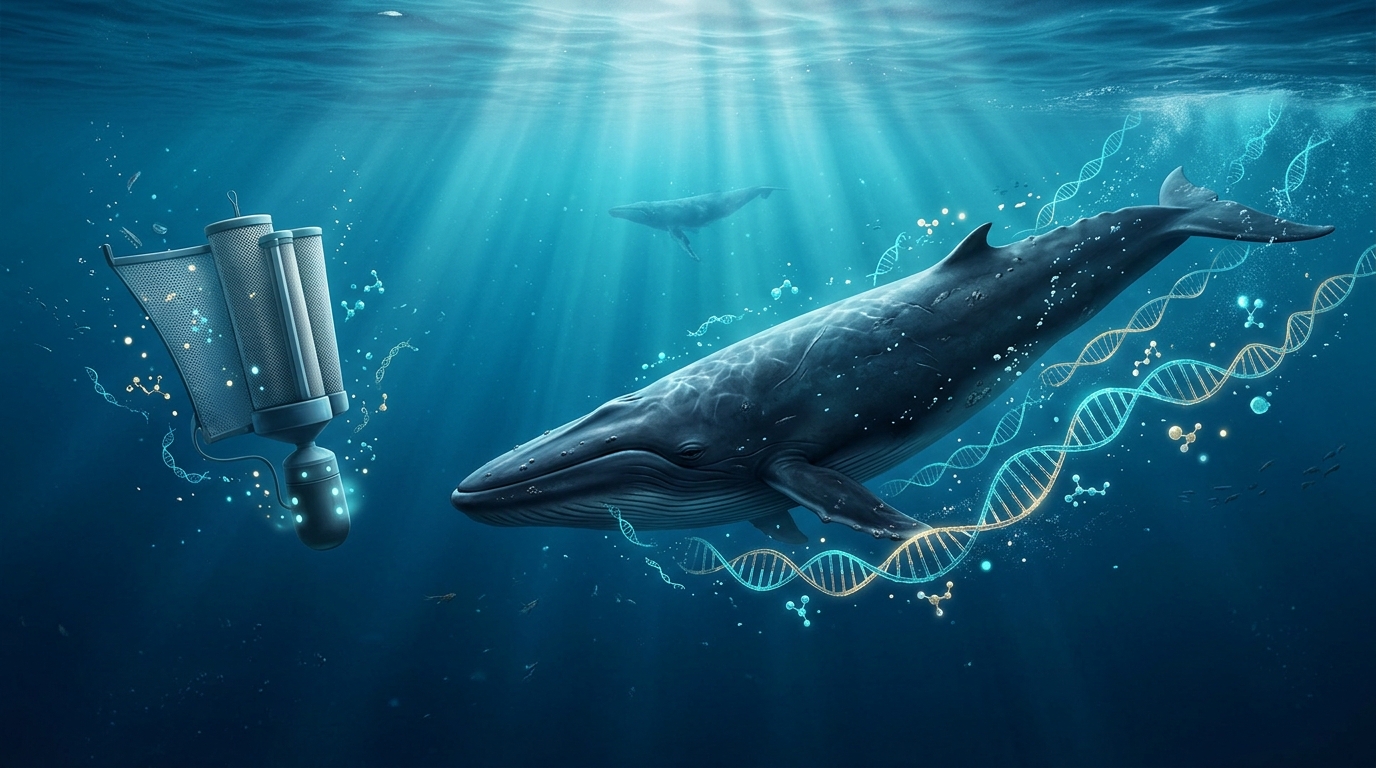
The research, published in the journal Metabarcoding and Metagenomics, evaluated four filtration setups: a traditional filter handling 1 liter, an integrated filter for 5 liters, a medium-capacity filter for 20 liters, and a large-capacity capsule filter for 50 liters. The capsule sampler uses a highly folded filter membrane that greatly expands the effective filtration surface area, reduces clogging, and allows continuous processing of more than 50 liters of seawater. In January 2025, the team collected 36 environmental water samples across three sites, with three technical replicates for each filtration volume at each site, plus field negative controls in which 5 liters of DNA-free ultrapure water were filtered to monitor cross-contamination.
The volume advantage was stark. At 50 liters, total DNA yield was 10 to 50 times higher than with the traditional 1-liter filter, and the same downstream metabarcoding pipeline recovered 15 to 20 times more sequence reads. For the focal species, Balaenoptera brydei, the payoff scaled with volume: filtering 20 liters produced roughly five times as many whale sequences as the 1-liter filter, and 50 liters produced about ten times as many. Because eDNA in seawater degrades and dilutes rapidly—driven by ultraviolet radiation, temperature, pH, microbial activity, and hydrodynamic conditions—small samples often capture too little DNA from rare animals to register at all.
Sequencing data told a consistent story. In the 5-, 20-, and 50-liter groups, the ten most abundant operational taxonomic units accounted for over 90 percent of total relative abundance, and cumulative abundance curves showed steeper slopes, indicating more efficient recovery of dominant taxa. Taxonomic composition shifted with volume as well. The 1-liter samples yielded the least DNA and were dominated by freshwater fish such as Silver Carp and Bighead Carp, along with human sequences—consistent with the proportionally greater impact of laboratory and reagent background when target DNA is scarce. As volume increased, the signal-to-noise ratio improved: marine fish such as Sardinella hualiensis and Nematalosa japonica dominated the 5-liter group, while cetacean and human sequences predominated at 20 liters, and 50-liter samples showed the highest proportions of human and marine fish DNA.
The human DNA signal deserves a closer look, because it illustrates the trade-offs of large-volume work. The elevated proportion in bigger samples likely reflects increased handling during extended field filtration. Supporting that interpretation, two of three field blanks contained 1,785 and 617 human reads, whereas PCR negatives held only trace amounts of 8, 1, and 1 reads. DNA concentrations in extraction negative controls fell below the Qubit detection limit, and no reads assigned to Bryde’s whale, other cetaceans, or candidate prey fish appeared in any negative control. Because contaminant taxa did not overlap with the ecological targets, the researchers applied no filtering threshold.
Marine fish species richness followed its own pattern, rising with volume up to 5 liters—20 species detected at 1 liter versus 26 at 5 liters—then declining slightly at higher volumes, to 24 species at 20 liters and 22 at 50 liters. Eight marine fish species were consistently detected across all volume groups, indicating stable presence and strong detection signals regardless of method. On this basis, the authors recommend 5 liters as a cost-effective option for broad fish community surveys, reserving 50-liter filtration for situations where detecting rare target species such as Bryde’s whale is the priority.
The study also ventured into diet analysis. During sampling, the team visually observed Bryde’s whale excreta and collected the surrounding seawater using all four filtration methods, with three replicates each. Metabarcoding of these fecal eDNA samples, combined with ecological correlation against the whale’s known feeding habits, flagged eight candidate prey-associated fish taxa: Coilia nasus, Hirundichthys speculiger, Ilisha melastoma, Oxyporhamphus micropterus, Parargyrops edita, Sillago sihama, Sphyraena jello, and Thryssa dussumieri. All are small to medium-sized pelagic or neritic fish of coastal or shelf waters, matching the foraging ecology of rorqual whales, which typically prey on schooling fish and small pelagic organisms.
The authors are careful about what these detections mean. eDNA signals from water collected near fecal plumes may originate from fecal particles, sloughed intestinal cells, or ambient water containing prey DNA, and because host-blocking primers and paired background water samples were not used, the relative contribution of ambient eDNA cannot be quantified. Relative read abundance also does not directly correspond to ingested biomass, since biases in extraction, amplification, and sequencing distort quantitative inference. The eight fish taxa should therefore be regarded strictly as candidate prey items requiring further validation, and the seawater fecal eDNA approach as a complementary, non-invasive screening tool rather than a replacement for established diet analysis methods such as stomach content analysis, stable isotope analysis, or fatty acid profiling.
The comparison between metabarcoding and quantitative PCR proved equally instructive. Across the 36 environmental samples, metabarcoding with the universal Teleo2 primers identified Bryde’s whale DNA in 35 of 36 samples—a 97.2 percent detection rate—while the cetacean-specific qPCR assay detected the target in only 4 samples, or 11.1 percent. The qPCR assay, validated with an efficiency of 92.4 percent and a limit of detection of 10 copies per microliter, required sufficient target DNA to exceed its quantification threshold, whereas metabarcoding’s universal fish and vertebrate primers cast a much wider net. The low qPCR rate is consistent with the expected scarcity of cetacean eDNA in open marine waters, particularly at distances from the animals.
Where both methods had something to detect, they agreed. Among the four qPCR-positive samples, all showed high metabarcoding read counts ranging from 4,118 to 432,281 reads, and regression across the 16 samples with both measurements available revealed a significant positive correlation (R² = 0.828, 95% CI 0.571–0.939, p < 0.001; standardized β = 0.910). The authors caution that this relationship was strongly influenced by the few high-concentration samples, with the remaining 12 qPCR-negative samples clustering near the origin, so the correlation should be read as concordance at high DNA concentrations rather than a continuous relationship across the full range. Taken together, the results argue for treating the two methods as complements: metabarcoding for broad-spectrum community screening and qPCR for targeted quantification when DNA is abundant enough. With limited replication—three technical replicates per volume across three sites—the authors acknowledge their statistical power for generalizing beyond the sampled locations is constrained, and they call for broader spatial coverage and repeated seasonal sampling. Even so, the message for conservation programs tracking endangered marine fauna is clear: when the animal is rare and the ocean is vast, filter more water.
Subject of Research: Large-volume environmental DNA sampling for detecting endangered marine species and candidate prey of Bryde's whales
Article Title: Large-volume sampling enhances eDNA monitoring of endangered marine species
Article References: Sun, J., He, J., Jia, R., Gao, F., Pang, B., Mu, Y., Liu, Z., Du, X., Yang, J., Yang, J., & Zhang, X. (2026). Large-volume sampling enhances eDNA monitoring of endangered marine species. Metabarcoding and Metagenomics, 10, Article e205755. https://doi.org/10.3897/mbmg.10.205755
Image Credits: AI Generated
Keywords: environmental DNA, eDNA metabarcoding, Bryde's whale, large-volume filtration, qPCR, marine conservation, Weizhou Island, fecal eDNA, prey identification, endangered species, capsule sampler, Beibu Gulf
News Source: Margaret Porter. (November 4, 2026). Filtering 50 Liters of Seawater Dramatically Boosts eDNA Detection of Endangered Bryde’s Whales. Scienmag.