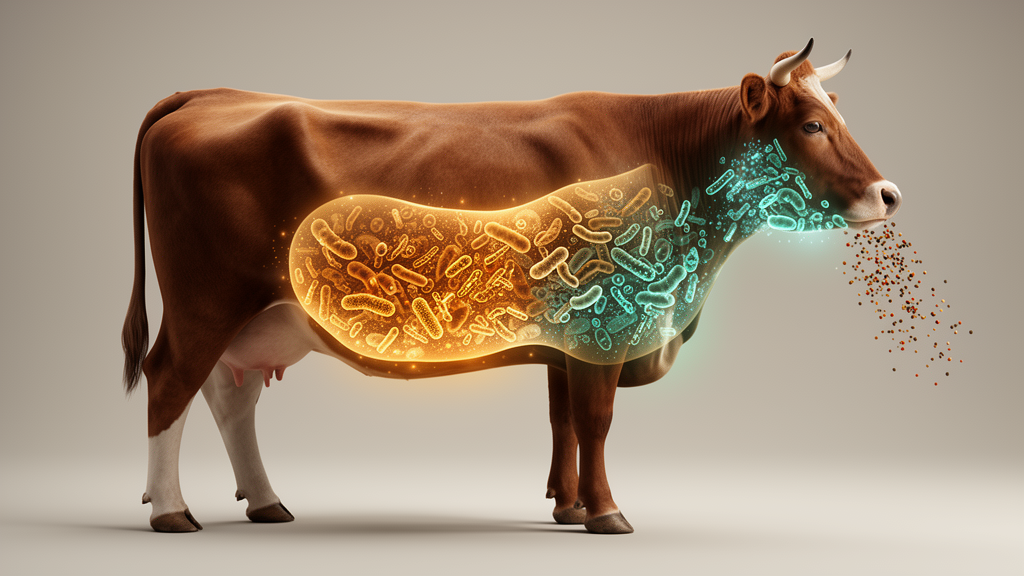
Feed additives such as ionophores, yeasts, prebiotics, and plant-derived compounds do not act on isolated metabolic pathways in cattle, sheep, and goats, but instead operate as systems-level modulators of an integrated rumen–liver–immune–reproductive axis. That is the central argument of a sweeping review published in Frontiers in Microbiology, in which researchers from New Mexico State University, Virginia State University, Tennessee Technological University, and West Virginia University synthesized evidence from metagenomics, metatranscriptomics, metabolomics, and host transcriptomics to reframe how the ruminant nutrition community thinks about feed additives. Rather than viewing these products as simple growth promoters or methane suppressants, the authors propose that they reprogram microbial networks, antimicrobial resistance dynamics, early developmental trajectories, and reproductive fitness through cross-tissue molecular crosstalk.
The stakes of this reframing are considerable. Ruminant livestock contribute roughly 33 percent of global livestock greenhouse gas emissions, with animals in developing countries accounting for about 70 percent of that share, creating a fundamental tension between food security and environmental sustainability. Antimicrobial resistance compounds the problem: the World Health Organization ranks it among the top ten global public health threats, and geospatial modeling of food animals has identified resistance hotspots across China, India, Brazil, and Central Asia, including 59 percent tetracycline resistance in Escherichia coli isolates and cefotaxime resistance reaching 33 percent in low- and middle-income countries. Reproductive inefficiency adds a further economic burden, with a meta-analysis of more than 56,000 diagnostic records from 159 studies estimating that approximately 48 percent of beef cows subjected to a single insemination were not pregnant by the end of the first month of gestation.
The biological foundation for the new framework lies in the sheer complexity of the ruminant gut, which harbors one of the most intricate microbial ecosystems known, comprising more than 10,000 metagenome-assembled genomes that collectively encode more metabolic functions than the host genome itself. This community functions as a metabolic organ, converting dietary substrates into volatile fatty acids, microbial proteins, and bioactive metabolites that regulate host gene expression, immune function, and reproductive physiology. Propionate serves as a glucogenic precursor in the liver, acetate feeds lipogenesis and peripheral energy metabolism, and butyrate coordinates ruminal epithelial metabolism, nutrient absorption, and ketogenesis. The authors are careful to note, however, that their proposed rumen–liver–immune–reproductive axis is a hypothesis-generating conceptual framework rather than an established mechanistic model, and that evidence linking additive-induced microbial changes to downstream immune and reproductive outcomes remains limited.
Across additive classes, the review finds a striking convergence on common modes of action. Sodium sulfate, an inorganic sulfur source, activates a co-abundance network between Desulfovibrio and Ruminococcaceae in steers that enhances sulfur amino acid metabolism and fiber degradation. Biochanin A, an isoflavone phytoestrogen, improves nitrogen utilization in dairy goats by selectively enriching taxa such as Selenomonadaceae and Aminobacteriaceae that express high-affinity peptidase and glycoside hydrolase activities, redirecting ruminal nitrogen flux from ammonia toward microbial protein synthesis. Yeast-based additives exemplify system-level reprogramming most vividly: integration of 16S rRNA sequencing with liquid chromatography–mass spectrometry metabolomics revealed that Saccharomyces cerevisiae fermentation products simultaneously increase fibrolytic taxa such as Fibrobacter and Ruminococcus and lactate-utilizing bacteria such as Megasphaera and Selenomonas, while depleting starch-fermenting taxa associated with acidosis.
The metabolic consequence of that microbial restructuring was a coordinated shift toward higher propionate-to-acetate ratios, elevated microbial crude protein synthesis, and reduced methane precursor availability—a configuration that the review links to improved energy harvest efficiency and lower enteric greenhouse gas emissions, while cautioning that responses depend on diet composition, yeast type, dosage, supplementation duration, and host physiology. Four taxa in particular—Prevotella, Butyrivibrio, Ruminococcus, and Fibrobacter—recurrently emerged across studies of feed efficiency, immune modulation, resistome dynamics, and reproductive fitness, suggesting a core functional consortium whose metabolic outputs, including straight and branched-chain volatile fatty acids, may serve as the primary signaling molecules communicating ruminal events to host tissues. The authors stress that these relationships are context dependent and not causal. Notably, ensemble machine learning analyses indicate the rumen microbiome accounts for approximately 36 percent of the variation in residual feed intake, hinting at practical diagnostic utility for on-farm selection.
The liver emerges as the molecular hub translating fermentation into phenotype. In Nellore beef steers, genome-wide association study–informed liver transcript analysis linked high feed efficiency with hepatic gene clusters enriched in xenobiotic metabolism, Nrf2-mediated oxidative stress response, and cholesterol biosynthesis, and the same animals carried rumen microbial profiles enriched in propionate-producing taxa whose outputs feed hepatic gluconeogenic and lipogenic pathways. Integrated ruminal, hepatic, and whole-blood transcriptomic profiling showed that steers with low residual feed intake exhibited upregulation of innate immune genes—Toll-like receptor signaling, complement activation, antimicrobial peptides—alongside lower ruminal abundances of Methanobrevibacter and several bacterial groups. MicroRNAs add a post-transcriptional regulatory layer: goats supplemented with prebiotic inulin showed enhanced hepatic gluconeogenic enzymes, dairy sheep fed 5 percent grape pomace displayed differential expression of miR-143-3p and miR-382-5p linked to lipid and glucose metabolism, and cows receiving menthol, thymol, and eugenol during dietary transition showed altered miRNA transcripts associated with rumen epithelium remodeling.
Immune modulation follows the same systems logic. Yeast culture supplementation mitigated heat stress in growing bulls at multiple levels, promoting fibrolytic and lactate-utilizing bacteria in the rumen while suppressing malondialdehyde and elevating glutathione peroxidase activity systemically, consistent with activation of the Nrf2-mediated antioxidant response. Whole-blood transcriptomics of steers given multi-species direct-fed microbials revealed upregulation of genes involved in antigen processing and presentation, interferon signaling, and T-cell receptor activation, while Astragalus supplementation in early-weaned lambs elevated serum IgA and IgG concentrations in parallel with altered rumen bacterial community structure. The review also highlights microRNAs such as miR-146a, an anti-inflammatory rheostat targeting TRAF6 and IRAK1 in the NF-κB cascade, and miR-155, which amplifies pro-inflammatory signaling, as integrative nodes that feed additives may modulate through antioxidant and anti-inflammatory effects.
The ruminant resistome receives particular attention as a One Health interface rather than an isolated ecological phenomenon. Metagenomic surveillance shows the bovine gastrointestinal tract harbors resistance genes against virtually every clinically important antimicrobial class, and a Nature Communications study demonstrated that environmental exposure to livestock farms significantly remodels the human gut microbiota and resistome, with farm workers acquiring livestock-associated genes such as blaCTX-M and fosA3. Yet the evidence on feed additives is mixed and context dependent: monensin and tylosin altered feedlot cattle microbiota without a detectable association with resistance genes, tylosin supplementation produced no significant differences in fecal resistome composition, while ionophore-supplemented grain-fed cattle showed elevated tetracycline, macrolide, aminoglycoside, beta-lactam, and bacitracin resistance genes compared with grass-fed counterparts. Preliminary work even suggests Aspergillus niger cultures lowered tetracycline resistance gene abundances in fattening sheep, though the authors insist such findings require independent validation and that changes in gene abundance alone should not be read as reduced transmission risk.
Early life emerges as the most tractable intervention window. The first weeks of life constitute a critical period in which pioneer microbial communities establish ecological niches that shape adult functional profiles, with goat kids progressing through aerobe-dominated, transitional, and mature colonization phases. Prenatal vitamin and mineral supplementation significantly altered multi-site microbial communities in newborn calves extending beyond the gut to the hoof, liver, lung, nasal cavity, eye, rumen, and vagina, and periparturient rumen-protected methionine supplementation altered neonatal calf microbiome and metabolome profiles from birth through preweaning. Preweaned calves also harbor a distinct resistome that differs significantly from lactating cows in the same facility, indicating that neonatal resistance gene acquisition follows its own transmission dynamics rather than simply mirroring adult exposure.
Reproductive physiology completes the axis. Resveratrol supplementation in ewes simultaneously altered the ruminal microbiome, enhanced systemic antioxidant capacity, and improved reproductive tract immune defense, with ruminal genera including Prevotella and Ruminococcus positively correlated with estradiol and progesterone concentrations and negatively correlated with inflammatory markers. In cattle, rumen-protected choline, Bacillus, and essential oil supplements altered vaginal, endometrial, and rectal microbiomes, with choline lowering the metritis pathogen Fusobacterium, while melatonin reshaped gut microbiota to alleviate heat stress spermatogenic dysfunction in dairy goats. The review concludes that translating these converging microbial and molecular signatures into precision feeding, antimicrobial stewardship, and breeding programs will require controlled longitudinal multi-omics studies with unified analytical pipelines, large replication, and rigorous batch-effect control—since current evidence remains largely cross-sectional, heterogeneous, and correlational rather than causal.
Subject of Research: Multi-omics review of feed additives as systems-level modulators of the ruminant host–microbiome axis
Article Title: Feed additives as systems-level modulators of the ruminant host–microbiome interaction: a multi-omics perspective on efficiency, resistance, and reproduction
Article References: Fijabi, O., Morenikeji, O. B., Ivey, S. L., Loest, C., Idowu, M., Ashley, R., Ogunade, I. M., & Taiwo, G. (2026). Feed additives as systems-level modulators of the ruminant host–microbiome interaction: a multi-omics perspective on efficiency, resistance, and reproduction. Frontiers in Microbiology, 17, Article 1995937. https://doi.org/10.3389/fmicb.2026.1995937
Image Credits: AI Generated
DOI: 10.3389/fmicb.2026.1995937
Keywords: feed additives, rumen microbiome, multi-omics, antimicrobial resistance, resistome, feed efficiency, reproductive microbiome, ruminants, microRNAs, One Health, early-life microbial programming, metabolomics
News Source: Morgan Morrow. (October 26, 2026). Feed Additives Reshape the Ruminant Microbiome as a Whole-Body System, Review Finds. Scienmag.