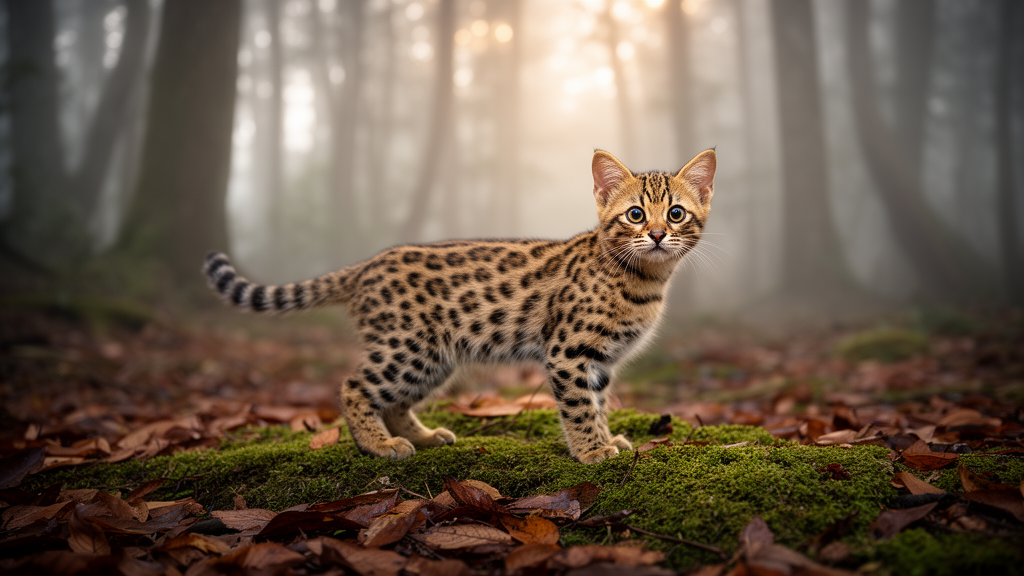
On the Japanese island of Tsushima, field researchers from Kyoto University spotted something they had never seen before: at least three Tsushima leopard cats with noticeably shortened tails. The trait is relatively common in domestic cats, which share the island’s landscape, but had not previously been observed in leopard cats. Because the Tsushima leopard cat is critically endangered, found nowhere else, and numbers only around 150 individuals according to the most recent government survey, any sign of possible hybridization with domestic cats is a serious conservation concern. The team managed to capture one of the short-tailed cats for examination and found that its tail was half the normal length. That observation set off a whole-genome investigation into whether the unusual tail reflected recent domestic cat ancestry or a variation arising within the leopard cat population itself.
The researchers analyzed the entire genome of the short-tailed individual and compared it with genome data from 15 additional Tsushima leopard cats, five domestic cats sampled on the island, and four continental Amur leopard cats, which served as an external wild reference. Their toolkit included principal component analysis, genome-wide inbreeding estimates, mitochondrial DNA phylogeny, ADMIXTURE ancestry clustering, and f-statistics to assess ancestry and introgression. They also screened two genes known to be associated with tail abnormalities in domestic cats. The results revealed no evidence of domestic cat introgression in either the short-tailed cat or the 15 other leopard cats sampled. Every step of the whole-genome analysis placed the short-tailed individual firmly within the Tsushima leopard cat population and detected no abnormalities.
“An unusual phenotype can immediately raise concerns about hybridization, but we wanted to determine objectively what the genome actually tells us before drawing conclusions from appearance alone,” says first author Yuki Matsumoto, who also has affiliations with Anicom Specialty Medical Institute Inc. and Azabu University. The study, published on 5 August 2026 in Global Ecology and Conservation under the title “Genome-wide assessment of suspected domestic cat introgression in the critically endangered Tsushima leopard cat,” is described by the team as the first clinical and genomic characterization of a short-tailed individual in the wild cat genus Prionailurus.
The underlying cause of the tail abnormality remains unresolved. The team’s observations of short-tailed Tsushima leopard cats in different locations suggest that more may be behind this rare phenotype than a single isolated case. Looking ahead, the researchers hope to examine additional short-tailed individuals and are developing non-invasive genetic monitoring that could track the leopard cats without requiring capture. Such methods could prove valuable for a species whose entire population is confined to one island and whose numbers are small enough that every individual matters for conservation planning.
“Appearance alone can be misleading when managing endangered wildlife,” says Matsumoto. “By combining long-term field observations, veterinary examination, and genome-wide data, we can make conservation decisions on the basis of genetic evidence rather than phenotype alone.” For an endangered species living alongside domestic cats, that distinction carries practical weight: introgression is a legitimate concern in such settings, and the study’s genome-wide approach offers a way to evaluate it objectively rather than relying on visible traits that can arise for other reasons.
Subject of Research: Whole-genome assessment of suspected domestic cat introgression in the critically endangered Tsushima leopard cat
Article Title: The first short-tailed Tsushima leopard cat
Article References: The first short-tailed Tsushima leopard cat. Original publication (Bibliographic details unavailable.)
Image Credits: AI Generated
DOI: Not provided
Keywords: Tsushima leopard cat, domestic cat introgression, whole-genome analysis, critically endangered species, tail abnormality, conservation genetics, Prionailurus, Kyoto University, Japan, hybridization, non-invasive genetic monitoring, Global Ecology and Conservation
News Source: Juliet Wilcox. (October 26, 2026). Short-tailed Tsushima leopard cat shows no domestic cat introgression, genome study finds. Scienmag.