• HOME
  • NEWS
  • EXPLORE
    • CAREER
      • Companies
      • Jobs
    • EVENTS
    • iGEM
      • News
      • Team
    • PHOTOS
    • VIDEO
    • WIKI
  • BLOG
  • COMMUNITY
    • FACEBOOK
    • INSTAGRAM
    • TWITTER
Thursday, November 5, 2026
BIOENGINEER.ORG
No Result
View All Result
  • Login
  • HOME
  • NEWS
  • EXPLORE
    • CAREER
      • Companies
      • Jobs
        • Lecturer
        • PhD Studentship
        • Postdoc
        • Research Assistant
    • EVENTS
    • iGEM
      • News
      • Team
    • PHOTOS
    • VIDEO
    • WIKI
  • BLOG
  • COMMUNITY
    • FACEBOOK
    • INSTAGRAM
    • TWITTER
No Result
View All Result
Bioengineer.org
No Result
View All Result
Home NEWS Science News Technology

Federated Unlearning System Removes Drone Data Without Full Network Retraining

by
November 5, 2026
in Technology
Reading Time: 2 mins read
0
Federated Unlearning System Removes Drone Data Without Full Network Retraining

Federated Unlearning System Removes Drone Data Without Full Network Retraining

Share on FacebookShare on TwitterShare on LinkedinShare on RedditShare on Telegram

A novel federated unlearning framework, FedUnlearn-HetFL, successfully erased target drone data during collaborative intrusion detection while cutting communication rounds by 95.0 percent and achieving a 1.70-fold execution speedup compared to retraining from scratch. Evaluated on the ISOT Drone benchmark under Dirichlet non-IID partitioning, the framework collapsed target node accuracy from 99.16 percent to 15.98 percent, with the receiver operating characteristic area under the curve dropping from 0.9999 to 0.4842. Concurrently, retained network clients maintained anomaly detection accuracy above 99.2 percent, and black-box membership inference audits confirmed empirical data erasure.

Collaborative intrusion detection across Flying Ad-Hoc Networks allows Unmanned Aerial Vehicles to identify distributed network anomalies, but deploying such systems under privacy regulations like the General Data Protection Regulation Right to be Forgotten faces two primary bottlenecks. First, structural feature heterogeneity stemming from diverse onboard sensor suites causes standard federated learning algorithms like FedAvg to fail. Second, retraining models from scratch imposes a severe computational burden when an individual drone departs the network or requests data retraction.

To handle asymmetric sensor inputs, the framework integrates localized attention-gated autoencoders that project asymmetric client feature dimensions of 40, 45, 50, and 62 features into a unified 64-dimensional latent space coupled with a shared 1D-CNN backbone. When an unlearning request is initiated, FedUnlearn-HetFL executes targeted unlearning via selective layer-frozen gradient ascent on the classification head, resets local input projections, and applies rapid stabilization fine-tuning across retained nodes to support bandwidth- and energy-constrained drone swarms.

Subject of Research: Federated unlearning for feature-heterogeneous drone network anomaly detection

Article Title: A novel federated unlearning framework with feature-heterogeneity-aware aggregation for privacy-preserving UAV anomaly detection

Article References: Ishak, M. K., Ghosh, K. P., Bithi, M., Silamane, J. B., & Hossain, M. A. (2026). A novel federated unlearning framework with feature-heterogeneity-aware aggregation for privacy-preserving UAV anomaly detection. Applied Intelligence, 56(16), Article 546. https://doi.org/10.1007/s10489-026-07570-x

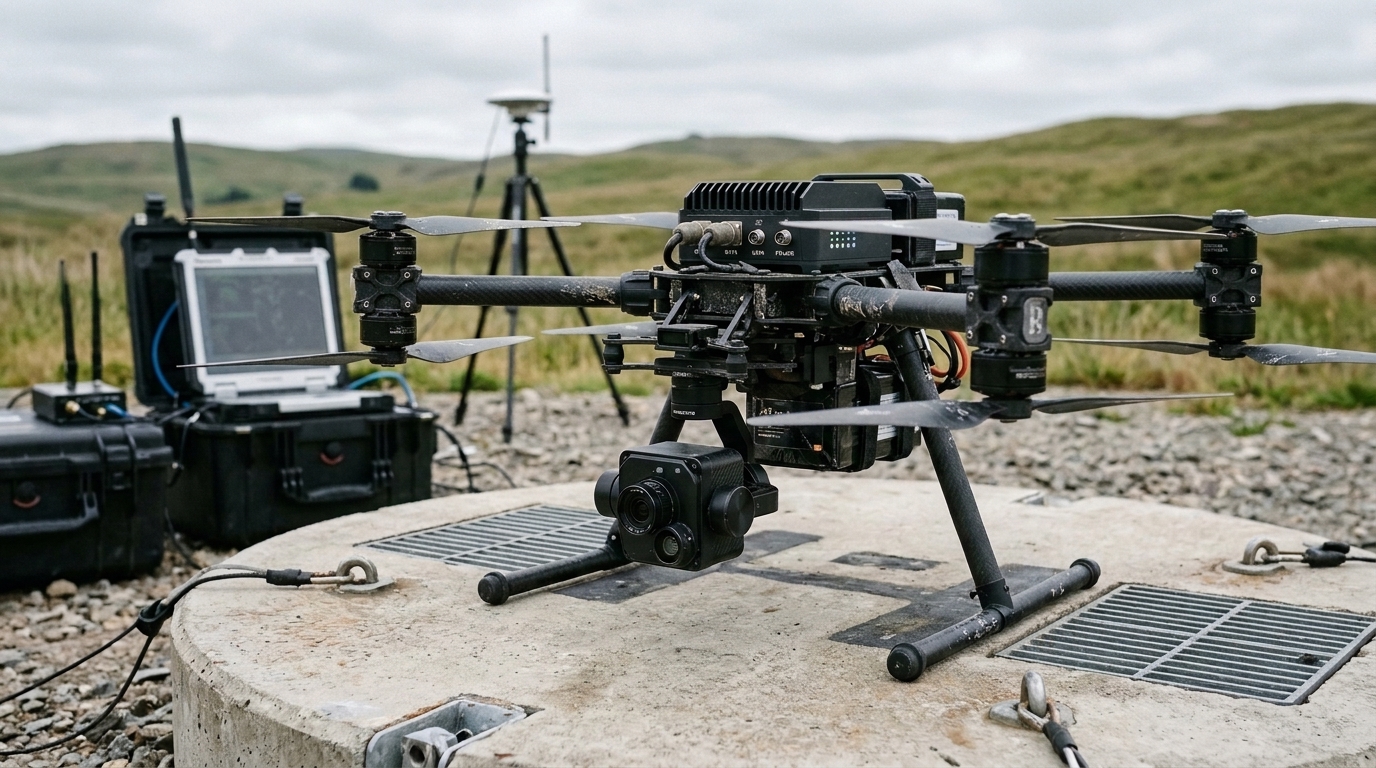
Image Credits: AI Generated

DOI: 10.1007/s10489-026-07570-x

Keywords: unmanned aerial vehicles, flying ad-hoc networks, federated unlearning, anomaly detection, feature heterogeneity, machine learning privacy, gradient ascent, ISOT drone benchmark, novel, federated, unlearning, framework

News Source: Denise Maddox. (November 5, 2026). Federated Unlearning System Removes Drone Data Without Full Network Retraining. Scienmag.

Tags: Anomaly Detectionfeature heterogeneityfederatedfederated unlearningflying ad-hoc networksframeworkgradient ascentISOT drone benchmarkmachine learning privacynovelUnLearningunmanned aerial vehicles
Share12Tweet7Share2ShareShareShare1

Related Posts

Miniature Zirconia Oxygen Sensor Tames Diffusion With a 20-Micrometer Hole

Miniature Zirconia Oxygen Sensor Tames Diffusion With a 20-Micrometer Hole

November 5, 2026
Flexible ligands give symmetric nanoparticles spontaneous valency

Flexible ligands give symmetric nanoparticles spontaneous valency

November 5, 2026

Vernacular architecture is an invention, argues 20-year study of earthen building in Argentina

November 5, 2026

Microbial Protease SP02 Shows Faster, Cooler Route to Greener Leather Dehairing

November 5, 2026

POPULAR NEWS

  • ECMO shows promise as rescue therapy for combat casualties, but evidence remains thin

    ECMO shows promise as rescue therapy for combat casualties, but evidence remains thin

    29 shares
    Share 12 Tweet 7
  • MRI habitat radiomics maps tumor diversity to predict lymph node spread in early-stage cervical cancer

    29 shares
    Share 12 Tweet 7
  • Japan’s Home Care Use Varies Sharply Across Municipalities Despite Universal Coverage

    29 shares
    Share 12 Tweet 7
  • Long Contact Times on AAV Affinity Resins Reshape Yield and Purity

    29 shares
    Share 12 Tweet 7

About

We bring you the latest biotechnology news from best research centers and universities around the world. Check our website.

Follow us

Recent News

ECMO shows promise as rescue therapy for combat casualties, but evidence remains thin

MRI habitat radiomics maps tumor diversity to predict lymph node spread in early-stage cervical cancer

Japan’s Home Care Use Varies Sharply Across Municipalities Despite Universal Coverage

Subscribe to Blog via Email

Enter your email address to subscribe to this blog and receive notifications of new posts by email.

Join 86 other subscribers
  • Contact Us

Bioengineer.org © Copyright 2023 All Rights Reserved.

Welcome Back!

Login to your account below

Forgotten Password?

Retrieve your password

Please enter your username or email address to reset your password.

Log In
No Result
View All Result
  • Homepages
    • Home Page 1
    • Home Page 2
  • News
  • National
  • Business
  • Health
  • Lifestyle
  • Science

Bioengineer.org © Copyright 2023 All Rights Reserved.