• HOME
  • NEWS
  • EXPLORE
    • CAREER
      • Companies
      • Jobs
    • EVENTS
    • iGEM
      • News
      • Team
    • PHOTOS
    • VIDEO
    • WIKI
  • BLOG
  • COMMUNITY
    • FACEBOOK
    • INSTAGRAM
    • TWITTER
Saturday, February 7, 2026
BIOENGINEER.ORG
No Result
View All Result
  • Login
  • HOME
  • NEWS
  • EXPLORE
    • CAREER
      • Companies
      • Jobs
        • Lecturer
        • PhD Studentship
        • Postdoc
        • Research Assistant
    • EVENTS
    • iGEM
      • News
      • Team
    • PHOTOS
    • VIDEO
    • WIKI
  • BLOG
  • COMMUNITY
    • FACEBOOK
    • INSTAGRAM
    • TWITTER
  • HOME
  • NEWS
  • EXPLORE
    • CAREER
      • Companies
      • Jobs
        • Lecturer
        • PhD Studentship
        • Postdoc
        • Research Assistant
    • EVENTS
    • iGEM
      • News
      • Team
    • PHOTOS
    • VIDEO
    • WIKI
  • BLOG
  • COMMUNITY
    • FACEBOOK
    • INSTAGRAM
    • TWITTER
No Result
View All Result
Bioengineer.org
No Result
View All Result
Home NEWS Science News Chemistry

Faux reefs for coastal protection

Bioengineer by Bioengineer
March 26, 2024
in Chemistry
Reading Time: 2 mins read
0
Reef Sketch
Share on FacebookShare on TwitterShare on LinkedinShare on RedditShare on Telegram

Engineers have designed a modular artificial reef that can dissipate wave energy far better than natural coral reefs, according to a study. Sixty percent of the world’s coral reefs are under threat from rising ocean temperatures, overfishing, or coastal development. At the same time, climate change is leading to sea level rise, frequent high-tide flooding, and powerful storm surges. Artificial reefs can help protect coastal infrastructure from storms as well as provide habitat for marine organisms. Michael Triantafyllou and colleagues proposed and tested an architected cellular reef structure designed to dissipate wave energy at higher rates than natural reefs. The structure is made of concrete and is designed as a modular unit, many of which can be combined like building blocks. Each unit, known as a voxel, is a truncated pyramid. The shape of the structure was optimized through hydrodynamic modeling and experimental testing. Tests of scale models of reefs made of miniaturized version of the modules at the MIT Towing Tank confirm its effectiveness at dissipating wave energy. According to the authors, coastal communities can help protect themselves and provide shelter for marine life by installing artificial reefs made of concrete voxels at a sufficient depth such that waves would encounter the reef before breaking.
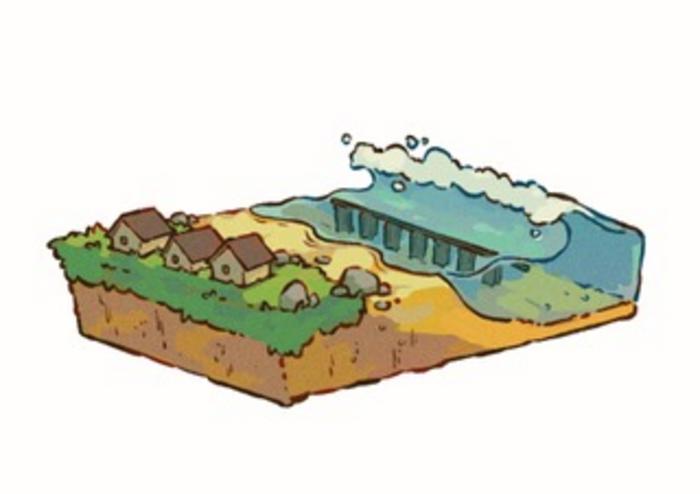
Reef Sketch

Credit: Melissa Wen

Engineers have designed a modular artificial reef that can dissipate wave energy far better than natural coral reefs, according to a study. Sixty percent of the world’s coral reefs are under threat from rising ocean temperatures, overfishing, or coastal development. At the same time, climate change is leading to sea level rise, frequent high-tide flooding, and powerful storm surges. Artificial reefs can help protect coastal infrastructure from storms as well as provide habitat for marine organisms. Michael Triantafyllou and colleagues proposed and tested an architected cellular reef structure designed to dissipate wave energy at higher rates than natural reefs. The structure is made of concrete and is designed as a modular unit, many of which can be combined like building blocks. Each unit, known as a voxel, is a truncated pyramid. The shape of the structure was optimized through hydrodynamic modeling and experimental testing. Tests of scale models of reefs made of miniaturized version of the modules at the MIT Towing Tank confirm its effectiveness at dissipating wave energy. According to the authors, coastal communities can help protect themselves and provide shelter for marine life by installing artificial reefs made of concrete voxels at a sufficient depth such that waves would encounter the reef before breaking.


Journal

PNAS Nexus

Article Title

Architected materials for artificial reefs to increase storm energy dissipation

Article Publication Date

26-Mar-2024
Share12Tweet8Share2ShareShareShare2

Related Posts

blank

Breakthrough in Environmental Cleanup: Scientists Develop Solar-Activated Biochar for Faster Remediation

February 7, 2026
blank

Cutting Costs: Making Hydrogen Fuel Cells More Affordable

February 6, 2026

Scientists Develop Hand-Held “Levitating” Time Crystals

February 6, 2026

Observing a Key Green-Energy Catalyst Dissolve Atom by Atom

February 6, 2026

POPULAR NEWS

  • Robotic Ureteral Reconstruction: A Novel Approach

    Robotic Ureteral Reconstruction: A Novel Approach

    82 shares
    Share 33 Tweet 21
  • Digital Privacy: Health Data Control in Incarceration

    63 shares
    Share 25 Tweet 16
  • Study Reveals Lipid Accumulation in ME/CFS Cells

    57 shares
    Share 23 Tweet 14
  • Breakthrough in RNA Research Accelerates Medical Innovations Timeline

    53 shares
    Share 21 Tweet 13

About

We bring you the latest biotechnology news from best research centers and universities around the world. Check our website.

Follow us

Recent News

Decoding Prostate Cancer Origins via snFLARE-seq, mxFRIZNGRND

Digital Health Perspectives from Baltic Sea Experts

Florida Cane Toad: Complex Spread and Selective Evolution

Subscribe to Blog via Email

Enter your email address to subscribe to this blog and receive notifications of new posts by email.

Join 73 other subscribers
  • Contact Us

Bioengineer.org © Copyright 2023 All Rights Reserved.

Welcome Back!

Login to your account below

Forgotten Password?

Retrieve your password

Please enter your username or email address to reset your password.

Log In
No Result
View All Result
  • Homepages
    • Home Page 1
    • Home Page 2
  • News
  • National
  • Business
  • Health
  • Lifestyle
  • Science

Bioengineer.org © Copyright 2023 All Rights Reserved.