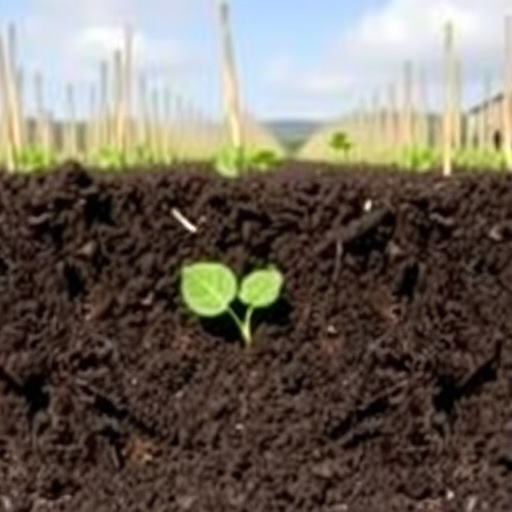
In recent years, biochar has emerged as a champion in the quest for sustainable agriculture and climate change mitigation, lauded for its potential to enhance soil health and sequester carbon effectively. Produced by the pyrolysis of plant biomass under limited oxygen conditions, biochar’s porous and carbon-rich structure has captivated scientists and farmers alike. However, groundbreaking research stemming from a rigorous 12-year field experiment in China reveals a decidedly more nuanced portrait of biochar’s interaction with soil carbon dynamics, challenging oversimplified narratives about its role in carbon storage across soil profiles.
This comprehensive investigation, conducted across two markedly different cropland soil types—a carbon-abundant Entisol and a carbon-deficient Ultisol—exposes the depth-dependent mechanisms through which biochar influences the accumulation of microbial necromass carbon. Microbial necromass, the residual biomass of dead microorganisms, particularly fungi and bacteria, constitutes a critical component of stable soil organic matter, governing long-term carbon sequestration via its incorporation and protection within soil matrices. The research distinctly shows that biochar’s carbon-enhancing effects are predominantly confined to the topsoil, while paradoxically reducing microbial necromass carbon deeper in the soil profile.
A striking outcome of this study is the significant increase in microbial necromass carbon within the upper 20 centimeters of the soil profile, where biochar addition amplified fungal-derived necromass by 23.3% in Entisols and 39.0% in Ultisols. This suggests fungal communities respond robustly to biochar amendments, which recalibrate the soil microenvironment, enhancing nutrient availability, microbial biomass, and biomass conversion efficiency. These factors collectively appear to strengthen biological pathways that lead to the enhanced stabilization of microbial residues, consolidating carbon pools at the soil surface and potentially increasing soil fertility and resilience.
Conversely, soil layers between 20 and 40 centimeters exhibited a contrasting pattern. Here, biochar application consistently diminished microbial necromass carbon by an alarming range of 17.9% to 30.4%, irrespective of the soil type. The causes appear linked to shifts in subsoil nutrient dynamics, with decreased nitrogen availability and heightened microbial metabolic stress triggering intensified enzymatic activity. These enzyme-mediated reactions may promote the degradation of extant microbial residues rather than fostering their accumulation, thereby undermining deeper soil carbon stability and complicating biochar’s presumed universal benefits.
The functional divergence between soil depths underscores a critical oversight in many biochar-related climate mitigation strategies: the implicit assumption that carbon gains in surface layers equate to net ecosystem benefits without accounting for potentially offsetting losses belowground. The implications are profound, suggesting that surface soil carbon enhancements might be partially negated by degradation in subsoil layers, thus necessitating a reconceptualization of biochar’s overall carbon sequestration value.
To validate these findings within a broader global context, the research team supplemented their field data with a meta-analysis incorporating 85 observations drawn from 23 independent studies worldwide. This synthesis confirmed a pervasive trend: biochar increases microbial necromass carbon in topsoil environments in approximately 83.5% of cases, on average by 10.2%. Furthermore, soils characterized by initially low organic carbon content and higher sand fractions demonstrated amplified responses, with biochar’s efficacy intensifying over longer durations, peaking near a decade post-application.
These meta-analytic results reinforce the necessity for long-term perspectives in evaluating biochar’s environmental performance. Immediate post-application effects may underestimate or misrepresent biochar’s benefits, which often manifest progressively as microbial communities adjust and soil physical-chemical properties evolve. The temporal dimension highlighted challenges prevalent short-term experimental designs and calls for sustained monitoring to capture the complex trajectories of soil carbon dynamics.
From an agronomic standpoint, this research demands greater precision in tailoring biochar use. Blanket recommendations risk inefficiencies or unintended consequences, especially given the differential impacts observed across soil types and depths. Crop yield improvements tied to biochar additions may not be universally realized, particularly if nutrient availability in subsoil horizons is compromised, possibly affecting root development and nutrient uptake.
Moreover, the soil microbiome’s pivotal role as a mediator of biochar’s carbon effects invites deeper mechanistic studies. The fungal dominance in necromass accumulation under biochar amendments elucidates the potential for targeted microbiome engineering or biochar formulations aimed at selectively enhancing beneficial microbial guilds. Such strategies could optimize carbon stabilization pathways while minimizing deleterious impacts at depth.
Critically, this study cautions against simplistic carbon accounting frameworks that exclude the vertical distribution of carbon pools. For climate mitigation policies and carbon credit systems to be scientifically robust and fair, they must integrate soil profile heterogeneity and microbial ecology insights. Overlooking subsoil dynamics risks overestimating biochar’s carbon sequestration potential and misguiding resource allocation.
In conclusion, while biochar remains a scientifically promising amendment for bolstering surface soil carbon stocks and fostering soil health, its deployment must be underpinned by nuanced understanding of soil depth-specific responses and long-term microbial transformations. Future research agendas should prioritize integrated, multilayered soil assessments coupled with advanced microbial and biochemical tracing techniques to unravel biochar’s multifaceted legacy in terrestrial ecosystems. This holistic approach will be instrumental in harnessing biochar’s full potential sustainably, balancing agronomic productivity with climate resilience goals.
Subject of Research: Experimental study on biochar’s influence on soil microbial necromass carbon across soil depths in croplands.
Article Title: Depth-dependent microbial necromass carbon accumulation responses to long-term biochar amendment in croplands.
News Publication Date: 16-Mar-2026.
Web References: Biochar Journal, DOI: 10.1007/s42773-026-00577-0.
References: Song, K., Liu, Z., Ma, R. et al. (2026). Depth-dependent microbial necromass carbon accumulation responses to long-term biochar amendment in croplands. Biochar, 8, 78.
Image Credits: Kaiyue Song, Zhiwei Liu, Ruiling Ma, Qi Yi, Jufeng Zheng, Rongjun Bian, Kun Cheng, Shaopan Xia, Xiaoyu Liu, Xuhui Zhang & Lianqing Li.
Keywords
Biochar, Soil Carbon Sequestration, Microbial Necromass, Fungi, Soil Microbiology, Carbon Cycle, Climate Mitigation, Soil Health, Subsoil Dynamics, Long-term Field Experiment, Cropland Soils, Soil Organic Matter.
Tags: biochar and soil organic matterbiochar impact on soil microbescarbon sequestration in topsoilclimate change mitigation through biocharcropland soil healthEntisol and Ultisol soil typeslong-term biochar applicationmicrobial carbon storagemicrobial necromass carbon accumulationpyrolysis biochar productionsoil depth effects on carbonsustainable agriculture practices