• HOME
  • NEWS
  • EXPLORE
    • CAREER
      • Companies
      • Jobs
    • EVENTS
    • iGEM
      • News
      • Team
    • PHOTOS
    • VIDEO
    • WIKI
  • BLOG
  • COMMUNITY
    • FACEBOOK
    • INSTAGRAM
    • TWITTER
Wednesday, May 13, 2026
BIOENGINEER.ORG
No Result
View All Result
  • Login
  • HOME
  • NEWS
  • EXPLORE
    • CAREER
      • Companies
      • Jobs
        • Lecturer
        • PhD Studentship
        • Postdoc
        • Research Assistant
    • EVENTS
    • iGEM
      • News
      • Team
    • PHOTOS
    • VIDEO
    • WIKI
  • BLOG
  • COMMUNITY
    • FACEBOOK
    • INSTAGRAM
    • TWITTER
  • HOME
  • NEWS
  • EXPLORE
    • CAREER
      • Companies
      • Jobs
        • Lecturer
        • PhD Studentship
        • Postdoc
        • Research Assistant
    • EVENTS
    • iGEM
      • News
      • Team
    • PHOTOS
    • VIDEO
    • WIKI
  • BLOG
  • COMMUNITY
    • FACEBOOK
    • INSTAGRAM
    • TWITTER
No Result
View All Result
Bioengineer.org
No Result
View All Result
Home NEWS Science News Chemistry

Fatty acid in triglycerides proves an effective platform for biological drug delivery

Bioengineer by Bioengineer
April 1, 2020
in Chemistry
Reading Time: 2 mins read
0
IMAGE
Share on FacebookShare on TwitterShare on LinkedinShare on RedditShare on Telegram

IMAGE

Credit: Haifa Shen, Houston Methodist

HOUSTON-(April 1, 2020)-We’ve all been warned about the dangers of triglycerides, the fat stored in your blood. But what if that unhealthy fat could effectively transport oral medication to your body and eliminate the need for some injections or IV treatment?

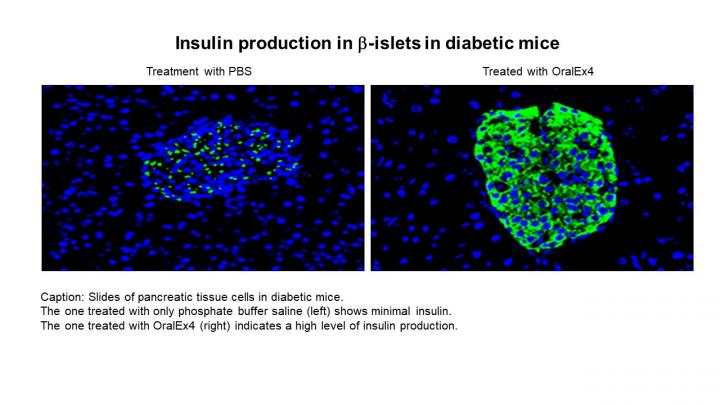
Houston Methodist nanomedicine researchers are studying this new drug delivery system for a diabetes drug that resulted in approximately 25% absorption in mice models, which is considered to be very high for an oral drug.

The research published in Science Advances may pave the way for oral delivery of more biological drugs, like those used to treat rheumatoid arthritis and other autoimmune diseases.

“We know the human body can absorb fatty acids, so we decided to chemically link biological drug molecules to fatty acids to see how well these drugs are absorbed into the gastrointestinal system. It turns out that our ‘transporter approach’ was effective,” said Haifa Shen, M.D., Ph.D., professor of nanomedicine, Houston Methodist Research Institute, who began this work more than five years ago when a family member diagnosed with diabetes needed insulin injections three times a day.

After designing a platform where a peptide-based drug used to treat diabetes mellitus was chemically linked to fatty acids, Shen and team packaged the resulting combination in a nanoparticle that was resistant to gastric acids in the stomach. Once inside the small intestine, the drug molecules were released from the nanoparticle and the mice absorbed 24.8% of the drug dosage.

The majority of small molecule drugs are prepared in tablets and given orally. But biological drugs, like those to treat diabetes, cannot sustain the harsh environment in the GI tract, which includes gastric fluids and digestive enzymes in the stomach. The only option has been intravenous infusion or injections, which are more costly than oral drugs and pose compliance challenges for many patients who struggle with inconvenient appointments and the high cost of treatment.

“This was just the first drug we tested. Our approach could be used to deliver many other biological drugs, such as human growth hormone and therapeutic antibodies,” said Shen.

Now that the nanomedicine researchers have proven the drug platform works in animal models, the next step is to perform toxicity studies, produce the drugs in a larger quantity and, eventually, move to clinical trial in patients. Although fatty acids may one day be key to fighting diabetes, the technology still has a ways to go before people can derive benefit from consuming fatty acids.

###

Other Houston Methodist researchers collaborating on this paper include Z. Hu, S. Nizzero, S. Goel, L. E. Hinkle, X. Wu, C. Li, and M. Ferrari (formerly Houston Methodist, now with European Research Council).

This study was supported in part by grants from the National Institute of Health (R01CA193880, R01CA222959 and U54CA210181) and U.S. Department of Defense (W81XWH-17-1-0389).

For more information: Molecular Targeting of FATP4 Transporter for Oral Delivery of Therapeutic Peptide. Science Advances. (online April 1, 2020). Zhenhua Hu, Sara Nizzero, Shreya Goel, Louis E. Hinkle, Xiaoyan Wu, Chao Li, Mauro Ferrari, Haifa Shen.

Media Contact
Gale Smith
[email protected]

Tags: BiochemistryBiotechnologyGenesMedicine/HealthNanotechnology/MicromachinesPharmaceutical ChemistryPharmaceutical SciencePharmaceutical SciencesPharmaceutical/Combinatorial Chemistry
Share12Tweet8Share2ShareShareShare2

Related Posts

Gravitational Wave Detectors Now Feature Automatic Signal Tuning — Chemistry

Gravitational Wave Detectors Now Feature Automatic Signal Tuning

May 13, 2026
Harnessing Neural Networks for Advances in Nonlinear Optics — Chemistry

Harnessing Neural Networks for Advances in Nonlinear Optics

May 12, 2026

Innovative Method Unveiled to Detect Signs of Dark Matter

May 12, 2026

Illuminating the Science Behind Historical Featherwork Art

May 12, 2026
Please login to join discussion

POPULAR NEWS

  • Research Indicates Potential Connection Between Prenatal Medication Exposure and Elevated Autism Risk

    842 shares
    Share 337 Tweet 211
  • New Study Reveals Plants Can Detect the Sound of Rain

    728 shares
    Share 290 Tweet 182
  • Salmonella Haem Blocks Macrophages, Boosts Infection

    62 shares
    Share 25 Tweet 16
  • Breastmilk Balances E. coli and Beneficial Bacteria in Infant Gut Microbiomes

    57 shares
    Share 23 Tweet 14

About

We bring you the latest biotechnology news from best research centers and universities around the world. Check our website.

Follow us

Recent News

Enhancing Carbon Capture Efficiency Using Laser-Engineered MOFs!

E-cadherin Loss Drives Tumor Environment in Lobular Cancer

Endothelial SPARC Drives Astrocyte Damage in NMOSD

Subscribe to Blog via Email

Enter your email address to subscribe to this blog and receive notifications of new posts by email.

Join 82 other subscribers
  • Contact Us

Bioengineer.org © Copyright 2023 All Rights Reserved.

Welcome Back!

Login to your account below

Forgotten Password?

Retrieve your password

Please enter your username or email address to reset your password.

Log In
No Result
View All Result
  • Homepages
    • Home Page 1
    • Home Page 2
  • News
  • National
  • Business
  • Health
  • Lifestyle
  • Science

Bioengineer.org © Copyright 2023 All Rights Reserved.