• HOME
  • NEWS
  • EXPLORE
    • CAREER
      • Companies
      • Jobs
    • EVENTS
    • iGEM
      • News
      • Team
    • PHOTOS
    • VIDEO
    • WIKI
  • BLOG
  • COMMUNITY
    • FACEBOOK
    • INSTAGRAM
    • TWITTER
Tuesday, June 16, 2026
BIOENGINEER.ORG
No Result
View All Result
  • Login
  • HOME
  • NEWS
  • EXPLORE
    • CAREER
      • Companies
      • Jobs
        • Lecturer
        • PhD Studentship
        • Postdoc
        • Research Assistant
    • EVENTS
    • iGEM
      • News
      • Team
    • PHOTOS
    • VIDEO
    • WIKI
  • BLOG
  • COMMUNITY
    • FACEBOOK
    • INSTAGRAM
    • TWITTER
  • HOME
  • NEWS
  • EXPLORE
    • CAREER
      • Companies
      • Jobs
        • Lecturer
        • PhD Studentship
        • Postdoc
        • Research Assistant
    • EVENTS
    • iGEM
      • News
      • Team
    • PHOTOS
    • VIDEO
    • WIKI
  • BLOG
  • COMMUNITY
    • FACEBOOK
    • INSTAGRAM
    • TWITTER
No Result
View All Result
Bioengineer.org
No Result
View All Result
Home NEWS Science News Chemistry

Faster than ever — neutron tomography detects water uptake by roots

Bioengineer by Bioengineer
September 25, 2019
in Chemistry
Reading Time: 2 mins read
0
IMAGE
Share on FacebookShare on TwitterShare on LinkedinShare on RedditShare on Telegram

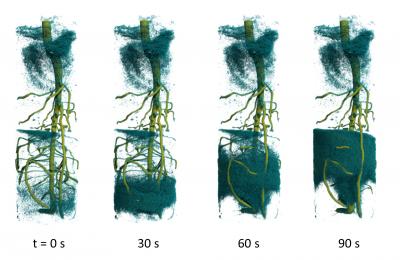
A team from Potsdam, Berlin and Grenoble was able to visualize the transport of water in soil as well as through roots of lupine plants using ultrafast 3D neutron imaging
IMAGE

Credit: C. Tötzke/Uni Potsdam

Water and nutrient uptake by plants involves dynamic and complex interactions of roots with the surrounding soil. “The tomographic method makes it possible to track 3D water paths from soil into roots over time,” says Dr. Christian Toetzke, who heads the research team at the University of Potsdam. “These insights can help to develop strategies for more efficient and sustainable use of water and fertilizer in crop cultivation.”

Neutrons are sensitive mainly to light elements such as hydrogen, lithium and their compounds. Neutron tomography can therefore be used to precisely map water content non-invasively, both in the roots and in the surrounding soil of a sample. How plants can take up water and nutrients depends largely on the properties of the rhizosphere, a few millimetres thick soil layer surrounding the roots. This region not only delivers the mineral and organic components from soil to roots, but is also influenced by root exudates and microbial activity.

Until now, the acquisition of 3D neutron images took at least ten seconds per tomogram. This still resulted in a limitation to study rapid processes such as the infiltration of the root system with water. To enable more images in a shorter time, a team led by HZB expert Dr. Nikolay Kardjilov optimized the method at NeXT-Grenoble, a recently opened tomography instrument of the Laue-Langevin Institute (ILL), which is supplied with cold neutrons by a 60 Megawatt research reactor. By exploiting the much more intense neutron beam, it has been possible to reduce the recording time per tomogram to almost one second. “The result even exceeded our expectations,” explains Toetzke: “The achieved acquisition rate was higher than assumed beforehand. Nevertheless, the signal-to-noise ratio and the spatial image resolution could be improved also”.

Now that the technical capabilities of ultrafast neutron tomography have been demonstrated, Kardjilov and his team are working on further improving the method and establishing its application in other research areas. Since the Berlin neutron source of the HZB will cease operation in December, the fast imaging set-up will be integrated into the NeXT instrument in Grenoble in order to be able to investigate fast transport processes in other materials in the future. For example, high-speed neutron tomography could provide new insights into the hydraulic fracturing of porous rock formations or could be used to investigate ion transfer during fast charging and discharging of lithium batteries in order to increase the safety, capacity and durability of such energy storage systems.

###

Media Contact
Antonia Roetger
[email protected]

Original Source

https://www.helmholtz-berlin.de/bin/news_seite?nid=20781;sprache=en;intern=1

Related Journal Article

http://dx.doi.org/10.1364/OE.27.028640

Tags: BiologyBiomechanics/BiophysicsFood/Food SciencePlant Sciences
Share12Tweet8Share2ShareShareShare2

Related Posts

Alkyl-Swap Platform Transforms Secondary N-Methylamines Late-Stage — Chemistry

Alkyl-Swap Platform Transforms Secondary N-Methylamines Late-Stage

June 15, 2026
You Just Devoured That Planet, Didn’t You? — Chemistry

You Just Devoured That Planet, Didn’t You?

June 15, 2026

How Proteins “Breathe” and What Causes Them to Freeze: New Discoveries from ISTA Research

June 15, 2026

CUHK Unveils All-Optical Signal Processor to Overcome AI Data Center Transmission Limits

June 15, 2026
Please login to join discussion

POPULAR NEWS

  • ESMO 2025: mRNA COVID Vaccines Enhance Efficacy of Cancer Immunotherapy

    325 shares
    Share 130 Tweet 81
  • Saying Goodbye to PGY-6: Pediatric Fellowship Realities

    100 shares
    Share 40 Tweet 25
  • Multi-Hospital Study Reveals Long Covid Burden Is Twice as High as Current Estimates

    91 shares
    Share 36 Tweet 23
  • Detection of EDCs in Breast Milk and Infant Urine Up to Six Months Highlights Early Exposure Risks

    74 shares
    Share 30 Tweet 19

About

We bring you the latest biotechnology news from best research centers and universities around the world. Check our website.

Follow us

Recent News

Genome Editing Revolutionizes Treatment of Human Diseases

Enhancing CNS Tumor Therapy with MRI-Guided Ultrasound

3D Multi-Omics Tumor Atlases: Tech to Clinic

Subscribe to Blog via Email

Enter your email address to subscribe to this blog and receive notifications of new posts by email.

Join 82 other subscribers
  • Contact Us

Bioengineer.org © Copyright 2023 All Rights Reserved.

Welcome Back!

Login to your account below

Forgotten Password?

Retrieve your password

Please enter your username or email address to reset your password.

Log In
No Result
View All Result
  • Homepages
    • Home Page 1
    • Home Page 2
  • News
  • National
  • Business
  • Health
  • Lifestyle
  • Science

Bioengineer.org © Copyright 2023 All Rights Reserved.