Credit: by Yanlei Hu, Zhongyu Wang, Xuewen Wang, Shengyun Ji, Chenchu Zhang, Jiawen Li, Wulin Zhu, Dong Wu, Jiaru Chu
Diffraction is a classic optical phenomenon accounting for the light propagation. The efficient calculation of diffraction is of significant value towards the real-time prediction of light fields. The diffraction of electromagnetic (EM) waves can be catalogued into scalar diffraction and vector diffraction according to the validation of different approximation conditions. Although mathematical expressions for both optical diffraction have been presented authoritatively for ages, fundamental breakthroughs have rarely been achieved in computation algorithms. The direct integration method and Fast Fourier transform (FFT) method have been developed and proved to suffer from the limits of either low efficiency or poor flexibility. Therefore, the versatile computation of optical diffraction in an efficient and flexible fashion is highly demanded.
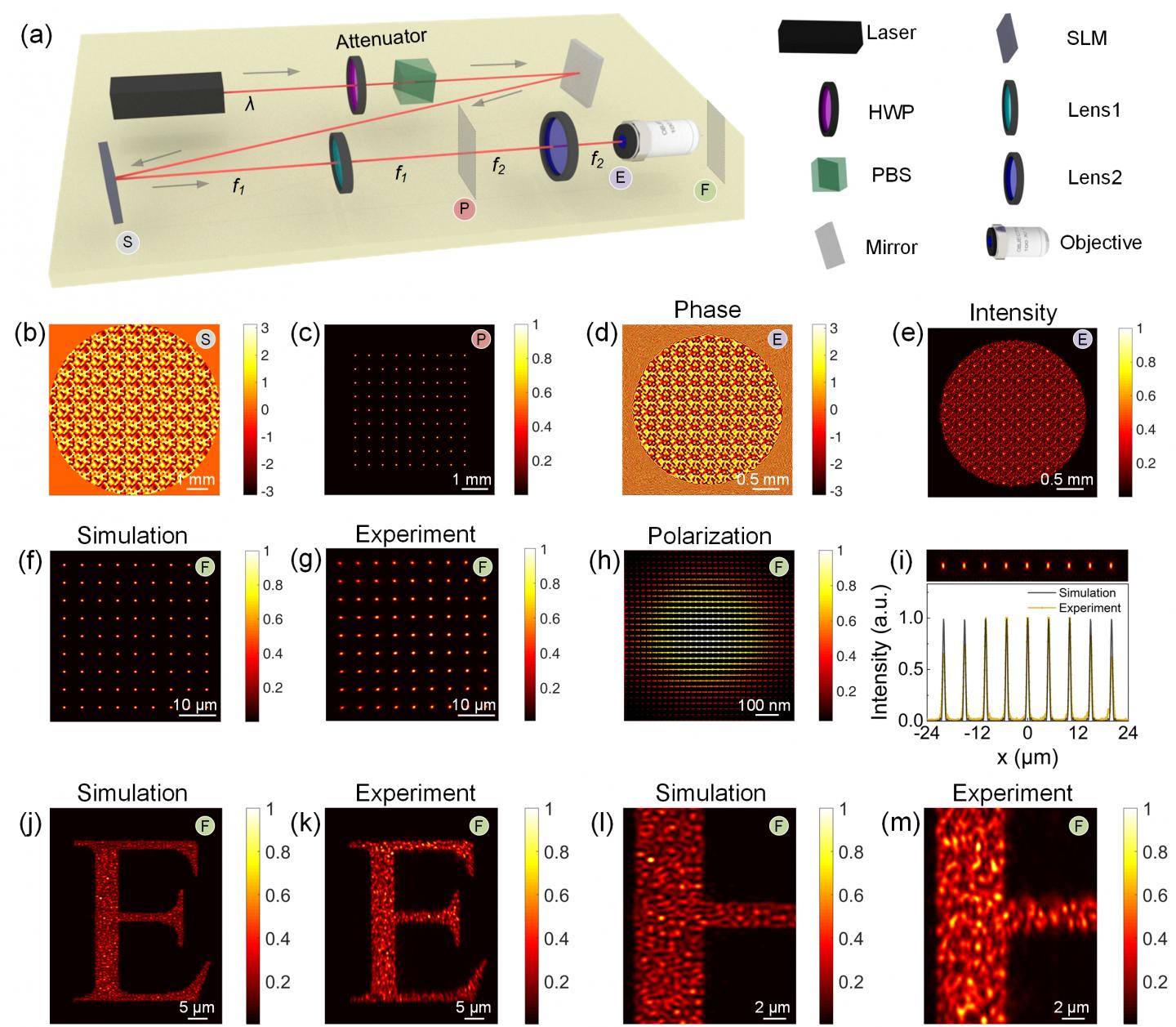
In a new paper published in Light Science & Application, a team of scientists, led by Professor Jiawen Li and Dong Wu from CAS Key Laboratory of Mechanical Behavior and Design of Materials, Key Laboratory of Precision Scientific Instrumentation of Anhui Higher Education Institutes, Department of Precision Machinery and Precision Instrumentation, University of Science and Technology of China, and co-workers have proposed an efficient full-path calculation method by exploring the mathematical similarities in scalar and vector diffraction. The scalar and vector diffraction are both expressed using the highly flexible Bluestein method. The computation time can be greatly reduced to the sub-second level, which is five orders of magnitude faster than that achieved by the direct integration approach and two orders of magnitude faster than that achieved by the FFT method. Furthermore, the ROIs and the sampling numbers can be arbitrarily chosen, endowing the proposed method with superior flexibility. Finally, full-path light tracing of a typical laser holographic system is presented with unprecedented computation speed, which agrees well with the experimental results. The proposed method holds great promise in the universal applications of optical microscopy, fabrication, and manipulation.
The Bluestein method is an elegant method conceived by L. Bluestein and further generalized by L. Rabiner et al., which is a promising tool in the engineer’s arsenal in the field of digital signal processing. The Bluestein method is capable of performing more general Fourier transforms at arbitrary frequencies as well as boosting the resolution over the full spectrum, offering us a spectral zoom operation with high resolution and arbitrary bandwidth. These scientists summarize the work of the application of the Bluestein method in both scalar and vector diffraction computation:
“We revisited and deduced the integral formulas for scalar and vector diffraction in Fourier transform forms, and then utilize the Bluestein method to completely supplant the Fourier transform in a more flexible fashion. Based on this, optical diffraction is evaluated with designated ROIs and sampling numbers.”
“A few representative examples are given for both scalar and vector diffraction to demonstrate the improvement in efficiency and flexibility. Moreover, full-path light tracing of an optical holographic system is presented with unprecedented computation speed. And the results are verified by the experimental measurements.” they added.
“Some important adjustments are made to the conventional Bluestein method including the definition of complex starting point and additional phase shifting factor in order to cope with the realistic condition for optical calculations” the scientists emphasized. “The proposed fast and flexible method for retrieving the light field can find wide applications in the fields of optical microscopy, photolithography and optical manipulation” they forecast.
###
Media Contact
Jiawen Li
[email protected]
Related Journal Article
http://dx.