

• HOME
  • NEWS
  • EXPLORE
    • CAREER
      • Companies
      • Jobs
    • EVENTS
    • iGEM
      • News
      • Team
    • PHOTOS
    • VIDEO
    • WIKI
  • BLOG
  • COMMUNITY
    • FACEBOOK
    • INSTAGRAM
    • TWITTER
Thursday, July 16, 2026
BIOENGINEER.ORG
No Result
View All Result
  • Login
  • HOME
  • NEWS
  • EXPLORE
    • CAREER
      • Companies
      • Jobs
        • Lecturer
        • PhD Studentship
        • Postdoc
        • Research Assistant
    • EVENTS
    • iGEM
      • News
      • Team
    • PHOTOS
    • VIDEO
    • WIKI
  • BLOG
  • COMMUNITY
    • FACEBOOK
    • INSTAGRAM
    • TWITTER
  • HOME
  • NEWS
  • EXPLORE
    • CAREER
      • Companies
      • Jobs
        • Lecturer
        • PhD Studentship
        • Postdoc
        • Research Assistant
    • EVENTS
    • iGEM
      • News
      • Team
    • PHOTOS
    • VIDEO
    • WIKI
  • BLOG
  • COMMUNITY
    • FACEBOOK
    • INSTAGRAM
    • TWITTER
No Result
View All Result
Bioengineer.org
No Result
View All Result
Home NEWS Science News Chemistry

Tiny Water Droplets May Unlock Solutions for Global Plastic Waste Dissolving

Bioengineer by Bioengineer
July 15, 2026
in Chemistry
Reading Time: 2 mins read
0
Tiny Water Droplets May Unlock Solutions for Global Plastic Waste Dissolving
Share on FacebookShare on TwitterShare on LinkedinShare on RedditShare on Telegram

A global team of scientists has unveiled a striking recycling route that turns tough plastic waste into valuable organic acids using nothing more than water and oxygen. The approach targets everyday polymers such as polyethylene and polypropylene—and even rubber tyres—while avoiding the expensive, sometimes hazardous catalysts that usually kick-start chemical recycling.

The work, led by researchers at Zhejiang University in collaboration with Cardiff University and the University of Tokyo, translates a long-standing laboratory curiosity into something closer to a practical process. Instead of relying on catalytic chemistry, the method exploits reactions that can be triggered at a microscopic scale.

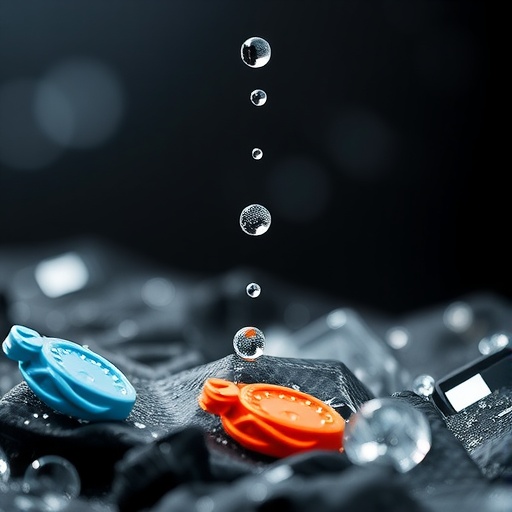
At the heart of the strategy are tiny water droplets formed when melted plastic is stirred into water. This produces a highly active “water–oil” interface, where reactive hydroxyl radicals arise spontaneously. Those radicals then function like molecular “scissors,” breaking the otherwise stubborn polymer chains into smaller, chemically useful fragments.

Using polyethylene as a test case, the team reports near-complete conversion under mild conditions and a 69% yield of short-chain diacids. Importantly for real-world waste streams, they report no microplastic residue left behind, an outcome that could reduce downstream purification demands.

The scientists emphasize that most conventional recycling routes can struggle when additives or mixed plastics contaminate the feed. Here, the process is described as robust enough to handle commercial additives and heterogeneous waste mixtures that commonly poison catalytic systems.

Just as crucially, the method works with both tap water and seawater, pointing to potential scalability beyond carefully controlled freshwater conditions. The authors also note that this catalyst-free chemistry is demonstrated at a practically relevant batch size in the laboratory, scaling to a 300 g run.

The study appears in Nature under the title “Catalyst-free, microdroplet-mediated waste plastic conversion to diacids” and is framed as an economically viable pathway for chemical plastic recycling. Lead author Yong Wang argues that removing catalysts eliminates major economic and environmental barriers to industrial adoption.

If the results hold up as the technology scales, the approach could reshape how chemical recycling is designed—by using interfacial physics to create the reactive agents needed for selective oxidation. For a planet awash in plastic waste, that reframing may be exactly what makes this science feel viral-worthy.

Subject of Research:

Not applicable

Article Title:

Catalyst-free, microdroplet-mediated waste plastic conversion to diacids

News Publication Date:

15-Jul-2026

Web References:

http://dx.doi.org/10.1038/s41586-026-10746-7

References:

Nature (DOI: 10.1038/s41586-026-10746-7)

Image Credits:
Tags: chemical recyclingenvironmentally friendly plastic recycling methodshydroxyl radicals in plastic breakdowninnovative approaches to plastic waste reductionmicroplastic-free recycling processesnon-catalytic polymer depolymerizationorganic acids production from plasticsplastic waste recyclingpolyethylene and polypropylene recyclingrubber tyre chemical recyclingsustainable waste management solutionswater-based polymer degradation

Share12Tweet7Share2ShareShareShare1

Related Posts

Chemistry from Alien World Detected in Meteorite That Hit New Jersey Home

Chemistry from Alien World Detected in Meteorite That Hit New Jersey Home

July 15, 2026
Low Carbon Dioxide Boosts Microbes to Produce More Biodegradable Plastic

Low Carbon Dioxide Boosts Microbes to Produce More Biodegradable Plastic

July 15, 2026

ROS Dynamics Controlled by Polyoxometalate-Functionalized Fe3O4 Nanozyme for Infected Wound Healing

July 15, 2026

Study Finds Smokers Rarely Increase Smoking After Switching to Low-Nicotine Cigarettes

July 15, 2026

POPULAR NEWS

  • New Drug Candidate Developed at McMaster Shows Potential for Treating Brain Cancer

    58 shares
    Share 23 Tweet 15
  • Scientists Overcome Antimicrobial Resistance in Bacteria Linked to Cystic Fibrosis

    42 shares
    Share 17 Tweet 11
  • Porcine Heart Transplant

    50 shares
    Share 20 Tweet 13
  • A varied menu

    51 shares
    Share 22 Tweet 12

About

We bring you the latest biotechnology news from best research centers and universities around the world. Check our website.

Follow us

Recent News

Ammonia Pressure Tunes Colloidal Metal Nitride Synthesis in Molten Salts

Allergic disease comorbidity shows distinct epidemiological patterns across Taiwan school grades

Correction: Positive TKT–c-Myc loop promotes TACE resistance in hepatocellular carcinoma

Subscribe to Blog via Email

Enter your email address to subscribe to this blog and receive notifications of new posts by email.

Join 85 other subscribers
  • Contact Us

Bioengineer.org © Copyright 2023 All Rights Reserved.

Welcome Back!

Login to your account below

Forgotten Password?

Retrieve your password

Please enter your username or email address to reset your password.

Log In
No Result
View All Result
  • Homepages
    • Home Page 1
    • Home Page 2
  • News
  • National
  • Business
  • Health
  • Lifestyle
  • Science

Bioengineer.org © Copyright 2023 All Rights Reserved.
