• HOME
  • NEWS
  • EXPLORE
    • CAREER
      • Companies
      • Jobs
    • EVENTS
    • iGEM
      • News
      • Team
    • PHOTOS
    • VIDEO
    • WIKI
  • BLOG
  • COMMUNITY
    • FACEBOOK
    • INSTAGRAM
    • TWITTER
Thursday, April 16, 2026
BIOENGINEER.ORG
No Result
View All Result
  • Login
  • HOME
  • NEWS
  • EXPLORE
    • CAREER
      • Companies
      • Jobs
        • Lecturer
        • PhD Studentship
        • Postdoc
        • Research Assistant
    • EVENTS
    • iGEM
      • News
      • Team
    • PHOTOS
    • VIDEO
    • WIKI
  • BLOG
  • COMMUNITY
    • FACEBOOK
    • INSTAGRAM
    • TWITTER
  • HOME
  • NEWS
  • EXPLORE
    • CAREER
      • Companies
      • Jobs
        • Lecturer
        • PhD Studentship
        • Postdoc
        • Research Assistant
    • EVENTS
    • iGEM
      • News
      • Team
    • PHOTOS
    • VIDEO
    • WIKI
  • BLOG
  • COMMUNITY
    • FACEBOOK
    • INSTAGRAM
    • TWITTER
No Result
View All Result
Bioengineer.org
No Result
View All Result
Home NEWS Science News Chemistry

Extreme weather conditions can tax urban drainage systems to the max

Bioengineer by Bioengineer
February 5, 2020
in Chemistry
Reading Time: 3 mins read
0
IMAGE
Share on FacebookShare on TwitterShare on LinkedinShare on RedditShare on Telegram

New design approach needed to handle impact of climate change
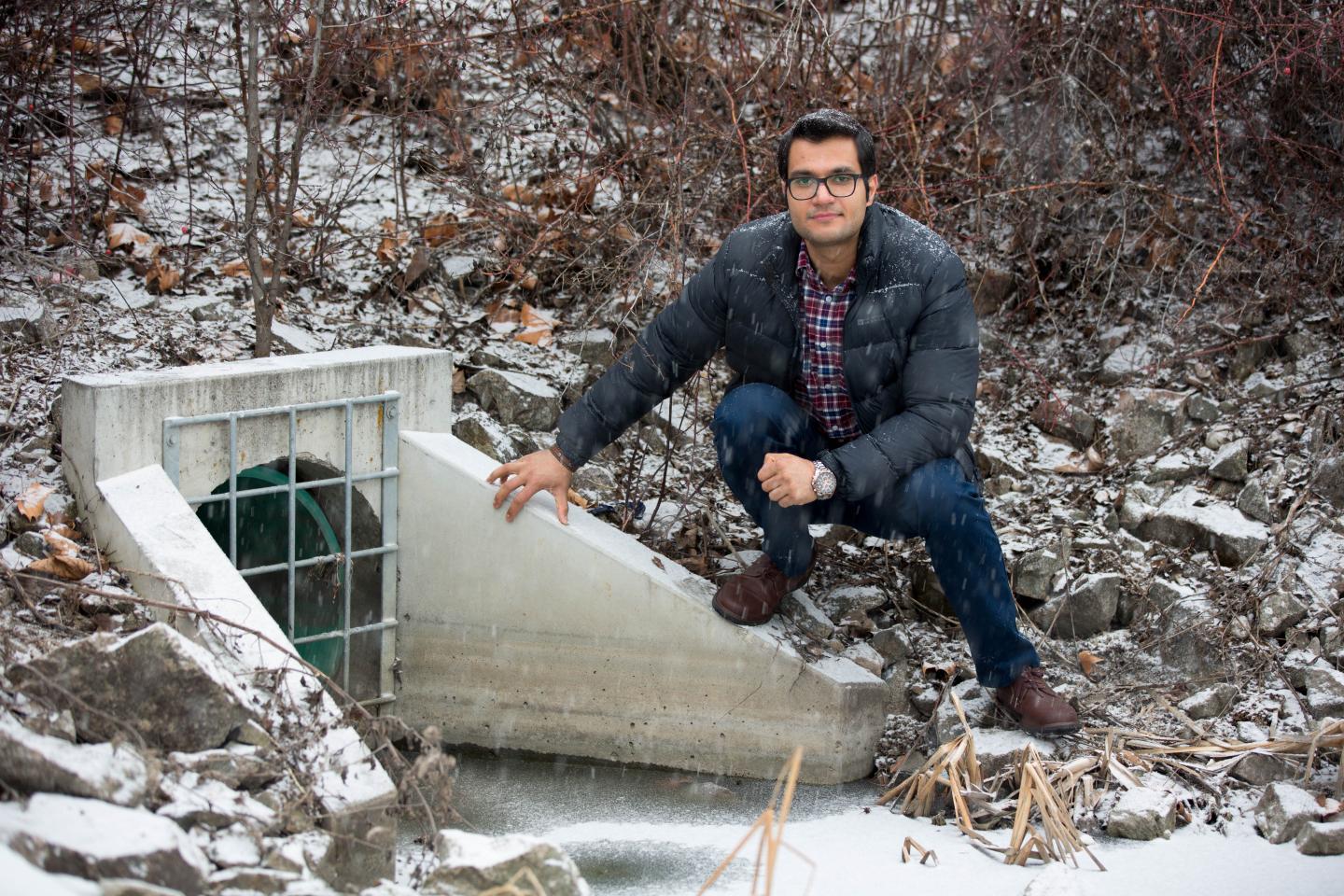
IMAGE

Credit: UBC Okanagan


During a typical Canadian winter, snow accumulation and melt–combined with sudden rainfalls–can lead to bottlenecks in storm drains that can cause flooding.

With that in mind, researchers at UBC’s Okanagan campus have been examining urban stormwater drainage systems, and they too have concerns about the resilience of many urban drainage systems.

A recently published paper from the School of Engineering says existing design methods for urban drainage systems aren’t going far enough to withstand possible catastrophic storms or even unpredictable failures during a moderate storm.

“As engineers, we run simulations of possible catastrophic events, and current systems often do not fare well,” says doctoral student Saeed Mohammadiun. “We are seeing sources of overloading such as structural failures, severe rainfalls or abrupt snowmelt stressing these systems.”

Add any extreme situation including quick snowmelt or a heavy and sudden rainfall, and Mohammadiun says many systems aren’t built to handle these worst-case scenarios. Mohammadiun has conducted several case studies of drainage systems in major urban areas around the world. He has determined many current urban standards designed for a 10-to-50 or even 100-year storm scenario are not meeting the increasing demands of climate change as well as intrinsic failure risk of networks’ elements.

“Conventional, reliability-based design methods only provide acceptable performance under expected conditions of loading,” he says. “Depending on the system, if something breaks down or there is a blockage, it can result in a failure and possible flooding.”

According to Mohammadiun, the resiliency of a system is not just dependent on the load it can handle, but also on its design and build. Many do not take into account the effects of climate change or unexpected weather conditions.

To establish an efficient resilient system, Mohammadiun says it is important to consider various sources of uncertainty such as rainfall characteristics, heavy snowfalls followed by a quick melt and different possible malfunction scenarios along with budget constraints, he says.

“Building or improving the resilience of urban stormwater drainage systems is crucial to ensuring these systems are protected against failure as much as possible, or they can quickly recover from a potential failure,” he adds. “This resilient capacity will provide urban drainage systems with the desired adaptability to a wide range of unexpected failures during their service life.”

The research points to several measures municipalities can proactively address the issue. Municipalities could build bypass lines and apply an appropriate combination of relief tunnels, storage units, and other distributed hydraulic structures in order to augment drainage system capacities in a resilient manner.

With the recent heavy snowfalls across Canada, Mohammadiun says the silver lining when it comes to drainage is that it takes snow time to melt whereas heavy rainfall puts an immediate stress on these systems. But from the engineering point of view, it is necessary to consider both acute and chronic conditions.

Not surprising, the research shows that urban drainage and stormwater systems that are built or modified to be more resilient, will handle extreme weather events more effectively and efficiently than conventional designs.

###

This research was recently published in Hydrological Sciences.

Media Contact
Patty Wellborn
[email protected]
250-317-0293

Original Source

https://news.ok.ubc.ca/2020/02/05/extreme-weather-conditions-can-tax-urban-drainage-systems-to-the-max

Related Journal Article

http://dx.doi.org/10.1080/02626667.2019.1690657

Tags: Civil EngineeringClimate ChangeClimate ScienceHydrology/Water ResourcesIndustrial Engineering/ChemistryTechnology/Engineering/Computer ScienceUrbanizationWeather/Storms
Share12Tweet8Share2ShareShareShare2

Related Posts

Breakthrough Laser Technique Unveils Secrets of Radioactive Atomic Nuclei

Breakthrough Laser Technique Unveils Secrets of Radioactive Atomic Nuclei

April 16, 2026
Ultra-Stretchable, Anti-Freezing Hydrogel Electrolytes Cross-Linked with Liquid Metal Particle Initiators for Advanced Soft Energy Storage Devices

Ultra-Stretchable, Anti-Freezing Hydrogel Electrolytes Cross-Linked with Liquid Metal Particle Initiators for Advanced Soft Energy Storage Devices

April 16, 2026

Scientists Develop Multiscale Electrode Design to Boost Hydrogen Production Efficiency

April 16, 2026

“Entangled, Staple-Like Particles Mimic Liquid Metal to Inspire Next-Gen Materials”

April 16, 2026
Please login to join discussion

POPULAR NEWS

  • Scientists Investigate Possible Connection Between COVID-19 and Increased Lung Cancer Risk

    61 shares
    Share 24 Tweet 15
  • Boosting Breast Cancer Risk Prediction with Genetics

    47 shares
    Share 19 Tweet 12
  • Popular Anti-Aging Compound Linked to Damage in Corpus Callosum, Study Finds

    45 shares
    Share 18 Tweet 11
  • NSF funds machine-learning research at UNO and UNL to study energy requirements of walking in older adults

    94 shares
    Share 38 Tweet 24

About

We bring you the latest biotechnology news from best research centers and universities around the world. Check our website.

Follow us

Recent News

Breakthrough Laser Technique Unveils Secrets of Radioactive Atomic Nuclei

Linear RAG Scanning Edits Igκ Variable Regions

Cytoplasmic Lattices: Massive Storage in Oocytes

Subscribe to Blog via Email

Enter your email address to subscribe to this blog and receive notifications of new posts by email.

Join 79 other subscribers
  • Contact Us

Bioengineer.org © Copyright 2023 All Rights Reserved.

Welcome Back!

Login to your account below

Forgotten Password?

Retrieve your password

Please enter your username or email address to reset your password.

Log In
No Result
View All Result
  • Homepages
    • Home Page 1
    • Home Page 2
  • News
  • National
  • Business
  • Health
  • Lifestyle
  • Science

Bioengineer.org © Copyright 2023 All Rights Reserved.