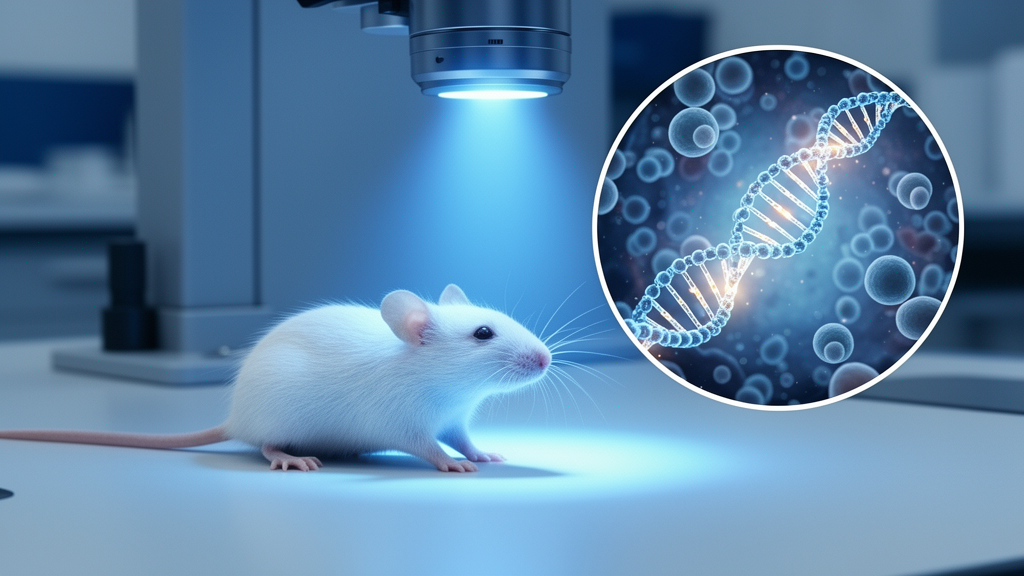
A research team has demonstrated a non-invasive optogenetic method that achieves targeted gene deletion across cell types in mouse subcutaneous white adipose tissue using external blue light illumination. The study, conducted using laboratory mouse models, provides proof-of-concept for spatial and temporal genetic manipulation in peripheral adipose depots without the surgical implantation of optical fibers or micro-light-emitting diodes. By exposing awake and freely moving mice to ambient blue light inside an engineered enclosure, the investigators achieved targeted ablation of the brain-derived neurotrophic factor gene specifically within inguinal subcutaneous fat. The experimental framework establishes an operational protocol that avoids tissue trauma and surgical morbidity, presenting an alternative method for exploring depot-specific molecular pathways and neuro-adipose crosstalk in fragile or metabolically compromised animal cohorts.
White adipose tissue carries out critical regulatory functions in metabolic homeostasis, executing specialized secretory activities and participating in bidirectional organ communication governed by extensive neural innervation. Mechanistic dissection of these biological pathways has relied predominantly on the Cre-Lox recombination system, wherein Cre recombinase catalyzes DNA excision between defined loxP recognition sites. While constitutive Cre drivers facilitate continuous recombination, their expression lacks temporal control, which can trigger embryonic lethality or introduce confounding developmental artifacts when examining pleiotropic genes.
To introduce temporal flexibility, investigators historically adopted ligand-inducible models such as tamoxifen-regulated CreERT systems or doxycycline-dependent tetracycline-controlled transcriptional transactivators. Nevertheless, the administration of chemical inducers presents recognized methodological challenges and biological liabilities. Tamoxifen alters systemic endogenous estrogen receptor signaling and can induce toxicity or morphological malformations in pregnant mice and developing litters. Similarly, doxycycline functions as a broad-spectrum antibiotic capable of disrupting gut microbiota composition, introducing uncontrolled experimental noise in metabolic studies.
The optogenetic platform deployed in this investigation utilizes the photoactivatable Cre recombinase system, known as PA-Cre, to achieve precise spatiotemporal gene ablation driven by blue light exposure. Genetically, PA-Cre transcription is initiated following FLP-mediated excision of an upstream frt-flanked stop sequence, yielding an mRNA transcript translated and processed via a P2A self-cleaving peptide. The resulting cleavage generates two discrete, catalytically inactive fragments of Cre recombinase designated nMag:CreN59 and pMag:CreC60. These complementary split segments are fused to engineered Magnet proteins derived from Vivid, a flavin-binding photoreceptor sourced from the fungus Neurospora crassa that responds specifically to visible blue spectrum wavelengths.
Upon exposure to blue light, the nMag and pMag protein domains undergo rapid heterodimerization, bringing the separated amino- and carboxy-terminal Cre fragments into functional proximity to assemble active recombinase complexes. When active, reconstituted PA-Cre excises DNA sequences demarcated by flanking loxP sites, which simultaneously deletes both the target genomic sequence and the PA-Cre cassette itself while rearranging the locus to trigger transcription of an mKate2 fluorescent reporter protein. The Vivid photoreceptor exhibits peak photon absorption at 450 nanometers, complemented by secondary spectral absorption bands at 428 and 478 nanometers. Physical light transmission data in mouse cutaneous tissue indicate that wavelengths between 400 and 500 nanometers penetrate dermal structures up to approximately 2000 micrometers, a depth sufficient to reach subcutaneous adipose deposits located beneath mouse skin that typically measures between 211 and 671 micrometers in thickness.
To validate the operational system, the investigators developed a non-surgical illumination enclosure assembled from transparent acrylic terrarium chambers measuring 4 by 4 by 8 inches. The cages were equipped with ventilation apertures, sliding doors secured by magnetic snaps, and acrylic elevation stands positioned over flexible blue silicone light-emitting diode strips. The lighting apparatus comprised 600 surface-mount diodes spanning 10 meters, powered at 12 volts and 60 watts, emitting a 6500 Kelvin color temperature with a spectral emission peak centered at 460 nanometers. Optical characterization within each chamber recorded an illuminance of 243 lux. Applying standard photopic luminous efficiency conversions, this illuminance corresponded to an internal irradiance of 5.9 watts per square meter, delivering consistent ambient photon flux to freely moving animals.
The experimental protocol evaluated triple-transgenic mice harboring heterozygous PA-Cre, homozygous FLPe, and homozygous floxed brain-derived neurotrophic factor alleles, compared against littermate control animals lacking the PA-Cre driver. Prior to light exposure, the animals underwent unilateral fur depilation restricted precisely to the cutaneous area overlying the inguinal subcutaneous white adipose depot. The mice were subsequently housed individually inside the illumination enclosure for two hours per day across three consecutive days.
Post-mortem molecular assessments focused on dissected inguinal subcutaneous adipose tissue, non-shaved axillary subcutaneous adipose tissue, and deep visceral perigonadal adipose tissue. Western blot quantification revealed an 87 percent reduction in brain-derived neurotrophic factor protein concentrations in the illuminated inguinal depot of knockout mice relative to controls, with a recorded comparative probability value of 0.0658. Conversely, protein quantification within the deeper perigonadal fat pads and the shielded axillary subcutaneous depots showed no statistically significant alterations, recording comparative probability values of 0.2436 and 0.1677, respectively. Confocal immunofluorescent imaging targeting the mKate2 fluorescent reporter confirmed that Cre-mediated recombination was confined exclusively to the shaved, light-exposed inguinal adipose depot.
These experimental outcomes demonstrate that dense black mammalian pelage functions as an anatomical barrier that effectively blocks transdermal transmission of blue wavelengths, preventing unintended Cre dimerization in underlying non-target tissues. Such operational features offer distinct utility for investigations involving vulnerable experimental groups, such as aged, severely obese, cachectic, pregnant, or juvenile animals that exhibit poor tolerance for invasive surgical interventions.
Despite its demonstrated efficacy, the optogenetic methodology presents distinct technical boundaries and procedural considerations that require rigorous experimental controls. Anatomical regions naturally devoid of pigmentation and fur covering, such as the plantar surface of paws, corneas, and retinal layers, remain fully permissive to ambient blue photons, necessitating careful functional screening if target genes are expressed in ocular or peripheral sensory tissues. Furthermore, high-intensity blue light exposure has been documented in prior cell culture literature to trigger mitochondrial oxidative stress, though the irradiance applied in this study was markedly lower than damage-inducing thresholds. Additionally, white adipocytes express encephalopsin, a 480-nanometer light-sensitive opsin linked to thermogenic regulation, underscoring the absolute necessity of incorporating light-exposed floxed littermate controls into future metabolic study designs.
The generation of the experimental cohort relied on specific mouse strains and structured breeding schemes approved under protocol guidelines at The Ohio State University. Researchers crossed Rosa26PA-Cre mice with Bdnf floxed animals and ROSA26-FLPe knock-in lines to produce the target experimental genotype carrying heterozygous photoactivatable Cre, homozygous FLPe, and homozygous floxed alleles alongside control littermates. Animals were maintained on standard twelve-hour light cycles with ad libitum food and water before experimental allocation. Following the blue light treatment regimen, tissue analysis depended on standardized molecular assays to quantify recombination fidelity. Harvested unilateral inguinal depots were snap-frozen in liquid nitrogen and homogenized in lysis buffer containing protease and phosphatase inhibitors. Membrane immunoblots loaded with thirty micrograms of total protein were probed with an anti-BDNF primary antibody and detected via chemiluminescence on a digital imaging system. For spatial validation, contralateral depots were fixed in paraformaldehyde, incubated with a pan-RFP antibody to enhance the mKate2 fluorescent signal, and evaluated using confocal microscopy.
Methodological parameters established during this evaluation also outline key translational boundaries for non-invasive optogenetics across diverse metabolic models. Although the illumination protocol achieved localized knockout in lean rodents, the investigators noted that tissue volume differences in obese animals present distinct physical hurdles. Furthermore, while the opaque black fur of the tested strain functioned effectively as a light barrier, pelage color represents an important experimental variable.
To address physical depth constraints and enhance cellular resolution, alternative optogenetic configurations and delivery platforms offer promising experimental refinements. Engineered Cre variants sensitive to red and far-red spectra spanning six hundred to eight hundred nanometers experience lower scattering and attenuation within dermal layers, providing a viable pathway to manipulate deeper visceral depots or enlarged adipose pads. Additionally, combining photoactivatable systems with viral delivery mechanisms introduces an added layer of biological precision. By utilizing tropism-restricted vectors such as the adipocyte-specific adeno-associated virus serotype Rec2 to drive localized FLPe expression, researchers could restrict Cre dimerization to single cell types within illuminated regions, avoiding systemic off-target effects associated with conventional whole-body driver lines.
Subject of Research: Non-invasive light-inducible gene knockout in mouse subcutaneous adipose tissue
Article Title: A non-invasive method for light-inducible knockout across all cell types in mouse subcutaneous adipose tissue
Article References: de Sousa, E., Blaszkiewicz, M., & Townsend, K. (2026). A non-invasive method for light-inducible knockout across all cell types in mouse subcutaneous adipose tissue. Adipocyte, 15(1), Article 2671558. https://doi.org/10.1080/21623945.2026.2671558
Image Credits: AI Generated
DOI: 10.1080/21623945.2026.2671558
Keywords: photoactivatable Cre, adipose tissue, subcutaneous fat, gene knockout, brain derived neurotrophic factor, blue light, optogenetics, mouse models, Cre-Lox recombination, mKate2 reporter, inguinal fat, metabolic homeostasis, Vivid photoreceptor, transdermal illumination, non-invasive genetics, Magnet system
News Source: Juliet Wilcox. (November 23, 2026). External Blue Light Induces Targeted Fat Gene Knockout in Mice. Scienmag.