In the panorama of modern physics, black holes have long symbolized the ultimate frontier of our understanding of the cosmos. These enigmatic celestial bodies, born from Einstein’s theory of general relativity and later mathematically described by Karl Schwarzschild, present a perplexing puzzle that continues to challenge physicists today. At the heart of standard black hole models lies a troubling feature: the singularity, a point where spacetime curvature and density skyrocket to infinity, and the very laws of physics as we know them appear to collapse. This conundrum has spurred decades of debate and has even been dubbed “Hic sunt leones,” or “Here be lions,” symbolizing the unknown territories beyond our current reach.
Black holes, according to classical theory, harbor singularities—infinitely dense points from which nothing, not even light, can escape. These singularities are predicted by exact solutions to Einstein’s field equations, notably the Schwarzschild solution, and embody a breakdown in our understanding of physical reality. The existence of such infinities signals a failure of classical general relativity under extreme conditions, implying that a more fundamental theory must intervene. This has positioned singularities as a kind of “white flag” in physics, highlighting zones where present models yield no conclusive physical interpretation and provoke an urgent search for novel frameworks.
Over the decades, empirical evidence for black holes has grown stronger and more tangible, cementing their place in astrophysical phenomena. The detection of gravitational waves from merging black holes, honored with Nobel Prizes in Physics in 2017 and 2020, and the Event Horizon Telescope’s sensational first images of black hole shadows in 2019 and 2022 are milestones that underscore this reality. However, these groundbreaking observations primarily probe the outer regions—the horizons and the surrounding spacetime—leaving the deepest interiors of black holes shrouded in mystery. The nature of the singularity remains elusive, with no direct observational imprint to confirm or deny its existence.
The scientific community recognizes that relying on singularities represents an unsatisfactory impasse. A truly profound understanding requires a paradigm shift: one in which singularities are “regularized” or replaced by structures that avoid infinite curvature. This quest has given rise to innovative theoretical models that endeavor to describe black holes without singularities, thus opening a new chapter in gravitational physics. These non-singular alternatives harness quantum gravity effects, which are anticipated to dominate at scales where classical general relativity fails, offering a self-consistent picture that remains well-behaved under extreme conditions.
A recent collaborative effort among leading physicists—spanning theorists and phenomenologists across different career stages—embodies this interdisciplinary approach. Emerging from a focused workshop organized by the Institute for Fundamental Physics of the Universe (IFPU), the paper synthesizes diverse viewpoints and complex debates. This unique format aims to transcend the conventional boundaries of research papers, providing a comprehensive narrative that captures the dynamic conversation shaping the future of black hole physics. Importantly, it reveals evolving perspectives and emerging consensus on the nature of these cosmic enigmas.
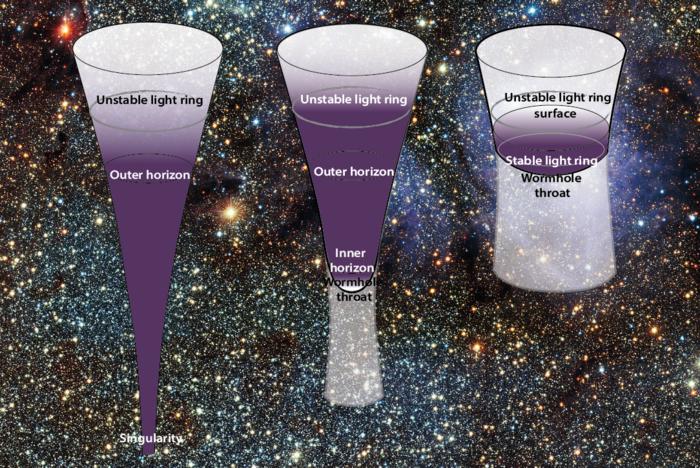
The discussion centers on three archetypal black hole models. The classical black hole retains both its defining feature, the event horizon, and the problematic singularity at its core. The second, known as the “regular black hole,” proposes a geometry that preserves the event horizon while removing the singularity, smoothing out the extremes of spacetime curvature through quantum effects. The third category, termed “black hole mimickers,” lacks both a singularity and an event horizon but mimics the observable features of classical black holes from an external viewpoint. These mimickers challenge the very definition of what constitutes a black hole and open fertile ground for both theoretical and observational exploration.
One promising avenue lies in the detailed analysis of photon rings and light-bending patterns around these objects. Black hole mimickers, due to the absence of a horizon, might produce intricate lensing features and photon trajectories that differ subtly but measurably from classical predictions. Additionally, gravitational waves emitted during the merger of such exotic objects could carry signatures of non-classical spacetimes, presenting as unexpected modulations or echoes in the waveforms. Furthermore, the presence or absence of thermal radiation from a horizonless surface provides another observational handle that may shed light on the fundamental nature of these bodies.
Looking forward, the interplay between theoretical advances and experimental breakthroughs will be crucial. Enhanced numerical simulations grounded in quantum gravity are expected to sharpen our predictions of signal characteristics unique to non-singular black holes. Innovations in telescope sensitivity, gravitational wave detectors, and multi-messenger astronomy will extend our observational reach into the intricate regimes where these effects become relevant. The maturation of this research domain promises a feedback loop whereby observation refines theory, progressively narrowing the landscape of plausible models until only those consistent with all data remain.
This line of inquiry is more than an esoteric theoretical quest; it has profound implications for the unification of physics. Black holes, as natural laboratories of extreme gravity and quantum effects, offer an unparalleled window into the elusive quantum theory of gravity. Success in developing a consistent, non-singular description of black hole interiors might provide the elusive bridge linking general relativity with quantum mechanics, two cornerstones currently at odds in their fundamental formulations. Such a breakthrough would mark a pivotal moment in our understanding of the universe at its most fundamental level.
Stefano Liberati, director of IFPU and one of the paper’s authors, aptly characterizes this era as the dawn of a vast and largely uncharted scientific landscape. The metaphor “Hic sunt leones” no longer signals an insurmountable barrier but instead maps the exciting new territories where mathematics, physics, and astronomy converge. The ongoing dialogue among experts, facilitated by collaborative workshops and interdisciplinary synthesis, will shape the contours of this emerging paradigm. The journey toward resolving the singularity conundrum is poised to redefine our conception of space, time, and gravity itself.
As we stand at this crossroads, it becomes evident that black hole research is entering an epoch of transformation. With the promise held by new models and the relentless advance of technological capabilities, the next decades may finally lift the veil on the inner workings of the universe’s darkest enigmas. The pursuit of a non-singular paradigm is not mere intellectual curiosity—it is a vital step towards a more complete, unified understanding of the cosmos, pushing the frontiers of human knowledge to unprecedented horizons.
—
Subject of Research: Black Hole Physics, Quantum Gravity, Non-singular Black Hole Models
Article Title: Towards a Non-singular Paradigm of Black Hole Physics
Image Credits: Sissa Medialab; Background image sourced from ESO/Cambridge Astronomical Survey Unit
Keywords
Black holes, Universe, Cosmology, Astrophysics, Theoretical astrophysics
Tags: black holes and general relativitychallenges in modern physicsEinstein’s theory of general relativityexploring cosmic frontiersfuture theories beyond black holesimplications of black hole singularitiesinfinities in physicsSchwarzschild solution explainedthe limits of classical physicsthe nature of spacetime curvatureunderstanding singularities in black holesunresolved questions in astrophysics