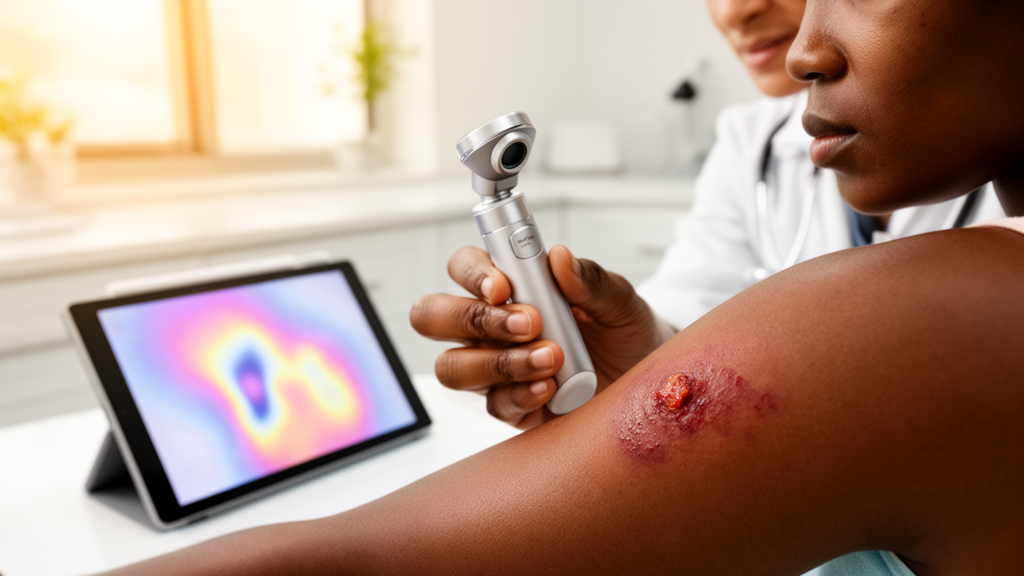
Artificial intelligence systems that can explain their own reasoning may offer a way to close a persistent and inequitable gap in the diagnosis of neglected tropical diseases that show themselves on the skin, according to a new structured narrative review published in BMC Artificial Intelligence. The review, led by David Chinaecherem Innocent and colleagues, synthesised peer-reviewed studies published between 2015 and 2025 on explainable AI approaches for distinguishing between skin-manifesting neglected tropical diseases, with a particular focus on people with darker skin tones, defined in the review as Fitzpatrick skin types IV to VI.
The central finding is sobering as well as promising. Deep learning models have achieved high diagnostic performance in dermatology, often reporting accuracy above 85 percent in controlled settings, but they consistently underperform in darker skin tones, with reported reductions of up to 20 percent. The review attributes these disparities largely to dataset imbalance, algorithmic bias and limited evaluation stratified by skin tone. Most publicly available dermatology image repositories have been constructed using data from high-income settings and predominantly light-skinned populations, so the models trained on them optimise performance for over-represented groups while generalising poorly to under-represented skin tones.
The diseases at stake are far from marginal. Skin-manifesting neglected tropical diseases include scabies, yaws, cutaneous leishmaniasis, Buruli ulcer and leprosy, conditions that disproportionately affect impoverished populations in tropical and subtropical regions and contribute to significant morbidity, disability and socioeconomic burden. These diseases commonly present with erythema, nodules, ulcers, plaques or papular eruptions, features that are neither pathognomonic nor disease-specific. Scabies may mimic atopic dermatitis or impetigo, early leprosy lesions are often mistaken for tinea or vitiligo, and cutaneous leishmaniasis and Buruli ulcer may both present as chronic, painless ulcers that normally require laboratory confirmation often unavailable in primary-care or rural settings.
The diagnostic challenge is compounded by visual overlap with non-NTD conditions such as fungal infections, bacterial pyodermas, eczema, psoriasis and insect-bite reactions, which frequently coexist in the same ecological and socioeconomic settings. In individuals with darker skin tones, erythema and inflammation are less visually conspicuous, further increasing the likelihood of misclassification. The review notes that large-scale evaluations of dermatology datasets have shown that classification accuracy, sensitivity and lesion localisation performance are consistently lower for Fitzpatrick skin types V to VI compared with types I to III, with reported accuracy differentials ranging from 5 percent to over 20 percent depending on task complexity and disease category. These disparities are particularly pronounced for inflammatory and infectious dermatoses.
It is precisely this visual, ambiguous character of skin-manifesting NTDs that makes them theoretically well suited for image-based AI diagnostics. Deep learning models, particularly convolutional neural networks, can automatically extract discriminative visual features such as colour gradients, texture irregularities and lesion boundaries directly from raw images, detecting subtle morphological patterns beyond human perception. Unlike laboratory-dependent diagnostics, AI systems trained on clinical images offer scalable decision support that can be deployed on smartphones or portable devices, addressing workforce shortages in endemic regions. Pilot studies targeting scabies, fungal infections and other visually driven skin diseases have achieved moderate to high classification accuracy even under variable image quality conditions, although earlier pilot investigations in the NTD domain reported only moderate classification accuracy of around 70 percent for multiple skin NTDs using convolutional neural networks trained on limited images from African populations, underscoring how nascent this field remains.
The review’s distinctive contribution lies in its focus on explainability rather than raw accuracy. Traditional black-box models provide little insight into how a decision was reached, making clinicians reluctant to trust or adopt these systems. Explainable AI techniques aim to make model reasoning interpretable by highlighting the features that contribute most to diagnostic predictions. Saliency maps have been applied across dermatological tasks to highlight lesion boundaries, colour heterogeneity and textural features, but their clinical utility remains contested, as saliency outputs can be noisy, unstable and sensitive to minor perturbations in input images. More robust techniques such as Gradient-weighted Class Activation Mapping, or Grad-CAM, and attention-based heatmaps have gained prominence, producing spatially coherent heatmaps that localise discriminative regions by weighting convolutional feature maps according to their contribution to a given class prediction. In dermatology, Grad-CAM has been shown to improve clinician trust by demonstrating whether models focus on clinically relevant lesion areas rather than background artefacts.
Beyond spatial explanations, the review highlights confidence scoring and decision visualisation as complementary components of explainability. Probability estimates, uncertainty quantification and confidence thresholds allow clinicians to assess the reliability of AI outputs and identify cases requiring referral or further investigation. This is particularly relevant in differential diagnosis of visually overlapping conditions, where overconfident yet incorrect predictions may carry significant clinical risk. The authors caution, however, that confidence scores are often poorly calibrated, and high confidence does not necessarily equate to correctness, especially in under-represented populations. Attention mechanisms extend the paradigm further by enabling models to learn where to attend within an image during training, embedding interpretability into the model architecture itself rather than applying it after the fact.
The review argues that explainability functions as a critical safeguard in differential diagnosis rather than a purely interpretive enhancement. Visual explanations such as Grad-CAM heatmaps enable clinicians to assess whether model attention is focused on clinically meaningful lesion characteristics, such as ulcer margins, scaling patterns or nodular architecture, rather than irrelevant background features. The stakes of misclassification are concrete: false positives may result in unnecessary antiparasitic or antibiotic treatment, contributing to adverse effects and antimicrobial resistance, while false negatives can delay treatment and increase transmission or disability risk. The review also notes that multi-class classification frameworks, which enable simultaneous differentiation among several plausible diagnoses, are better aligned with clinical reasoning than binary disease-versus-non-disease models, although they introduce greater susceptibility to misclassification when training data are imbalanced or phenotypically homogeneous.
Deployment in low- and middle-income countries brings its own set of practical constraints that the review examines in detail. Image quality variability, driven by inconsistent lighting conditions, diverse skin tones, camera limitations and non-standardised acquisition practices, can substantially degrade AI diagnostic accuracy, particularly for subtle lesions common in early-stage NTDs, necessitating robust preprocessing pipelines and quality-control mechanisms that flag unreliable inputs before inference. Many endemic regions experience intermittent or absent internet connectivity, so systems relying exclusively on cloud-based inference risk limited usability and inequitable access; on-device or edge-based inference has emerged as a pragmatic solution enabling real-time decision support while preserving data privacy and operational continuity, though it introduces computational constraints that must be balanced against model complexity and explainability requirements. Device heterogeneity adds another layer, since model performance may vary significantly across smartphones with different camera quality and processing power, and bias-aware evaluation across device classes is essential to ensure equitable performance. Meaningful impact, the authors argue, ultimately depends on integration into existing frontline workflows, with AI tools that support rather than replace health workers and provide actionable outputs such as referral guidance or confidence indicators.
The review’s implications reach into clinical practice, public health and policy. Clinically, transparent model reasoning through heatmaps, confidence scores and attention mechanisms could allow clinicians to critically appraise AI outputs rather than accept them uncritically, reducing over-reliance on automated systems, and improved diagnostic accuracy and transparency may reduce diagnostic delay and misclassification, which are known drivers of prolonged morbidity, disability and transmission in diseases such as leprosy and Buruli ulcer. At the population level, equitable diagnostic tools are described as essential for achieving global NTD elimination targets, since under-diagnosis in specific populations undermines surveillance accuracy and intervention effectiveness. On the research and policy front, the review calls for inclusive, skin-tone-diverse datasets and routine performance stratification in AI research, and argues that explainability should be treated as a regulatory requirement rather than merely a technical enhancement. The authors are candid about their own limitations: the search was restricted to English-language publications, the rapidly evolving field means some recent models or preprints may not have been captured, substantial heterogeneity in study design and reporting standards limited direct quantitative comparison, and the scarcity of NTD-specific AI studies constrained disease-specific performance estimates. As the authors conclude, explainability alone is insufficient without inclusive data, context-aware model design and integration into frontline workflows, but for skin-manifesting NTDs, where visual overlap, diagnostic delay and misclassification are common, explainable AI presents a uniquely valuable opportunity to improve diagnostic confidence, support non-specialist health workers and advance equitable care.
Subject of Research: Explainable AI for differential diagnosis of skin-manifesting neglected tropical diseases in darker skin tones
Article Title: Explainable AI for differential diagnosis of skin-manifesting neglected tropical diseases (NTDS) in darker skin tones
Article References: Innocent, D. C., Anyakorah, P. E., Innocent, R. C., Innocent, I. P., Chukwuocha, U. M., Dozie, I. N. S., Emerole, C. O., Moroh, J. E., George, T. C., Blessing, A.-A., Dozie, U. W., Anuwe, J. C., Nkemehule, F., Kourouma, I. K., Obani, S. I., Rabaan, A., & Damileye, A. T. (2026). Explainable AI for differential diagnosis of skin-manifesting neglected tropical diseases (NTDS) in darker skin tones. BMC Artificial Intelligence, 2(1), Article 15. https://doi.org/10.1186/s44398-026-00033-w
Image Credits: AI Generated
DOI: 10.1186/s44398-026-00033-w
Keywords: explainable AI, neglected tropical diseases, dermatology, algorithmic bias, darker skin tones, Grad-CAM, differential diagnosis, deep learning, LMIC health systems, dataset diversity, skin of colour, medical imaging
News Source: Blake Davidson. (October 28, 2026). Explainable AI Could Help Diagnose Neglected Tropical Diseases in Darker Skin, Review Finds. Scienmag.