


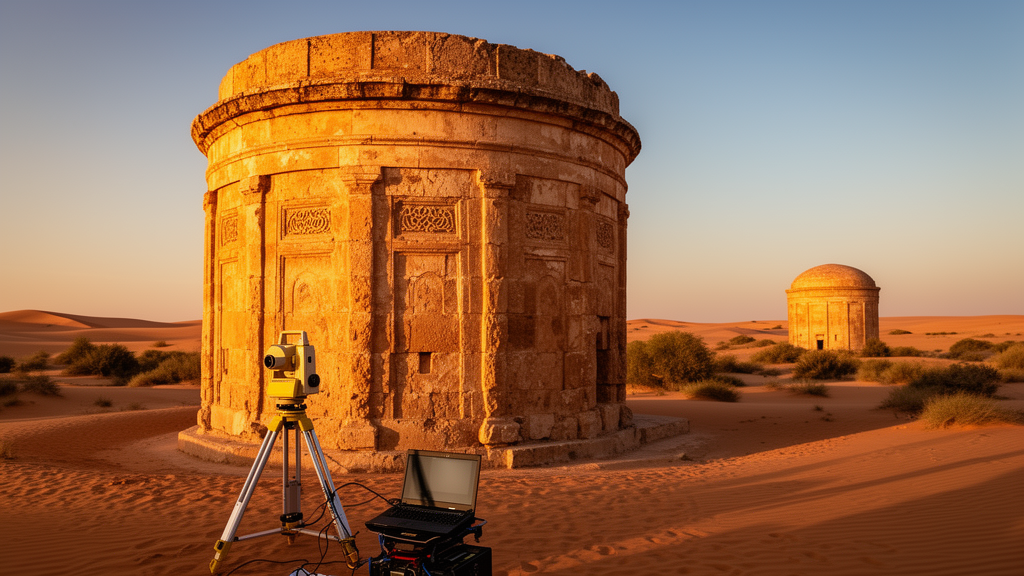
Three domed mausoleums at the Gazouli Zaouia in Sidi Ouriache, in the Algerian province of Tlemcen, share far more geometry than their differing facades suggest. Using terrestrial photogrammetry, researchers built metric three-dimensional models of the tombs of a founding imam, his son, and his grandson, extracted orthographic plans and sections, and compared dimensionless ratios across the corpus. The comparison yielded an overall geometric compatibility of approximately 86.3 percent, with pairwise values exceeding 84 percent in all cases, indicating a shared funerary grammar transmitted across three generations of the Gazouli lineage.
The study, published in the journal Built Heritage, addresses a documentation gap that its authors say is widespread in Algeria. Scholarship on saintly mausoleums there has remained predominantly historical, religious, and anthropological, while metrically controlled architectural comparison and heritage-oriented digital documentation have been extremely limited. To the authors’ knowledge, no metrically controlled comparative architectural corpus had previously been established for the Gazouli mausoleums themselves. The deficit, they argue, hampers the establishment of reliable conservation baselines and complicates the interpretation of later repairs and transformations at an active funerary complex that still structures local devotional memory.
The Gazouliya Sufi order, part of the wider Maghrebi al-Shadhiliyya tradition, was founded by Sheikh Muhammad ibn Suleyman al-Ghazuli. Its zaouia in Sidi Ouriache developed as an important religious centre in western Algeria, where spiritual formation, charitable activity, and funerary commemoration remained closely intertwined. Over generations, the lineage built three funerary mausoleums dedicated respectively to the founder, his son, and his grandson. Because the three buildings belong to the same devotional lineage and occupy the same sacred complex, differences among them can be read as controlled variation within a shared ritual and commemorative framework rather than as unrelated site conditions.
The technical workflow combined photogrammetric acquisition, metric model generation, orthographic extraction, controlled measurement, and ratio-based comparison. Because aerial acquisition was prohibited for safety reasons, all photographs were captured from the ground with a Canon EOS 1200D digital SLR camera and processed in Agisoft Metashape Professional 2.1.2 through a standard Structure-from-Motion and Multi-View Stereo workflow. The projects were processed in local metric coordinates and scaled using field-based scale bars and markers. The final datasets included 315 cameras, 8 markers, and 2 scale bars for Gazouli 1; 231 cameras, 6 markers, and 2 scale bars for Gazouli 2; and 153 cameras, 8 markers, and 3 scale bars for Gazouli 3, with camera optimisation sigma values of 0.1907, 0.1267, and 0.1653 respectively.
The authors are explicit about the accuracy limits of their data. Because no independent checkpoint network was available, the sigma values are reported as internal processing indicators rather than absolute accuracy measures, and the proportional analysis is interpreted at the level of architectural tendency and relative comparability, not as a millimetric deformation assessment. Because the internal chambers are not perfectly regular, repeated orthographic measurements were taken and expressed as average wall-to-wall values. The authors also stress that their models are static, photogrammetry-derived metric records rather than operational Digital Twins: they involve no real-time updating, bidirectional data flow, sensor-based monitoring, or simulation capacity, though they are structured for future conservation-oriented reuse.
The proportional analysis rested on three operational hypotheses: that the funerary core should show lower proportional variation than the external envelope; that the strongest differences should affect envelope articulation and surface treatment rather than the tomb and chamber; and that, if a golden-ratio logic were relevant, some principal ratios should approximate phi = 1.618 within a tolerance of plus or minus 5 percent. The measured ratios covered overall compactness, burial-chamber regulation, wall-to-dome articulation, and the position of the funerary core within the envelope. None of the principal planimetric or volumetric ratios fell within the tolerance, so the dataset does not support a Golden Ratio interpretation; the corpus is instead read through compact funerary organisation and intergenerational core stability.
The measured values trace a clear lineage sequence. Mausoleum 01, the founder’s tomb, shows a moderately elongated footprint with an external length-to-width ratio of 1.16, a near-square funerary chamber at 0.94, and the strongest vertical emphasis in the corpus, with total height to external width at 1.02. Mausoleum 02, the son’s, marks the phase of greatest architectural amplification, with an almost square external footprint at 0.92, a more differentiated chamber ratio of 0.78, and reduced vertical emphasis at 0.87, alongside zellij decoration and more articulated volumes. Mausoleum 03, the grandson’s, is the most regularised: a near-square footprint at 0.95, an almost perfectly square burial chamber at 1.00, and a proportionally larger chamber within the envelope, occupying 0.85 of external length and 0.81 of external width.
Descriptive statistics reinforce the core-envelope distinction. The most stable indicators across the corpus are the interior vertical relation, with a coefficient of variation of 1.0 percent, and tomb proportion, at 1.8 percent, supporting the interpretation that the strongest continuity concerns the funerary core. The most variable indicator is the chamber length-to-external length relation, at 26.7 percent, mainly because Mausoleum 03 presents a proportionally larger burial chamber within a simplified envelope. External footprints remain close to square, with length-to-width values ranging only from 0.92 to 1.16. The authors note that, given the limited size of the corpus, the analysis uses descriptive statistics to identify within-corpus regularity and does not claim statistical generalisation or proof of a universal proportional canon.
Culturally, the three mausoleums are treated not as isolated objects but as material supports of lineage memory, saintly commemoration, visitation, and local recognition. The authors frame their cultural reading as contextual inference: the measurements demonstrate recurrence, stability, and variation, but do not by themselves prove symbolic intention, cosmological doctrine, or a fixed proportional canon. Because no direct archival accounts have yet been identified for the Gazouli mausoleums, explanations involving differential decorative investment, changing commemorative emphasis, or later repair histories, informed by broader Maghrebi and Ottoman evidence on Habous and Waqf endowments, are presented as plausible contextual hypotheses rather than established facts. Visible plaster repairs and simplified mouldings at Mausoleum 03, for instance, suggest that part of its present state may reflect later upkeep rather than original design intention alone.
The workflow’s transferable contribution lies in the protocol rather than typological conclusions. The authors propose it as a reproducible comparative method for coherent heritage corpora, such as rural mausoleum groups, zawiya complexes, small domed shrines, or vernacular religious buildings sharing comparable function, scale, construction logic, or ritual use, where archival documentation is scarce. The results support four concrete heritage uses: conservation baselines identifying the stable burial core as an inherited invariant; risk-aware documentation focusing future surveys on envelope zones more likely to record cracks, plaster loss, or deformation; educational exercises in extracting measurements and comparing ratios from digital records; and cultural valorisation through annotated 3D models, exhibition panels, and digital storytelling presenting the mausoleums as a genealogical and devotional ensemble. Future work, the authors conclude, should extend the corpus and test the observed invariants against a broader range of Algerian vernacular mausoleums.
Subject of Research: Metric documentation and proportional analysis of three lineage mausoleums at the Gazouli Zaouia in Algeria
Article Title: Photogrammetry-derived metric documentation and proportional analysis of the Gazouli Zaouia lineage mausoleums in Sidi Ouriache, Algeria
Article References: Kawther, B., Nadir, A. K., Monia, B., & Kaouther, B. N. (2026). Photogrammetry-derived metric documentation and proportional analysis of the Gazouli Zaouia lineage mausoleums in Sidi Ouriache, Algeria. Built Heritage, 10(1), Article 63. https://doi.org/10.1186/s43238-026-00306-3
Image Credits: AI Generated
DOI: 10.1186/s43238-026-00306-3
Keywords: photogrammetry, Algeria, Built Heritage, funerary architecture, zawiya, digital heritage, proportional analysis, conservation, vernacular architecture, 3D documentation, Tlemcen, mausoleums
News Source: Denise Maddox. (October 29, 2026). Photogrammetry Reveals Shared Geometric Grammar in Three Algerian Lineage Mausoleums. Scienmag.



