• HOME
  • NEWS
  • EXPLORE
    • CAREER
      • Companies
      • Jobs
    • EVENTS
    • iGEM
      • News
      • Team
    • PHOTOS
    • VIDEO
    • WIKI
  • BLOG
  • COMMUNITY
    • FACEBOOK
    • INSTAGRAM
    • TWITTER
Monday, May 11, 2026
BIOENGINEER.ORG
No Result
View All Result
  • Login
  • HOME
  • NEWS
  • EXPLORE
    • CAREER
      • Companies
      • Jobs
        • Lecturer
        • PhD Studentship
        • Postdoc
        • Research Assistant
    • EVENTS
    • iGEM
      • News
      • Team
    • PHOTOS
    • VIDEO
    • WIKI
  • BLOG
  • COMMUNITY
    • FACEBOOK
    • INSTAGRAM
    • TWITTER
  • HOME
  • NEWS
  • EXPLORE
    • CAREER
      • Companies
      • Jobs
        • Lecturer
        • PhD Studentship
        • Postdoc
        • Research Assistant
    • EVENTS
    • iGEM
      • News
      • Team
    • PHOTOS
    • VIDEO
    • WIKI
  • BLOG
  • COMMUNITY
    • FACEBOOK
    • INSTAGRAM
    • TWITTER
No Result
View All Result
Bioengineer.org
No Result
View All Result
Home NEWS Science News Chemistry

Experimental device generates electricity from the coldness of the universe

Bioengineer by Bioengineer
May 6, 2019
in Chemistry
Reading Time: 3 mins read
0
IMAGE
Share on FacebookShare on TwitterShare on LinkedinShare on RedditShare on Telegram

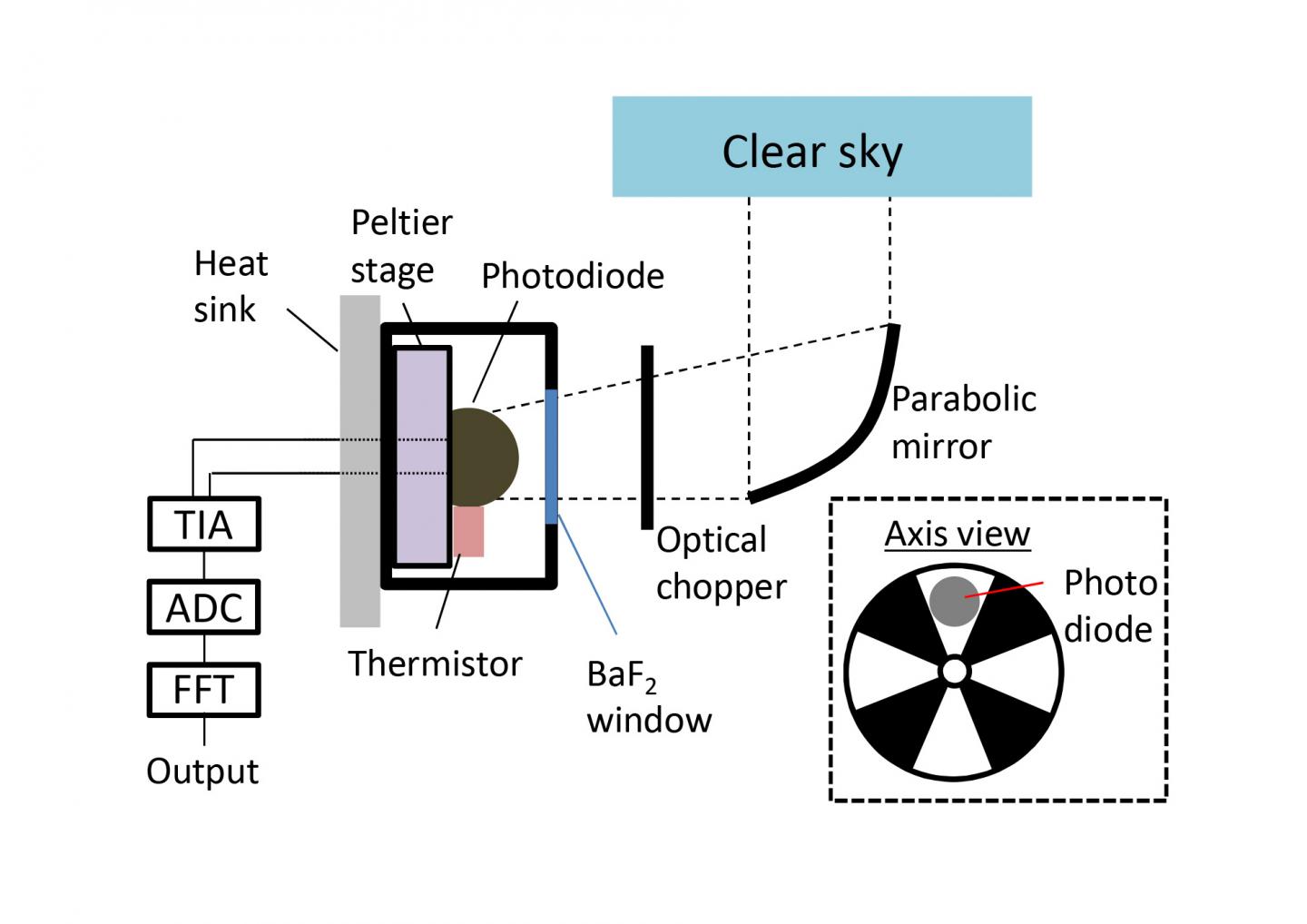
Using an infrared photodiode pointed to the sky, a new device harvests energy from the temperature difference between Earth and near absolute zero temperatures of deep space.
IMAGE

Credit: Masashi Ono

WASHINGTON, D.C., May 6, 2019 — The obvious drawback of solar panels is that they require sunlight to generate electricity. Some have observed that for a device on Earth facing space, which has a frigid temperature, the chilling outflow of energy from the device can be harvested using the same kind of optoelectronic physics we have used to harness solar energy. New work, in a recent issue of Applied Physics Letters, from AIP Publishing, looks to provide a potential path to generating electricity like solar cells but that can power electronics at night.

An international team of scientists has demonstrated for the first time that it is possible to generate a measurable amount of electricity in a diode directly from the coldness of the universe. The infrared semiconductor device faces the sky and uses the temperature difference between Earth and space to produce the electricity.

“The vastness of the universe is a thermodynamic resource,” said Shanhui Fan, an author on the paper. “In terms of optoelectronic physics, there is really this very beautiful symmetry between harvesting incoming radiation and harvesting outgoing radiation.”

In contrast to leveraging incoming energy as a normal solar cell would, the negative illumination effect allows electrical energy to be harvested as heat leaves a surface. Today’s technology, though, does not capture energy over these negative temperature differences as efficiently.

By pointing their device toward space, whose temperature approaches mere degrees from absolute zero, the group was able to find a great enough temperature difference to generate power through an early design.

“The amount of power that we can generate with this experiment, at the moment, is far below what the theoretical limit is,” said Masashi Ono, another author on the paper.

The group found that their negative illumination diode generated about 64 nanowatts per square meter, a tiny amount of electricity, but an important proof of concept, that the authors can improve on by enhancing the quantum optoelectronic properties of the materials they use.

Calculations made after the diode created electricity showed that, when atmospheric effects are taken into consideration, the current device can theoretically generate almost 4 watts per square meter, roughly one million times what the group’s device generated and enough to help power machinery that is required to run at night.

By comparison, today’s solar panels generate 100 to 200 watts per square meter.

While the results show promise for ground-based devices directed to the sky, Fan said the same principle could be used to recover waste heat from machines. For now, he and his group are focusing on improving their device’s performance.

###

The article, “Experimental demonstration of energy harvesting from sky using the negative illumination effect of a semiconductor photodiode,” is authored by Masashi Ono, Parthiban Santhanam, Wei Li, Bo Zhao and Shanhui Fan. The article appeared in Applied Physics Letters on April 23, 2019 (DOI: 10.1063/1.5089783). It can be accessed at http://aip.scitation.org/doi/10.1063/1.5089783.

Media Contact
Wendy Beatty
[email protected]

Related Journal Article

http://dx.doi.org/10.1063/1.5089783

Tags: Chemistry/Physics/Materials SciencesClimate ChangeEarth ScienceElectrical Engineering/ElectronicsEnergy SourcesEnergy/Fuel (non-petroleum)MaterialsTechnology/Engineering/Computer ScienceTemperature-Dependent Phenomena
Share12Tweet8Share2ShareShareShare2

Related Posts

Miniature Sensor Uses Light to Detect Touch — Chemistry

Miniature Sensor Uses Light to Detect Touch

May 8, 2026
Iron Minerals Determine Whether Dissolved Organic Matter Fuels Microbes or Becomes Long-Term Carbon Storage — Chemistry

Iron Minerals Determine Whether Dissolved Organic Matter Fuels Microbes or Becomes Long-Term Carbon Storage

May 8, 2026

Kate Evans Appointed Associate Lab Director for Biological and Environmental Systems Science at ORNL

May 8, 2026

Advancing Multiscale Modeling and Overcoming Operational Challenges in Autothermal COâ‚‚-to-Methanol Reactors

May 8, 2026
Please login to join discussion

POPULAR NEWS

  • Research Indicates Potential Connection Between Prenatal Medication Exposure and Elevated Autism Risk

    840 shares
    Share 336 Tweet 210
  • New Study Reveals Plants Can Detect the Sound of Rain

    727 shares
    Share 290 Tweet 181
  • Salmonella Haem Blocks Macrophages, Boosts Infection

    61 shares
    Share 24 Tweet 15
  • Breastmilk Balances E. coli and Beneficial Bacteria in Infant Gut Microbiomes

    57 shares
    Share 23 Tweet 14

About

We bring you the latest biotechnology news from best research centers and universities around the world. Check our website.

Follow us

Recent News

New Post-Hoc Analysis Explores Daily Oral Orforglipron Use in Adults Over 65 with Obesity, Regardless of Diabetes Status

Evaluating Digoxin Use in Patients with Symptomatic Rheumatic Heart Disease

Evaluating the Effectiveness and Safety of Digitalis Glycosides in Treating Heart Failure

Subscribe to Blog via Email

Enter your email address to subscribe to this blog and receive notifications of new posts by email.

Join 82 other subscribers
  • Contact Us

Bioengineer.org © Copyright 2023 All Rights Reserved.

Welcome Back!

Login to your account below

Forgotten Password?

Retrieve your password

Please enter your username or email address to reset your password.

Log In
No Result
View All Result
  • Homepages
    • Home Page 1
    • Home Page 2
  • News
  • National
  • Business
  • Health
  • Lifestyle
  • Science

Bioengineer.org © Copyright 2023 All Rights Reserved.