The exosomes were secreted by cardiac cells derived from human induced pluripotent stem cells. These non-living exosomes may be an easier form of regenerative treatment than living cells.
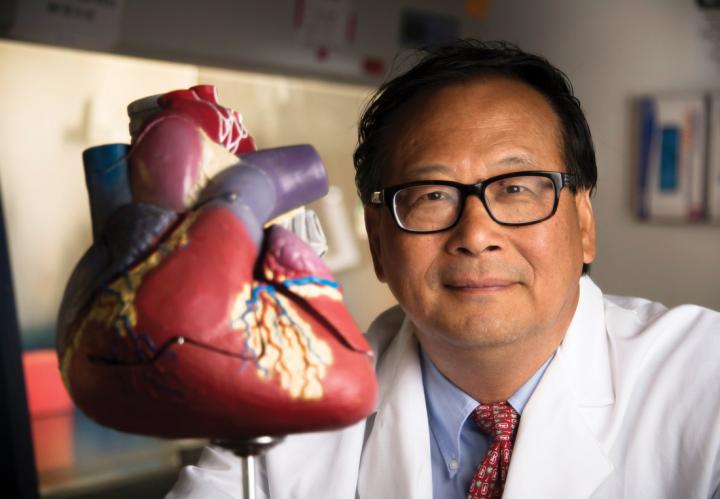
Credit: UAB
BIRMINGHAM, Ala. – Science has long known that recovery from experimental heart attacks is improved by injection of a mixture of heart muscle cells, endothelial cells and smooth muscle cells, yet results have been limited by poor engraftment and retention, and researchers worry about potential tumorigenesis and heart arrhythmia.
Now research in pigs shows that using the exosomes naturally produced from that mixture of heart muscle cells, endothelial cells and smooth muscle cells — which were all derived from human induced pluripotent stem cells — yields regenerative benefits equivalent to the injected human induced pluripotent stem cell-cardiac cells, or hiPSC-CCs.
Exosomes are membrane-bound extracellular vesicles that contain biologically active proteins, RNAs and microRNAs. Exosomes are well known to participate in cell-to-cell communication, and they are actively studied as potential clinical therapies.
“The hiPSC-CC exosomes are acellular and, consequently, may enable physicians to exploit the cardioprotective and reparative properties of hiPSC-derived cells while avoiding the complexities associated with tumorigenic risks, cell storage, transportation and immune rejection,” said Ling Gao, Ph.D., and Jianyi “Jay” Zhang, M.D., Ph.D., University of Alabama at Birmingham corresponding authors of the study, published in Science Translational Medicine. “Thus, exosomes secreted by hiPSC-derived cardiac cells improved myocardial recovery without increasing the frequency of arrhythmogenic complications and may provide an acellular therapeutic option for myocardial injury.”
At UAB, Gao was a postdoctoral fellow in Biomedical Engineering, a joint department of the UAB School of Medicine and the UAB School of Engineering. Zhang is chair of the department.
Studies in large animals are necessary to identify, characterize and quantify responses to potential treatments. Prior to this current study, the feasibility of hiPSC-CC exosomes for cardiac therapy had been shown only in mouse models and in vitro work.
In the UAB experiments, juvenile pigs with experimental heart attacks had one of three treatments injected into the damaged myocardium: 1) a mixture of cardiomyocytes, endothelial cells and smooth muscle cells derived from human induced pluripotent stem cells, 2) exosomes extracted from the three cell types, or 3) homogenized fragments from the three cell types.
The researchers had two primary findings from the pig studies. First, they found that measurements of left-ventricle function, infarct size, wall stress, cardiac hypertrophy, apoptosis and angiogenesis in animals treated with hiPSC-CCs, hiPSC-CC fragments or hiPSC-CC exosomes were similar and significantly improved compared to animals that recovered without any of the three experimental treatments. Second, they found that exosome therapy did not increase the frequency of arrhythmia.
In experiments with cells or aortic rings grown in culture, they found that exosomes produced by hiPSC-CCs promoted blood vessel growth in cultured endothelial cells and isolated aortic rings. Furthermore, the exosomes protected cultured hiPSC-cardiomyocytes from the cytotoxic effects of serum-free low-oxygen media by reducing the programmed cell death called apoptosis and by maintaining intracellular calcium homeostasis, which has a direct beneficial effect on heart conductivity. The exosomes also increased cellular ATP content, which is beneficial since deficiencies in cellular ATP metabolism are believed to contribute to the progressive decline in heart function for patients with left ventricle hypertrophy and heart failure.
The researchers also found that some of these in vitro beneficial effects could also be mediated by synthetic mimics of the 15 most abundant microRNAs found in the hiPSC-CC exosomes. The researchers noted that knowledge of the potential role of microRNAs in clinical applications is still far from complete.
###
Co-authors with Gao and Zhang for the study, “Exosomes secreted by hiPSC-derived cardiac cells improve recovery from myocardial infarction in swine,” are Lu Wang, Yuhua Wei, Prasanna Krishnamurthy, Gregory P. Walcott and Philippe Menasché, UAB Department of Biomedical Engineering. Menasché also has an appointment at the Université de Paris, France. Gao is now at Tongji University School of Medicine, Shanghai, China.
Support came from National Institutes of Health grants HL95077, HL114120, HL131017, HL138023, HL149137 and HL134764.
At UAB, Zhang holds the T. Michael and Gillian Goodrich Endowed Chair of Engineering Leadership.
Media Contact
Jeff Hansen
[email protected]
Original Source
https:/
Related Journal Article
http://dx.