• HOME
  • NEWS
  • EXPLORE
    • CAREER
      • Companies
      • Jobs
    • EVENTS
    • iGEM
      • News
      • Team
    • PHOTOS
    • VIDEO
    • WIKI
  • BLOG
  • COMMUNITY
    • FACEBOOK
    • INSTAGRAM
    • TWITTER
Friday, May 15, 2026
BIOENGINEER.ORG
No Result
View All Result
  • Login
  • HOME
  • NEWS
  • EXPLORE
    • CAREER
      • Companies
      • Jobs
        • Lecturer
        • PhD Studentship
        • Postdoc
        • Research Assistant
    • EVENTS
    • iGEM
      • News
      • Team
    • PHOTOS
    • VIDEO
    • WIKI
  • BLOG
  • COMMUNITY
    • FACEBOOK
    • INSTAGRAM
    • TWITTER
  • HOME
  • NEWS
  • EXPLORE
    • CAREER
      • Companies
      • Jobs
        • Lecturer
        • PhD Studentship
        • Postdoc
        • Research Assistant
    • EVENTS
    • iGEM
      • News
      • Team
    • PHOTOS
    • VIDEO
    • WIKI
  • BLOG
  • COMMUNITY
    • FACEBOOK
    • INSTAGRAM
    • TWITTER
No Result
View All Result
Bioengineer.org
No Result
View All Result
Home NEWS Science News Chemistry

Exciting tweaks for organic solar cells

Bioengineer by Bioengineer
March 5, 2020
in Chemistry
Reading Time: 2 mins read
0
IMAGE
Share on FacebookShare on TwitterShare on LinkedinShare on RedditShare on Telegram

Molecular changes could improve the efficiency of next-generation photovoltaics
IMAGE

Credit: Illustration by Mindy Takamiya


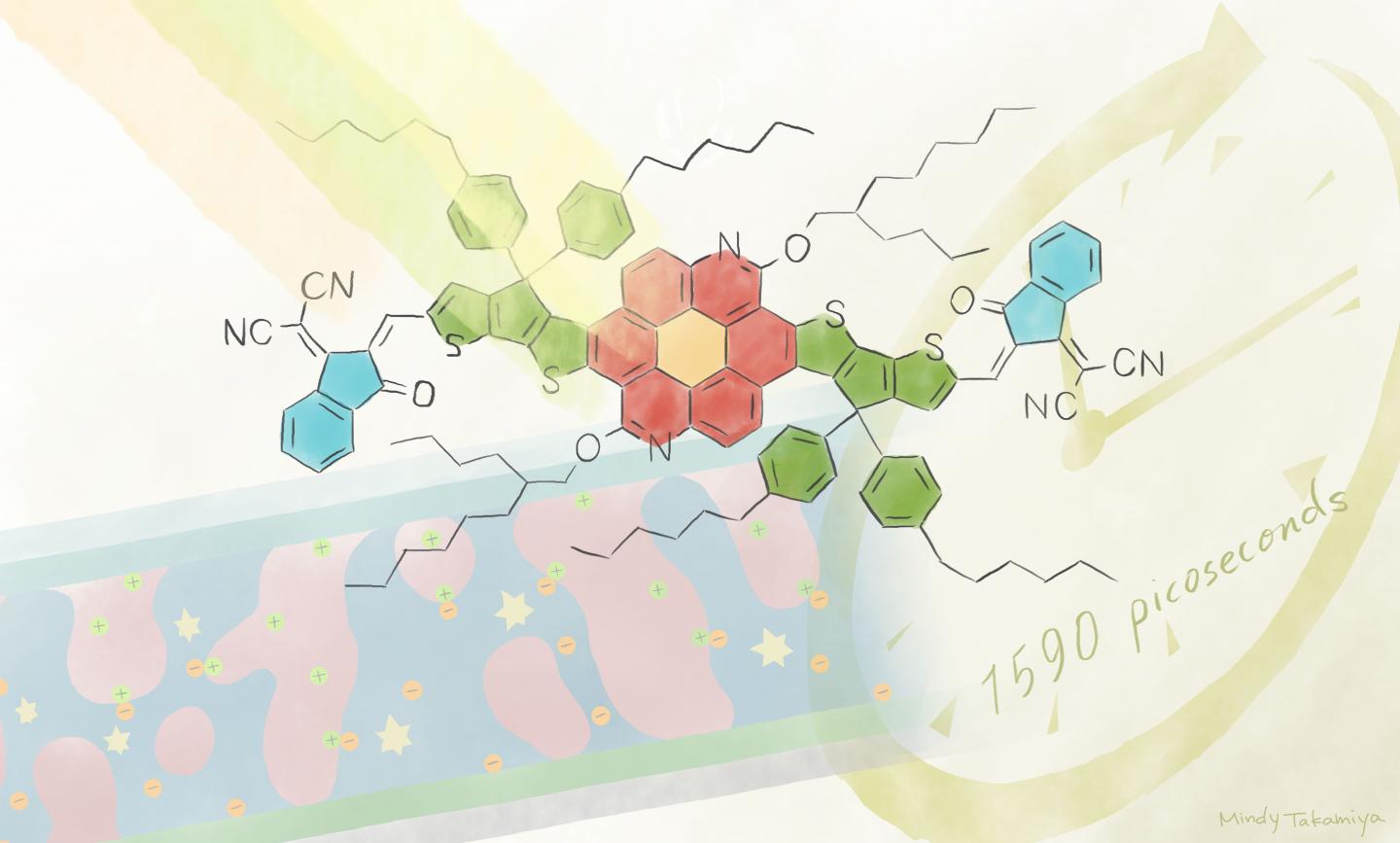
A molecular tweak has improved organic solar cell performance, bringing us closer to cheaper, efficient, and more easily manufactured photovoltaics. The new design approach, targeting the molecular backbone of the cell’s power-generating layer, was developed by scientists at Kyoto University’s Institute for Integrated Cell-Material Sciences (iCeMS) and published in the journal Chemical Science.

Organic photovoltaics are expected to become the next generation of solar cells as they use cheaper components, and are more lightweight, flexible and easily manufactured compared to currently used inorganic solar cells.

“There is growing concern over the use of fossil fuels and their environmental impacts,” says Hiroshi Imahori, a molecular engineer at iCeMS who led the work with colleague Tomokazu Umeyama. “We need to work hard to improve sustainable energy systems.”

The power-generating layer in organic photovoltaics contains molecules that either donate or accept electrons. Light is absorbed by this thin layer, exciting the molecules, which generate charges that go on to form an electric current. But for light to be efficiently converted to electricity, the electron-accepting component needs to stay excited.

One type of organic cell is very good at absorbing a broad spectrum of light, but doesn’t stay excited for long. To try to address this, Imahori, Umeyama and their colleagues in Japan targeted the molecular backbone of the cell’s electron-accepting component. Specifically, they replaced a central ring with a molecule called thienoazacoronene, creating a new molecule called TACIC.

Similar to its predecessor, TACIC absorbed a broad spectrum of visible and near-infrared light. Significantly, it maintained its excited state 50 times longer, converting more than 70% of light particles into current. The design achieved this by stabilizing the vibration and rotation that normally occur when light is absorbed, saving kinetic energy and facilitating intermolecular interaction.

The cell continues to have a power conversion efficiency of just under 10%, which is comparable to other organic solar cells being researched. The team believes modifications to the side chains and core structure of the thienoazacoronene molecule could further improve the efficiency of organic photovoltaics.

###

DOI: 10.1039/C9SC06456G

About Kyoto University’s Institute for Integrated Cell-Material Sciences (iCeMS):

At iCeMS, our mission is to explore the secrets of life by creating compounds to control cells, and further down the road to create life-inspired materials.

https://www.icems.kyoto-u.ac.jp/

For more information, contact:

I. Mindy Takamiya/Mari Toyama

[email protected]

Media Contact
I. Mindy Takamiya
[email protected]
81-757-539-764

Related Journal Article

http://dx.doi.org/10.1039/C9SC06456G

Tags: Chemistry/Physics/Materials SciencesEnergy SourcesEnergy/Fuel (non-petroleum)Industrial Engineering/ChemistryMaterials
Share12Tweet8Share2ShareShareShare2

Related Posts

New Drexel Study Reveals Key to Keeping Students on Track in Physics Learning — Chemistry

New Drexel Study Reveals Key to Keeping Students on Track in Physics Learning

May 15, 2026
Reversible Glue Technology Powers Up with Electric Activation — Chemistry

Reversible Glue Technology Powers Up with Electric Activation

May 15, 2026

Sweet as Honey: Unveiling a New Heat Transport Regime in Ultrathin Semiconductors

May 15, 2026

High-Precision Boltzmann Luminescent Nanothermometry Achieved Through Predictive Rules

May 15, 2026
Please login to join discussion

POPULAR NEWS

  • Research Indicates Potential Connection Between Prenatal Medication Exposure and Elevated Autism Risk

    843 shares
    Share 337 Tweet 211
  • New Study Reveals Plants Can Detect the Sound of Rain

    730 shares
    Share 291 Tweet 182
  • Salmonella Haem Blocks Macrophages, Boosts Infection

    62 shares
    Share 25 Tweet 16
  • Breastmilk Balances E. coli and Beneficial Bacteria in Infant Gut Microbiomes

    58 shares
    Share 23 Tweet 15

About

We bring you the latest biotechnology news from best research centers and universities around the world. Check our website.

Follow us

Recent News

Testing Reverse Osmosis Systems for Microbial Safety

Feeding Risks for Extremely Preterm Infants: Timing vs. Amount

Revolutionizing Gastro-Oesophageal Adenocarcinoma Treatment: Progress and Prospects

Subscribe to Blog via Email

Enter your email address to subscribe to this blog and receive notifications of new posts by email.

Join 82 other subscribers
  • Contact Us

Bioengineer.org © Copyright 2023 All Rights Reserved.

Welcome Back!

Login to your account below

Forgotten Password?

Retrieve your password

Please enter your username or email address to reset your password.

Log In
No Result
View All Result
  • Homepages
    • Home Page 1
    • Home Page 2
  • News
  • National
  • Business
  • Health
  • Lifestyle
  • Science

Bioengineer.org © Copyright 2023 All Rights Reserved.