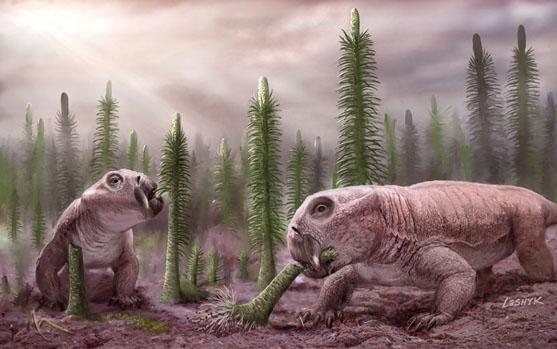
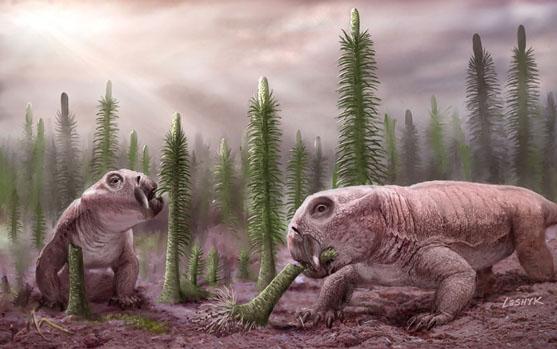
Credit: Victor O. Leshyk, website: victorleshyk.com
Mass extinctions were followed by periods of low diversity in which certain new species dominated wide regions of the supercontinent Pangaea, reports a new study.
The findings, published in Nature Communications, indicate that mass extinctions may have predictable consequences and provide insights into how biological communities may be expected to change in the future as a result of current high extinction rates.
Mass extinctions are thought to produce 'disaster faunas', communities dominated by a small number of widespread species. However, studies to test this theory have been rare and limited in scope, such as being focused on small regions.
The researchers, from the University of Birmingham (UK), North Carolina State University (USA), University of Leeds (UK) and CONICET?Museo Argentino de Ciencias Naturales (Argentina) assessed long-term changes in biodiversity in the supercontinent Pangaea. They analysed changes in nearly 900 animal species between approximately 260 million and 175 million years ago (spanning the late Permian to Early Jurassic). This period witnessed two mass extinctions and the origins of dinosaurs and many modern vertebrate groups.
These extinction events were very important in shaping the evolutionary history of life. The end-Permian event wiped out many of the groups which dominated life on land at the time. By doing so, it freed up ecological niches and allowed new groups to evolve, including the earliest dinosaurs, crocodiles and relatives of mammals and lizards. The end-Triassic event then again wiped-out many major groups, helping to set the stage for the dinosaurs to take over.
The team compared the similarity of animal communities from different regions of the globe based both on which species they shared, and how closely related the species from one region were to those from other regions. This allowed them to calculate the overall similarity of faunas from across the globe through time – the "Biogeographic connectedness".
David Button, a postdoctoral researcher at North Carolina State University and the resident Brimley Scholar at the NC museum of Natural Sciences said, "These results show that, after both mass extinctions, biological communities not only lost a large number of species, but also became dominated by widespread, newly-evolving species, leading to low diversity across the globe. These common patterns suggest that mass extinctions have predictable influences on animal distributions and may have the potential to guide modern conservation efforts."
Richard Butler, Professor of Palaeobiology at the University of Birmingham, said, "Mass extinctions were global disasters that fundamentally reshaped ecosystems. Our new analyses provide crucial data that show just how profoundly these cataclysmic events changed and influenced animal distribution.
Martín Ezcurra, Researcher of the Museo Argentino de Ciencias Naturales, said, "The fossil record has the potential to test evolutionary hypotheses in long time spans, which is not possible if evolutionary researches all limited to living plant and animals. This study allows understanding better how macroevolutionary patters developed in the deep time and may help to predict large-scale ecological changes in the short term".
Due to human activity, we are currently in the sixth mass extinction. There are already concerns that humans are driving global faunas to become more homogenous as a result of landscape simplification, increasing temperatures and introduction of exotic species. This study identifies an additional contributor to this risk, as ongoing biodiversity loss will be expected to result in a "disaster fauna" of more similar species across the globe.
###
Media Contact
Luke Harrison
[email protected]
@unibirmingham
http://www.bham.ac.uk
Related Journal Article
http://dx.doi.org/10.1038/s41467-017-00827-7