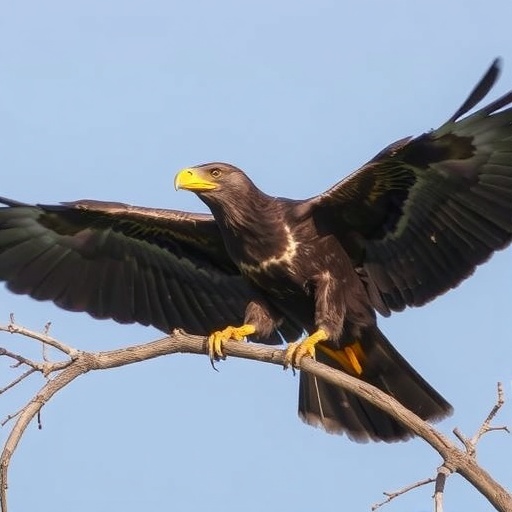
Europe’s Iconic Common Buzzard Sheds Light on Complexities of Avian Color Variation
The common buzzard (Buteo buteo) stands as one of Europe’s most ubiquitous birds of prey, recognized for its distinctive hunting behaviors and strikingly diverse plumage. Known in French as the “buse variable,” this nomenclature aptly captures the extraordinary variation in its feather coloration, which historically has perplexed birdwatchers and ornithologists alike. Recent large-scale scientific investigation led by the Max Planck Institute for Biological Intelligence, leveraging an expansive database of citizen-science contributions, has produced the first comprehensive continental mapping of buzzard coloration patterns and their temporal shifts, unveiling intricate ecological and evolutionary dynamics at play.
In the realm of animal biology, coloration is a multifaceted trait influenced by myriad factors, including camouflage, thermoregulation, and sexual selection. These evolutionary pressures often manifest as geographically structured color adaptations within species. For instance, darker pigmentation may confer advantages in colder climates due to enhanced solar heat absorption, while lighter hues provide camouflage in open or less vegetated landscapes. However, these broad ecological theories have yet to be rigorously tested in the common buzzard, a species whose phenotypic variation challenges traditional paradigms.
Delving into nearly two decades of meticulously compiled observational data, researchers analyzed approximately 100,000 records from diverse sources, ranging from dedicated portals designed for systematic buzzard color scoring to thousands of public-contributed photographs hosted on platforms like iNaturalist and Ornitho.it. The color of individual birds was assessed on a nuanced seven-point continuum, from pale to dark, allowing for a detailed spatio-temporal analysis. This extensive dataset was then integrated with high-resolution satellite-derived environmental variables encompassing climate metrics, vegetation indices, and soil characteristics.
Contrary to anticipated ecological correlations, the researchers observed that widely accepted environmental models accounted for only a modest fraction of the variability in buzzard coloration. Notably, lighter-colored buzzards were more prevalent in the colder climes of northern and central Europe, diverging from the expected pattern of darker forms predominating in such regions. Conversely, darker morphs clustered primarily in southwestern Europe, especially Brittany and the Iberian Peninsula. Intermediate phenotypes, neither distinctly light nor dark, were most frequent in southeastern Europe and the British Isles, constructing a complex geographical mosaic that defied straightforward classification.
These findings propel alternative hypotheses regarding the evolutionary underpinnings of buzzard color variation. Genetic inheritance patterns appear to heavily influence color traits, suggesting that the present spatial distributions may reflect historical recolonization routes postdating the Last Glacial Maximum. Such legacy effects imply that population genetic structure, shaped by glacial refugia and subsequent range expansions, plays a pivotal role in shaping phenotypic diversity. Additionally, unmeasured ecological variables—such as interspecific interactions or microhabitat preferences—might further modulate color expression.
A groundbreaking aspect of the study lies in its identification of temporal trends over the past two decades. Data revealed an increasing predominance of intermediate-colored buzzards within the European population, accompanied by a noticeable decline in the frequency of both exceedingly light and dark morphs. Specifically, dark and light birds diminished by approximately 22% and 14%, respectively, while intermediates expanded their demographic footprint. This shift intimates a reduction in the species’ overall color polymorphism, a phenomenon with significant evolutionary implications.
Earlier localized research has linked intermediate coloration in buzzards to heightened fitness levels, including superior survival rates and reproductive success. The continental-scale substantiation of these dynamics suggests that natural selection may be favoring intermediate phenotypes, possibly due to their improved adaptability or ecological versatility. This attrition of color extremes may also denote a concomitant erosion of underlying genetic diversity, potentially constraining the population’s evolutionary potential in the face of ongoing environmental change.
Environmental degradation factors, such as diminishing forest cover, showed some association with color distribution shifts but failed to fully elucidate the observed patterns. This partial explanation underscores the necessity for integrative approaches combining genomics, long-term ecological monitoring, and physiological studies to disentangle the interplay of genetic and environmental determinants of coloration. Insights from preserved museum specimens offer an invaluable historical baseline against which contemporary genomic variation can be contextualized, enabling reconstruction of the species’ evolutionary trajectory.
The collaborative framework harnessing citizen science in this investigation exemplifies the transformative potential of public involvement in biodiversity research. By engaging enthusiasts across Europe in systematic data collection and color scoring, researchers gained access to unprecedented volumes of observational data. This democratization of science not only accelerated discovery but also fostered awareness and appreciation of avian diversity, creating a virtuous cycle of knowledge generation and conservation advocacy.
As environmental challenges intensify globally, understanding how phenotypic traits like coloration respond to multifarious pressures is critical. The common buzzard’s nuanced color variation serves as a living laboratory illuminating the mechanisms by which genetic heritage, ecological context, and selective forces interact over space and time. Future research priorities include deploying high-throughput genomic technologies to trace the genetic architecture of coloration and its linkage to fitness traits, as well as expanding ecological modeling to incorporate fine-scaled environmental gradients and behavioral traits.
Such comprehensive efforts promise to deepen our grasp of adaptive variation, informing conservation strategies tailored to preserve not only species but the rich tapestry of intraspecific diversity that underpins resilience in changing ecosystems. The enduring spectacle of the common buzzard’s variable plumage thus transcends aesthetic intrigue, symbolizing a nexus where evolutionary biology, ecology, and citizen science converge to advance knowledge and stewardship of Europe’s natural heritage.
Subject of Research: Animals
Article Title: Environmental correlates of spatio-temporal patterns of colour variation in a bird of prey: The common buzzard (Buteo buteo)
News Publication Date: 7-Mar-2026
Web References: http://dx.doi.org/10.1111/ibi.70041
Image Credits: © MPI for Biological Intelligence / Kaspar Delhey
Keywords: Ecology, Life sciences, Evolutionary biology, Population biology
Tags: animal camouflage and thermoregulationavian plumage diversitybird coloration evolutioncitizen science in ornithologyclimate impact on bird pigmentationcommon buzzard color variationEuropean birds of preyevolutionary biology of raptorsgeographic color adaptation in birdslong-term bird population studiesMax Planck Institute bird researchsexual selection in bird coloration