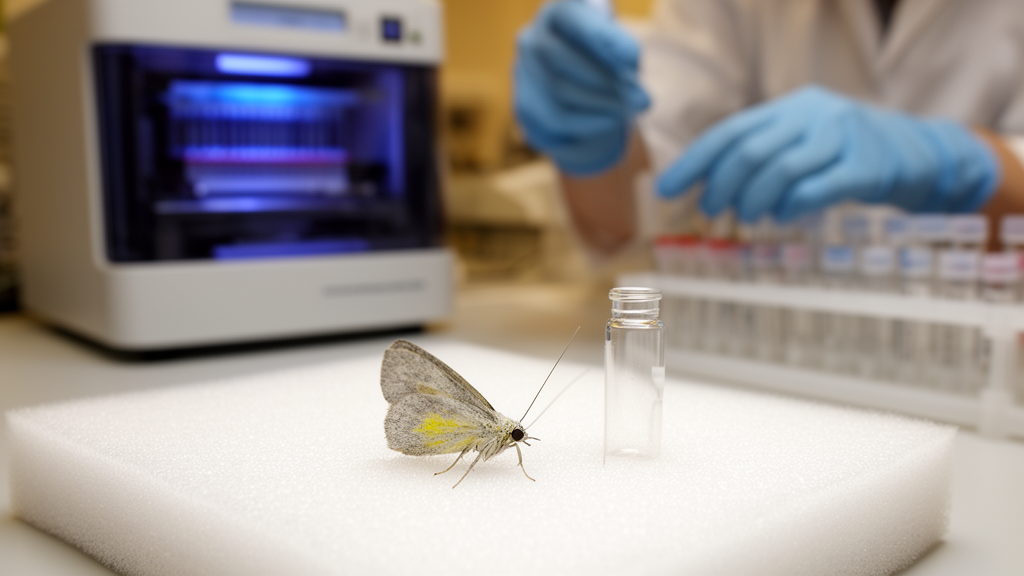
A study of mitochondrial DNA barcodes from European populations of the moth genus Setina found three principal genetic lineages corresponding to Setina irrorella, S. roscida and S. aurita, while several smaller groups and taxonomic assignments could not be resolved confidently. The barcode analysis was based on 86 COI sequences and therefore offers an initial grouping rather than a definitive phylogeny or a complete determination of biological species boundaries.
The investigation arose from a project to DNA-barcode the macroheteroceran Lepidoptera of the Iberian Peninsula. Researchers found that Iberian Setina shared barcode haplotypes with populations from Central Europe, prompting a broader analysis across Europe rather than a comparison restricted to particular regional classifications. The genus is taxonomically difficult because Setina shows substantial variation within and among populations, while male genitalia are relatively uniform and offer few species-specific characters.
For the molecular study, 23 adult specimens were processed and sequenced at the Canadian Centre for DNA Barcoding in Guelph using a standard high-throughput protocol. Their results were combined with 63 publicly available sequences from BOLD, the Barcode of Life Data System. All 86 analysed sequences were more than 500 base pairs long and were accompanied by geographic and specimen information. The researchers retained the original identifications assigned by the entomologists who submitted the sequences, which were subsequently evaluated against the molecular patterns.
The sequences were aligned and analysed with several methods. Kimura 2-parameter distances were used to measure sequence divergence, and trees were constructed by Maximum Likelihood in FastTree 2.1.11 and by Neighbor-Joining in MEGA6. Bootstrap support was calculated with 1,000 replicates, and Stigmatophora micans was used as the outgroup. Haplotype numbers were calculated in DnaSP 5.10, while Barcode Index Numbers and the Assemble Species by Automatic Partitioning algorithm were used to explore potential molecular species groupings.
The analysis identified 45 haplotypes across 10 BINs. Overall haplotype diversity was 0.9718 ± 0.007, based on 78 polymorphic sites, 78 mutations and nucleotide diversity per site of 0.01771; no insertions or deletions were found. Despite this variation, both Maximum-Likelihood and Neighbor-Joining analyses supported three broad Setina lineages. Mean divergence among the four morphologically recognized species examined in the comparison, including S. alpestris, ranged from 1.7% to 2.9%, with a mean of 2.1%.
The S. irrorella lineage included specimens identified as S. irrorella, S. flavicans and S. aurita and was represented by 37 samples in BIN BOLD:AAC0260. The S. roscida cluster included S. roscida, S. cantabrica and S. kuhlweini, while the S. aurita cluster contained 22 samples assigned to several BINs. These multiple BINs within S. aurita and S. irrorella, together with additional branches in the ASAP results, indicated that variation in the COI barcode region could not diagnose all of the smaller taxonomic groups within the three main lineages.
Two Iberian taxa showed especially close barcode matches to populations elsewhere. Mean divergence between S. flavicans and S. irrorella ranged from 0% to 0.15%, while S. cantabrica differed from S. roscida by a mean of 0.38%. These values were lower than the study’s mean interspecific divergence of 2.1%, supporting the placement of the two Iberian lineages within the broader S. irrorella and S. roscida groups in the authors’ interpretation. The authors also stated that the continuing use of the name Setina aurita should be reviewed because of nomenclatural homonymy.
Morphological analysis was limited to 23 Iberian adults—18 identified as flavicans and five as cantabrica—because specimens collected outside the Iberian Peninsula were not morphologically reviewed. External coloration, spot size and wing shape were examined, and genital structures were dissected and compared with published taxonomic keys. Specimens from the Cantabrian Mountains matched S. cantabrica, while material collected from the Cantabrian Mountains to the Pyrenees matched S. flavicans. The limited regional sample means these morphological observations do not independently validate the species boundaries of the entire European dataset.
Several exceptional groups differed by more than 3.8% from the main Setina clusters. These included specimens from Provence in France assigned to S. aurita or S. irrorella, a specimen from North Macedonia assigned to S. irrorella, and other isolated groups from southern Austria and Finland. The authors stated that these groups should be studied separately. More generally, they cautioned that COI barcodes have limited power for resolving Setina as biological species. The three-lineage arrangement is best treated as a practical grouping for identification rather than a definitive phylogeny, because it has not been confirmed by a comprehensive molecular phylogenetic study.
Subject of Research: COI barcode analysis of European Setina moth lineages and taxonomic limits
Article Title: A barcode-based outlook on the Western European Setina Schrank, 1802 ( Lepidoptera , Erebidae , Arctiinae )
Article References: Ortiz, A. S., Rubio, R. M., Guerrero, J. J., Garre, M., & Yela, J. L. (2026). A barcode-based outlook on the Western European Setina Schrank, 1802 (Lepidoptera, Erebidae, Arctiinae). Alpine Entomology, 10, 89-101. https://doi.org/10.3897/alpento.10.173884
Image Credits: AI Generated
DOI: 10.3897/alpento.10.173884
Keywords: Setina, DNA barcoding, COI, Lepidoptera, Erebidae, taxonomy, species delimitation, phylogeography, European moths, barcode-based, outlook, Western
News Source: Juliet Wilcox. (October 20, 2026). European Setina moth barcodes resolve three main lineages but leave species limits uncertain. Scienmag.