• HOME
  • NEWS
  • EXPLORE
    • CAREER
      • Companies
      • Jobs
    • EVENTS
    • iGEM
      • News
      • Team
    • PHOTOS
    • VIDEO
    • WIKI
  • BLOG
  • COMMUNITY
    • FACEBOOK
    • INSTAGRAM
    • TWITTER
Monday, May 18, 2026
BIOENGINEER.ORG
No Result
View All Result
  • Login
  • HOME
  • NEWS
  • EXPLORE
    • CAREER
      • Companies
      • Jobs
        • Lecturer
        • PhD Studentship
        • Postdoc
        • Research Assistant
    • EVENTS
    • iGEM
      • News
      • Team
    • PHOTOS
    • VIDEO
    • WIKI
  • BLOG
  • COMMUNITY
    • FACEBOOK
    • INSTAGRAM
    • TWITTER
  • HOME
  • NEWS
  • EXPLORE
    • CAREER
      • Companies
      • Jobs
        • Lecturer
        • PhD Studentship
        • Postdoc
        • Research Assistant
    • EVENTS
    • iGEM
      • News
      • Team
    • PHOTOS
    • VIDEO
    • WIKI
  • BLOG
  • COMMUNITY
    • FACEBOOK
    • INSTAGRAM
    • TWITTER
No Result
View All Result
Bioengineer.org
No Result
View All Result
Home NEWS Science News Biology

Epigenetic signaling axis regulates proliferation and self-renewal of neural stem/progenitor cells

Bioengineer by Bioengineer
June 13, 2017
in Biology
Reading Time: 2 mins read
0
Share on FacebookShare on TwitterShare on LinkedinShare on RedditShare on Telegram
IMAGE

Credit: LIU Changmei

Polycomb group (PcG) proteins comprise the Polycomb complexes PRC1 and PRC2 that regulate gene expression levels through histone modification. Although PRC1 and PRC2 are emerging as having important roles in cancer stem cells, their functions in neural stem/progenitor cells (NSPCs) are largely unknown.

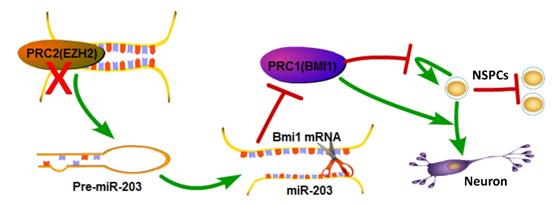
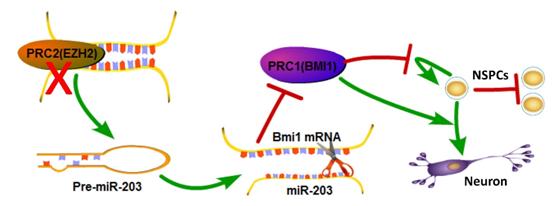
In a recent study published in Stem Cell Reports, a team led by Drs. LIU Changmei and TENG Zhaoqian from the State Key Laboratory of Stem Cell and Reproductive Biology, Institute of Zoology of the Chinese Academy of Sciences, found a novel epigenetic signaling axis (composed of PRC1, microRNA, and PRC2) that regulates self-renewal and proliferation of NSPCs.

The researchers generated an Ezh2 (a key PRC2 component) conditional knockout mouse model, and found that Ezh2 loss of function results in decreased self-renewal and proliferation ability in NSPCs.

They then discovered that Ezh2 represses the expression of miR-203, which negatively regulates self-renewal and proliferation of NSPCs, but promotes their neuronal differentiation capacity.

In addition, they demonstrated that Bmi1 (a PRC1 component) is a direct downstream target of miR-203, and ectopic overexpression of BMI1 can rescue the self-renewal and proliferation deficiency exhibited by miR-203 overexpression in NSPCs.

As PcG proteins and microRNAs are usually co-expressed, these findings might have significant implications for other cell types or cancer tissues.

###

This work was supported by grants from the National Science Foundation of China, National Science and Technology Major Projects, the State Key Laboratory of Stem Cell and Reproductive Biology, and the Hundred Talents Program of CAS.

Media Contact

LIU Changmei
[email protected]

http://english.cas.cn/

Related Journal Article

http://dx.doi.org/10.1016/j.stemcr.2017.05.007

############

Story Source: Materials provided by Scienmag
Share12Tweet8Share2ShareShareShare2

Related Posts

Butyrate Alleviates Temporomandibular Joint Pain via Epigenetic Mechanisms — Biology

Butyrate Alleviates Temporomandibular Joint Pain via Epigenetic Mechanisms

May 18, 2026
How Hibernation Impacts Visual Processing in Squirrels’ Brains — Biology

How Hibernation Impacts Visual Processing in Squirrels’ Brains

May 18, 2026

PKU Researchers Pioneer First-in-Class Drug Candidate Targeting Cholestatic Itch

May 18, 2026

Economic Impact Report Highlights the Value of Open Biodata Infrastructure

May 18, 2026
Please login to join discussion

POPULAR NEWS

  • Research Indicates Potential Connection Between Prenatal Medication Exposure and Elevated Autism Risk

    845 shares
    Share 338 Tweet 211
  • New Study Reveals Plants Can Detect the Sound of Rain

    731 shares
    Share 292 Tweet 182
  • Salmonella Haem Blocks Macrophages, Boosts Infection

    62 shares
    Share 25 Tweet 16
  • Breastmilk Balances E. coli and Beneficial Bacteria in Infant Gut Microbiomes

    58 shares
    Share 23 Tweet 15

About

We bring you the latest biotechnology news from best research centers and universities around the world. Check our website.

Follow us

Recent News

Gigahertz Lithium Niobate Receiver Boosts Quantum Communication

Minute-Scale Control Reveals Dynamics of Bacterial Effectors

Microfluidic Platforms Reveal Neuronal Network Recovery

Subscribe to Blog via Email

Enter your email address to subscribe to this blog and receive notifications of new posts by email.

Join 82 other subscribers
  • Contact Us

Bioengineer.org © Copyright 2023 All Rights Reserved.

Welcome Back!

Login to your account below

Forgotten Password?

Retrieve your password

Please enter your username or email address to reset your password.

Log In
No Result
View All Result
  • Homepages
    • Home Page 1
    • Home Page 2
  • News
  • National
  • Business
  • Health
  • Lifestyle
  • Science

Bioengineer.org © Copyright 2023 All Rights Reserved.