

• HOME
  • NEWS
  • EXPLORE
    • CAREER
      • Companies
      • Jobs
    • EVENTS
    • iGEM
      • News
      • Team
    • PHOTOS
    • VIDEO
    • WIKI
  • BLOG
  • COMMUNITY
    • FACEBOOK
    • INSTAGRAM
    • TWITTER
Monday, July 6, 2026
BIOENGINEER.ORG
No Result
View All Result
  • Login
  • HOME
  • NEWS
  • EXPLORE
    • CAREER
      • Companies
      • Jobs
        • Lecturer
        • PhD Studentship
        • Postdoc
        • Research Assistant
    • EVENTS
    • iGEM
      • News
      • Team
    • PHOTOS
    • VIDEO
    • WIKI
  • BLOG
  • COMMUNITY
    • FACEBOOK
    • INSTAGRAM
    • TWITTER
  • HOME
  • NEWS
  • EXPLORE
    • CAREER
      • Companies
      • Jobs
        • Lecturer
        • PhD Studentship
        • Postdoc
        • Research Assistant
    • EVENTS
    • iGEM
      • News
      • Team
    • PHOTOS
    • VIDEO
    • WIKI
  • BLOG
  • COMMUNITY
    • FACEBOOK
    • INSTAGRAM
    • TWITTER
No Result
View All Result
Bioengineer.org
No Result
View All Result
Home NEWS Science News Biology

Enhancing the efficiency of plant regeneration

Bioengineer by Bioengineer
October 3, 2023
in Biology
Reading Time: 2 mins read
0
Enhancing the efficiency of plant regeneration
Share on FacebookShare on TwitterShare on LinkedinShare on RedditShare on Telegram

Crop modification can be traced to the beginning of agriculture and human civilization.
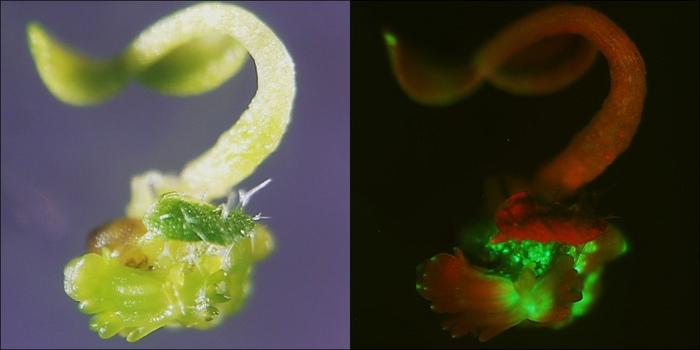
Enhancing the efficiency of plant regeneration

Credit: Photo courtesy of Basitaan Bargmann.

Crop modification can be traced to the beginning of agriculture and human civilization.

Native Americans, for example, developed corn from a wild grass called teosinte more than 7,000 years ago.

Methods to increase crop resiliency and sustainability have evolved, and improved, over time. Biotechnology, or the use of biology to develop new products and organisms, is an application that holds great promise for impactful changes to the agricultural systems. Through this method, the DNA in plant cells is modified — for instance so that crops require less water and fertilizer supplementation or are more tolerant to drought conditions and resistant to plant diseases — resulting in improved crop traits.

Although biotechnology has shown success in crop trait improvement, the process can be long and tedious, said Bastiaan Bargmann, assistant professor in the School for Plant and Environmental Sciences and an affiliated faculty member of the Fralin Life Sciences Institute.

“A huge bottleneck in the implementation of biotechnology is that you have to be able to grow a whole plant back from the few cells where you’ve managed to change the DNA. This is called regeneration” he said. “We can change the DNA in a few cells, but then getting those cells to turn back into a whole plant can be quite challenging in many species.”

With funding from the National Science Foundation, Bargmann, the principal investigator, in partnership with researchers at the Donald Danforth Plant Science Center in Missouri, aims to enhance the efficiency of plant regeneration. The project will test the use of morphogenic factors to reprogram cell fate and steer it toward the formation of whole plants. The team was awarded a $1.2 million grant to aid in this research.

The bulk of the research, Bargmann said, will focus on the fundamental understanding of plant regeneration.

“To that end, we will perform studies in a model plant system, thale cress (Arabidopsis thaliana), to better understand the cellular and molecular regulation of regeneration and identify factors that can enhance the process,” he said.

As a proof of concept, the team will then implement the use of such factors in wheat, a crop known to be difficult to transform and regenerate. Virginia Tech is well-known for its small grains breeding program, and the research team will partner with Assistant Professor Nicholas Santantonio, program leader, to apply this process on different wheat varieties.

In addition to the planned research, the research team will advance public understanding and youth involvement through the development of a lecture series for high school students in the Virginia Summer Residential Governor’s School for Agriculture titled “The Past, Present, and Future of Bioengineering for Crop Trait Improvement.”



Share12Tweet8Share2ShareShareShare2

Related Posts

Here are a few rewritten headlines for a science magazine post, each with a slightly different tone: Intriguing & poetic: How do organs sculpt themselves? Sea stars hold the secret Direct & research-focused: Sea stars reveal the hidden rules of organ formation Metaphorical & inviting: Tiny architects beneath the waves: What sea stars teach us about building organs Short & punchy: Star-shaped clues to how our organs take shape Question-led: Could a sea star show us how organs form? Elegant & feature-style: The body’s blueprint, glimpsed in a sea star’s arm

July 6, 2026
Bacteria evolve faster with unconventional gene copies — Biology

Bacteria evolve faster with unconventional gene copies

July 6, 2026

Neighbours rewire soil feedback via root microbiome shifts

July 6, 2026

Evolution-Inspired Biosensors Revolutionize Lipid Tracking in Real Time

July 2, 2026

POPULAR NEWS

  • Detection of EDCs in Breast Milk and Infant Urine Up to Six Months Highlights Early Exposure Risks

    77 shares
    Share 31 Tweet 19
  • New Drug Candidate Developed at McMaster Shows Potential for Treating Brain Cancer

    58 shares
    Share 23 Tweet 15
  • Saying Goodbye to PGY-6: Pediatric Fellowship Realities

    103 shares
    Share 41 Tweet 26
  • KTU Researchers Explore Ultrasound’s Role in Enhancing Blood Flow Beyond Diagnostics

    53 shares
    Share 21 Tweet 13

About

We bring you the latest biotechnology news from best research centers and universities around the world. Check our website.

Follow us

Recent News

Flame retardant BDE-209 targets molecularly linked to ulcerative colitis

Ultra-high frequency particle impacts mimic rockbursts to shatter hard rock

Kidney transplant outcomes in older adults studied by German researchers

Subscribe to Blog via Email

Enter your email address to subscribe to this blog and receive notifications of new posts by email.

Join 83 other subscribers
  • Contact Us

Bioengineer.org © Copyright 2023 All Rights Reserved.

Welcome Back!

Login to your account below

Forgotten Password?

Retrieve your password

Please enter your username or email address to reset your password.

Log In
No Result
View All Result
  • Homepages
    • Home Page 1
    • Home Page 2
  • News
  • National
  • Business
  • Health
  • Lifestyle
  • Science

Bioengineer.org © Copyright 2023 All Rights Reserved.