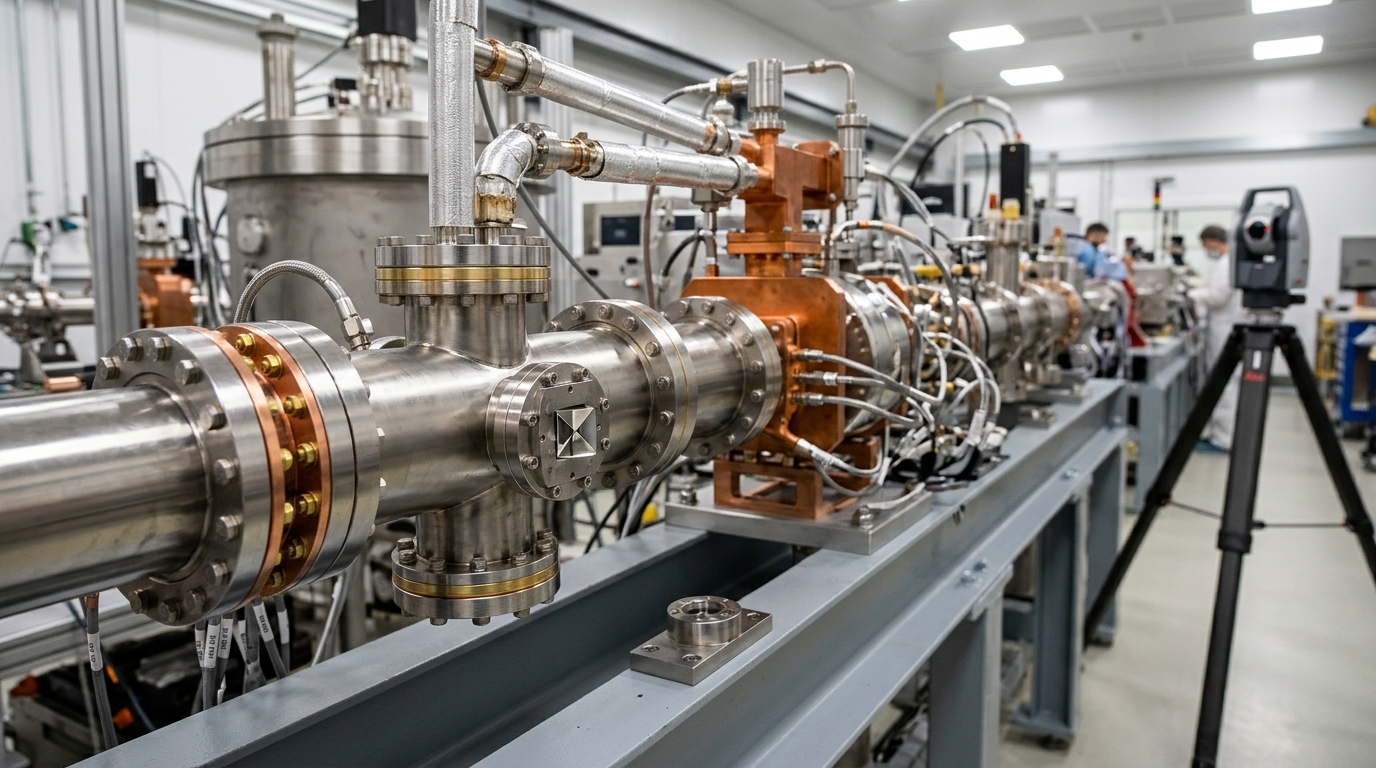
Deep inside every future particle collider lies a region where machine and detector must coexist in a space measured in centimeters, and a team of engineers and physicists has now laid out exactly how that coexistence will work for the proposed Future Circular Collider, FCC-ee. In a study published in EPJ Techniques and Instrumentation, researchers including Manuela Boscolo, Fabrizio Palla, Filippo Bosi, Francesco Fransesini and Stefano Lauciani present a complete mechanical model of the FCC-ee interaction region, from the thin-walled beam pipe at the collision point to the carbon-fibre support tube that will hold the luminosity calorimeter and the silicon trackers.
The FCC-ee itself is a design study for a circular electron-positron collider with a proposed circumference of about 90.6 kilometers, intended to probe physics between the Z pole at 91.2 GeV and the top-antitop threshold at 365 GeV in the center of mass. Following the 2020 update of the European Strategy for Particle Physics, the CERN Council launched an FCC Feasibility Study in 2021, building on the Conceptual Design Report published in 2019.
Vertical beam sizes of tens of nanometers and horizontal sizes of a few microns demand tiny beta functions at the interaction point, down to 0.1 meters vertically and 0.8 millimeters horizontally at the Z pole, produced by a doublet of superconducting quadrupoles. The distance from the final quadrupole face to the interaction point is fixed at 2.2 meters, necessarily inside the detector itself. The two beam lines are separated everywhere except for a common beam pipe spanning 1.8 meters around the collision point, and physics reconstruction would benefit if accelerator components stayed within a cone of 100 milliradians from the interaction point along the beam axis. Meanwhile, the detector solenoid provides a 2-tesla field, and a compensation solenoid placed 1.23 meters from the interaction point cancels the integrated field between the collision point and the final-focus quadrupoles, a configuration that leaves the magnetic centers of the two opposing beams only a few centimeters apart.
At the heart of the design sits the vacuum chamber, and its requirements pull in opposite directions. The pipe must be smooth to keep electrical impedance low, thin to minimize the material that particles traverse, yet rigid enough to resist mechanical stress, and it must be cooled to control the heat deposited by beam-induced wakefields and synchrotron radiation. The central chamber, extending 90 millimeters on either side of the interaction point, is a double layer of AlBeMet162, an alloy of 62 percent beryllium and 38 percent aluminum chosen for its high stiffness and low density. Each of the two concentric cylinders is 0.35 millimeters thick, assembled with a 1-millimeter gap through which liquid paraffin flows as coolant, bringing the effective diameter of the central beam pipe and its cooling layer to 23.4 millimeters. Copper cooling channels are embedded in the alloy using a thick copper deposition technique, and the pipe’s cross-section transitions smoothly from circular to elliptical before merging with two symmetric beam pipes of 15-millimeter radius at 1.28 meters from the interaction point.
Beyond the central section, the so-called trapezoidal chamber carries the same 0.35-millimeter AlBeMet162 wall but with a constant total thickness of 2 millimeters, cooled by asymmetric copper channels deposited directly onto the pipe so that the luminosity calorimeter can fit as close as possible; a 50-milliradian cone defines the cutting profile. A thermo-structural analysis assuming perfect thermal contact between materials, with about 50 watts of deposited power on the central chamber and 130 watts on the trapezoidal chamber, found that paraffin cooling would hold the central chamber at a maximum of 33.1 degrees Celsius while water cooling keeps the trapezoidal chamber at 47.6 degrees, with the coolants themselves reaching 20.1 and 20.5 degrees respectively. The system tolerates roughly a 15 percent increase in heat load before coolant velocity and flow rate must be adapted. Structural simulations considering gravity, vacuum load, the attached vertex detector and the calculated temperature distribution yielded acceptable stresses and an estimated safety factor of about 5 against the 193-megapascal yield strength of AlBeMet162, although the team notes that buckling behavior is more critical than static loading and that experimental tests would be extremely useful to validate the analysis.
Wrapped around this delicate plumbing is the silicon tracker of the IDEA detector concept, an evolution of one of two detector designs described in the FCC-ee Conceptual Design Report. Each module measures 32 by 8.4 square millimeters, carries pixels of 25 by 25 square microns, and is only 50 microns thick, corresponding to 0.052 radiation lengths, with an assumed power consumption of 50 milliwatts per square centimeter. The first layer comprises 15 staves of 6 modules each, overlapped in azimuth to allow internal alignment; the second holds 24 ladders of 10 modules at an average radius of 23.7 millimeters, with the pinwheel angle reversed to mitigate charge-dependent effects on track reconstruction; and the third arranges 18 ladders in a lampshade geometry at radial positions of 33.05 and 35.55 millimeters. The whole assembly mounts on a carbon-fibre conical support weighing about 450 grams, cooled by air flowing through channels embedded in the structure.
A middle barrel layer sits at 13 centimeters with 22 ladders of 8 modules, while the outermost layer at 31.5 centimeters uses 51 ladders of 16 modules each, supported by a flange attached to the external support tube. Three disk pairs at 30.47, 62 and 93 centimeters from the interaction point complete the coverage, each disk built from four forward and backward petals on a sandwich of 0.3-millimeter carbon-fibre walls and 5.4-millimeter Rohacell foam. Preliminary thermal computations indicate the largest temperature variation across the outer tracker, from the coolest point below the pipe to the chip periphery, is about 7 kelvin.
The luminosity calorimeter, the instrument that will allow the FCC-ee to measure collision rates with an accuracy on the order of 10^-4, consists of two cylindrical devices placed about 1 meter from the interaction point, each weighing roughly 65 kilograms. Each contains 26 passive tungsten disks of 3.5-millimeter thickness interleaved with 25 silicon pad detectors in a 1-millimeter housing, with sensitive radial coverage between 54 and 115 millimeters from the beamline and a service region extending to 145 millimeters. The front face of the first tungsten disk sits at 1074 millimeters from the interaction point. To achieve its precision goals, the inner radius must be known to plus or minus 1.5 microns, the outer radius to plus or minus 3.5 microns, and the relative positioning of the two sides to plus or minus 110 microns, requirements that dictate the tungsten disks and silicon pads be assembled as single-piece parts forming a rigid hollow cylinder. To avoid interference with the bellows, the last four detector layers will have an inner radius 2 centimeters larger than the others, a solution whose impact on physics performance is currently under evaluation but expected to be marginal.
Binding all of these elements together is the paper’s most novel contribution: a longitudinally split carbon-fibre support tube, complemented by two aluminum flanges, two endcaps and six internal aluminum ribs, that will cantilever the beam pipe, shield the thin-walled central chamber from assembly loads, and carry both the luminosity calorimeter and the outer tracker as a single rigid structure. Structural analysis with double-fixed-end constraints, using deliberately overestimated loads that account for water ducts and power cables running to the end of the tube, confirmed the structural resistance is safely respected, with small maximum stress and displacement values. The assembly sequence is equally deliberate: the outer barrel, middle barrel and innermost disks are preassembled in the laboratory and fixed to one half of the cylinder; the remaining disks are installed on the reinforcement ribs; the luminosity calorimeter is mounted on the endcaps; the vacuum chamber with the vertex detector attached is slid inside with a dedicated tool; and the second half of the tube closes the structure. Mounting precision of the detector elements will be better than 100 microns, maintained with dedicated tooling, and the main structures will be surveyed to about 50 microns using laser scanner technology. The team has proposed a full-scale mock-up with prototypes of the vacuum chamber, the bellows, the support tube and air-cooling tests of the vertex detector to experimentally validate these key components, while wakefield simulations for the bellows and the engineering of the superconducting final-focus magnets remain ongoing.
Subject of Research: Mechanical engineering design of the interaction region for the proposed FCC-ee electron-positron collider
Article Title: Mechanical model for the FCC-ee interaction region
Article References: Boscolo, M., Palla, F., Bosi, F., Fransesini, F., & Lauciani, S. (2023). Mechanical model for the FCC-ee interaction region. EPJ Techniques and Instrumentation, 10(1), Article 16. https://doi.org/10.1140/epjti/s40485-023-00103-7
Image Credits: AI Generated
DOI: 10.1140/epjti/s40485-023-00103-7
Keywords: FCC-ee, particle collider, interaction region, beam pipe, vertex detector, silicon tracker, luminosity calorimeter, carbon-fibre support tube, cooling system, machine-detector interface, CERN, crab-waist collisions
News Source: Denise Maddox. (November 5, 2026). Engineers Map Out the Heart of the FCC-ee Collider, One Millimeter at a Time. Scienmag.