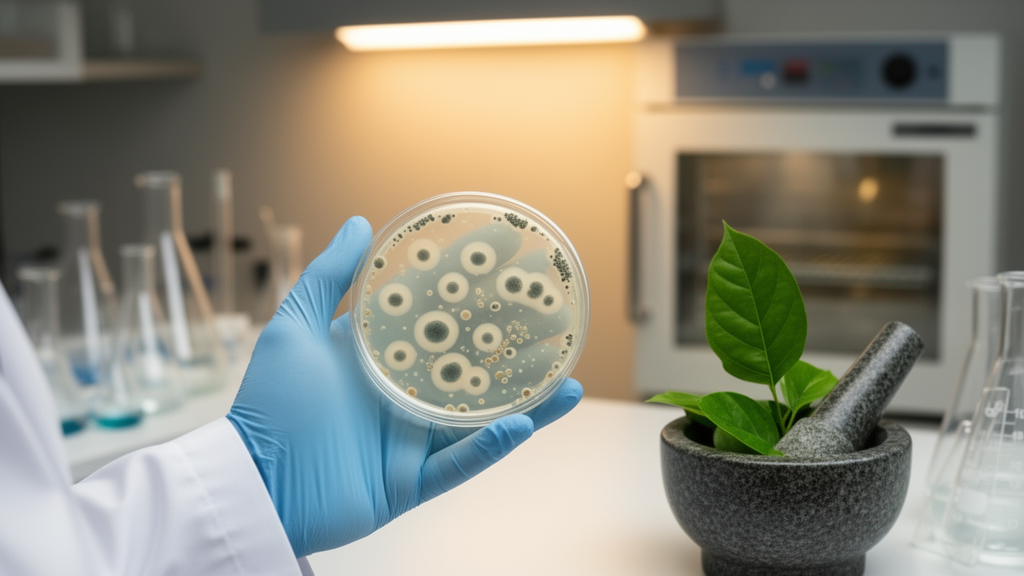
Researchers have isolated a bacterium living inside the roots of Echinops kebericho M., a plant long used in traditional Ethiopian medicine, and found in laboratory tests that its crude extract can inhibit the growth of Escherichia coli and scavenge free radicals.
The team, led by Dinku Senbeta with co-authors Aman Dekebo and Seid Mohammed Ebu, collected a healthy root of E. kebericho M. for experimental analysis. Endophytic bacteria, the microorganisms that reside within plant tissues without causing disease, are described in the paper as a promising source of bioactive compounds with potential value to medicine, agriculture and industrial applications.
To identify the isolate, the researchers performed 16S rRNA gene sequencing, a standard method for bacterial classification based on a conserved genetic marker. The sequencing showed that the potent isolate clustered with Proteus mirabilis ATCC 29906T, and the strain was designated Proteus sp. EKWG2I3, with the sequence deposited under the accession number PV635194.
With the identity established, the researchers turned to the isolate’s chemistry. They performed in vitro antibacterial testing, antioxidant assays and gas chromatography–mass spectrometry (GC-MS) profiling of the crude extracts. In the antibacterial assays, the crude extract of Proteus sp. EKWG2I3 showed notable activity against E. coli ATCC 25922T, producing a zone of inhibition of 15 ± 0.0529 millimetres.
The antioxidant evaluation measured the extract’s free radical scavenging potential. The concentration required to inhibit 50 percent of radicals, known as the IC50 value, was 45.46 micrograms per millilitre, a result the authors describe as potent when compared against ascorbic acid, the common reference antioxidant used in such assays.
The GC-MS analysis identified the major constituents of the extract. Methyl phenylacetate was the most abundant compound at 38.49 percent of the profile, followed by pentanoic acid, methyl ester at 12.71 percent. These ester compounds dominated the chemical fingerprint of the crude extract obtained from the isolate.
The authors suggest that Proteus sp. EKWG2I3 associated with E. kebericho M. could be a potential source of bioactive compounds to combat emerging diseases caused by drug-resistant pathogens.
Several caveats apply to the findings. All activity measurements were conducted in vitro, meaning in laboratory conditions rather than in living organisms, and the reported antibacterial and antioxidant results come from crude extracts rather than purified compounds. The published version is also an early-release, peer-reviewed accepted manuscript that remains subject to further edits before the final version of record appears.
Within those limits, the study adds a specific data point to the growing catalogue of endophytic bacteria recovered from medicinal plants. It documents the identity of a Proteus isolate from E. kebericho M., quantifies its antibacterial and antioxidant activity against standard test strains, and provides a GC-MS chemical profile dominated by methyl phenylacetate and pentanoic acid, methyl ester.
Subject of Research: In vitro antibacterial, antioxidant and GC-MS chemical profiling of the endophytic bacterium Proteus sp. EKWG2I3 isolated from Echinops kebericho M.
Article Title: In vitro assay and GC-MS profiling of Proteus sp.EKWG2I3 isolate obtained from Echinops kebericho M.: a traditional medicinal plant
Article References: Senbeta, D., Dekebo, A., & Ebu, S. M. (2026). In vitro assay and GC-MS profiling of Proteus sp.EKWG2I3 isolate obtained from Echinops kebericho M.: a traditional medicinal plant. Annals of Microbiology. https://doi.org/10.1186/s13213-026-01878-2
Image Credits: AI Generated
DOI: 10.1186/s13213-026-01878-2
Keywords: endophytic bacteria, Proteus sp. EKWG2I3, Echinops kebericho, 16S rRNA sequencing, GC-MS profiling, antibacterial activity, antioxidant activity, methyl phenylacetate, crude extract, medicinal plants, drug-resistant pathogens, Annals of Microbiology
News Source: Morgan Morrow. (October 28, 2026). Endophytic Proteus bacterium from Ethiopian medicinal plant shows antibacterial activity in lab tests. Scienmag.