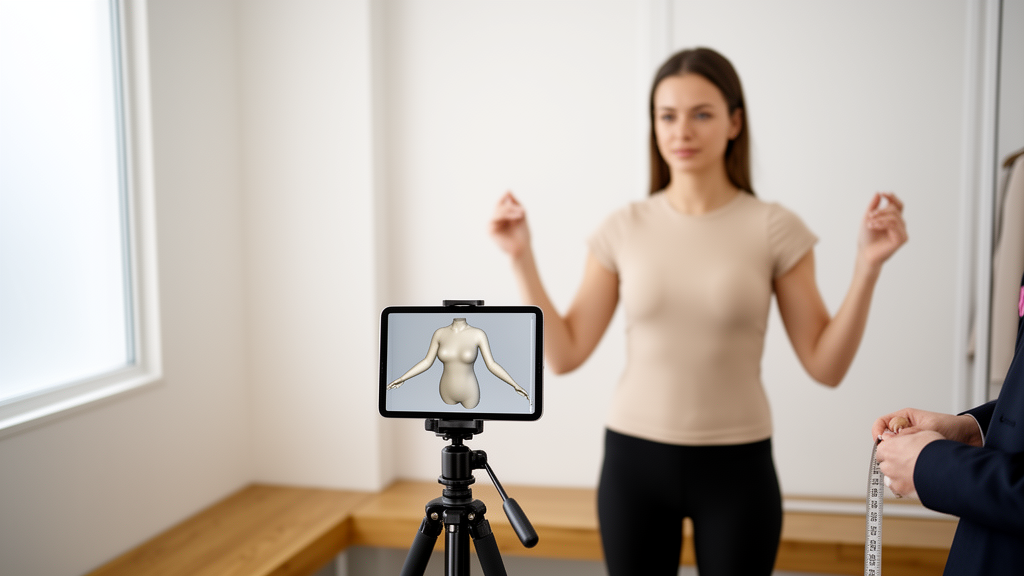
Artificial intelligence is quietly moving into one of retail’s most stubborn problems: finding a bra that actually fits. A new critical narrative review published in Frontiers in Artificial Intelligence on 28 October 2026 examines what AI can genuinely deliver for intimate apparel fit and comfort, and its conclusion is more nuanced than either the hype or the dismissals suggest. Chandni S. Sharma and Kathiravan Srinivasan of Vellore Institute of Technology in India argue that the field has real, component-level progress to show, but that the crucial links between body measurements, comfortable garments, and business outcomes remain largely unvalidated.
The review, which is not a systematic review but a purposive sampling of published studies across IEEE Xplore, ScienceDirect, SpringerLink, Taylor & Francis Online, and MDPI, draws a sharp line between direct evidence, meaning studies of bras, breast morphology, or bra-related wearer experience, and adjacent evidence from general clothing, body reconstruction, and image synthesis. That distinction matters commercially. A visually convincing garment image, an accurately classified breast morphology, and a comfortable garment are related achievements, the authors stress, but each requires entirely different observations to verify.
The direct computational studies are more substantial than a casual observer might expect. One study used three-dimensional scans from 201 female college students to identify breast-morphology features, reporting 99 percent recognition for three selected features. Another used data from 150 individuals to build a long short-term memory classifier and a breast-to-bra mapping, reporting 85.71 percent shape identification. The review is careful to note that these percentages use different morphology definitions and study samples, so they cannot be ranked against each other, and neither measures wearer comfort or retail recommendation success.
Physics-based modeling adds another layer. Finite-element studies have modeled pressure and breast deformation in adjustable bras, and simulated contact pressure and displacement across sports-bra support levels and movement conditions. These are direct mechanical studies, the review emphasizes, not evidence that a machine-learning model predicts individual comfort. Dynamic acquisition pushes further: one study combined time-varying 3D scanning, material selection, and cup-pattern design in a study of ten participants running at 8 kilometers per hour, connecting local deformation to a design process without establishing population-wide prediction.
Wearer evidence rounds out the picture. Seven athletic participants with the same nominal bra size took part in a comparison of auxetic and conventional pads using scanning and pressure measurements. A study of 17 trained junior runners examined underband tightness and found it associated with changes in respiratory and perceptual responses, illustrating that tighter support cannot be treated as an unconditional improvement. A longitudinal study combined questionnaires, interviews, laboratory trials, and a 14-week field study of military recruits, enrolling 93 recruits of whom 56 completed the final questionnaire, with a reported 40 percent loss to follow-up attributed to discharge or re-squadding. A configurable physical manikin allows repeatable bra-support comparison, but a manikin, the authors note, cannot report perceived comfort.
The review’s central analytical tool is a four-question transfer test: does the source predict the same quantity, are sensing and reference measurements comparable, are garment-body mechanics relevant to the proposed use, and is the measured endpoint the claimed outcome? There is no compensatory threshold, the authors insist; a mismatch in a necessary condition blocks that particular inference. A visual-synthesis result cannot establish pressure accuracy even when its inputs depict the same body region, and a validated pressure simulator may support a mechanical hypothesis without establishing perceived comfort. Applied to adjacent technologies, the test is sobering. Resources such as DeepFashion, SMPL, VITON-HD, BooW-VTON, VTON 360, and QuantFit-VTON offer useful visual representations, body geometry, and increasingly measurement-conditioned image generation, but none supplies bra support, tissue compression, or contextual comfort labels.
On the business side, the review is equally restrained. A deployed size-and-fit prediction system in general fashion e-commerce shows that computational prediction can be integrated into a commercial workflow, but it is not a bra-specific estimate of customer benefit or profitability. The reviewed sources do not support a pooled effect on intimate-apparel returns, margin, or satisfaction. The authors propose that any business trial compare a clearly specified service with the current size chart, quiz, fitter, or customer-service workflow, using reason-coded fit returns, successful exchanges, or verified comfort as primary outcomes, since conversion alone is inadequate because a persuasive but inaccurate recommendation can move costs downstream.
Privacy receives detailed treatment, reflecting the sensitivity of intimate body data. The review warns that removing faces or names cannot alone establish anonymity of detailed body records, since body-shape features can contribute to person recognition, and linkage with accounts or transactions may increase risk. Proposed safeguards include collecting only information necessary for the defined service, separating account identity from measurement records, limiting raw-image retention, and offering a manual-measurement route. On differential privacy, the authors note there is no universal mapping from the privacy parameter epsilon to millimeters of sizing error, and no domain-specific threshold is established by the sources used. The review also maps selected statutory distinctions across the European Union, California, Illinois, China, and India, cautioning that a torso scan should not automatically be classified as covered under every biometric statute.
The proposed path forward is a staged research agenda with explicit resource assumptions: an initial six-month phase to define claims, reference measurements, and baselines; a second phase testing the next transfer condition; a third comparing a live service with current practice; and a conditional later phase for hybrid simulation or multi-party learning only if it resolves a measured bottleneck. The authors are explicit that these are planning scenarios, not costs estimated from published trials, and that the proposals are analytical contributions rather than empirically validated maturity models or deployment guarantees. The central implication, they conclude, is that businesses should match each proposed claim to its measured outcome and scale investment only after the relevant technical, wearer, and operational evidence is established.
What emerges is neither a eulogy nor an endorsement. The direct evidence is concentrated in bras, several studies use narrow participant or activity ranges, and some direct studies were accessible only through abstracts, restricting conclusions to what those sources report. The review’s own limitations include no independent duplicate screening, no formal risk-of-bias appraisal, and no meta-analysis. Yet the authors resist calling the domain empty or uniformly immature. The missing link, they argue, is not a complete absence of direct or longitudinal bra research, but integration with externally validated AI decisions and attributable business outcomes, and that link will only be forged by studies designed to test exactly the claims being made.
Subject of Research: A critical narrative review of artificial intelligence for bra fit and comfort, evaluating technical evidence and business validation needs.
Article Title: Artificial intelligence for intimate apparel fit and comfort from technical evidence to business governance
Article References: Sharma, C. S., & Srinivasan, K. (2026). Artificial intelligence for intimate apparel fit and comfort from technical evidence to business governance. Frontiers in Artificial Intelligence, 9, 1934450. https://doi.org/10.3389/frai.2026.1934450
Image Credits: AI Generated
DOI: 10.3389/frai.2026.1934450
Keywords: artificial intelligence, bra fit, intimate apparel, virtual try-on, body measurement, breast morphology, comfort measurement, privacy, business governance, finite-element modeling, size recommendation, evidence gaps
News Source: Denise Maddox. (October 28, 2026). AI Can Measure Your Body for a Better Bra Fit, but the Evidence Stops Short of Proving It Works. Scienmag.