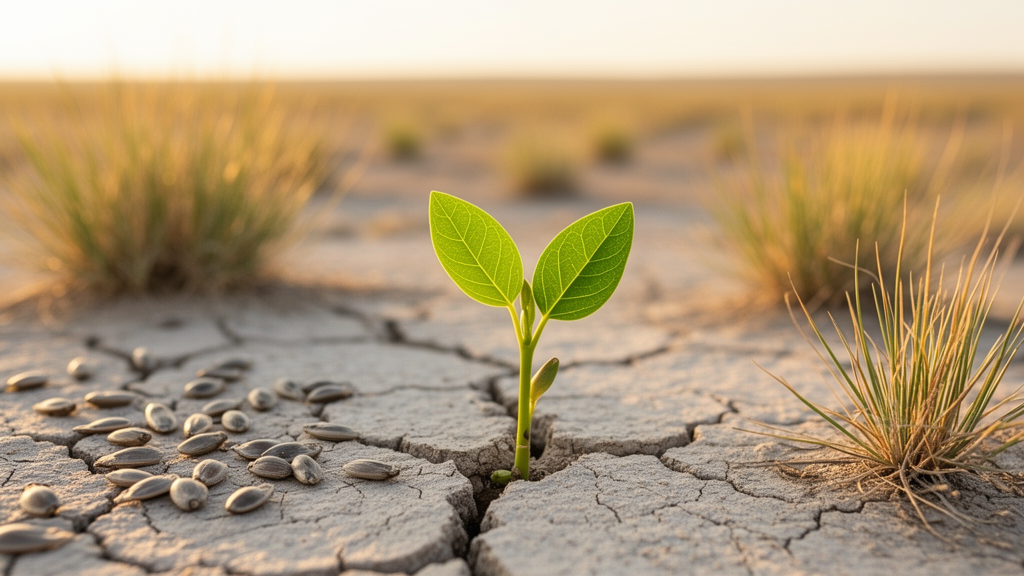
Researchers have charted how seeds of Physorhynchus chamaerapistrum, a rangeland species native to semi-arid regions, respond to temperature, water stress and salinity, identifying specific thresholds that could guide future seed-based restoration work. The study, published in BMC Plant Biology, tested germination across a wide range of controlled laboratory conditions and reported that the species germinates over a broad thermal window but declines progressively as osmotic and salt stress intensify.
Under constant temperatures, germination occurred between 10 and 40 °C, with the best performance between 15 and 30 °C. Maximum germination of 88 percent was recorded at 30 °C, while the fastest germination rate, 15.26 seeds per day, occurred at 25 °C; model predictions pointed to a peak germination rate at 23.76 °C. Alternating temperature regimes told a similar story: germination reached 88 percent at 25/15 °C (day/night) and the highest rate occurred at 30/20 °C, but performance dropped sharply at elevated temperatures, falling to 18 percent at 40/30 °C.
Water stress, imposed through osmotic potentials ranging from 0 to −1.2 MPa, revealed considerable tolerance at mild levels. Germination reached 95 percent at −0.2 MPa, but 50 percent inhibition occurred at −0.61 MPa and complete inhibition at −1.2 MPa. Salinity trials, using NaCl concentrations from 0 to 350 mM, showed a linear decline in germination, from 90 percent at 0 mM to complete inhibition at 350 mM, with the germination rate reduced by 50 percent at 90 mM. Notably, the authors observed that the salinity threshold for a 50 percent reduction in germination rate was lower than the threshold for final germination, indicating that germination speed is particularly sensitive to salt.
Stress also slowed the process, not just the outcome. Mean germination time increased substantially under all stress conditions, reaching a maximum of 8.64 days at an osmotic potential of −0.84 MPa and 6.06 days at 244 mM salinity. The authors conclude that the species has a distinct thermal range favorable for germination and exhibits progressively reduced germination under increasing osmotic and salinity stress. They present the identified thermal, osmotic and salinity thresholds as species-specific benchmarks that may inform future seed-based restoration studies in semi-arid rangelands, while cautioning that the implications for field establishment and grazing management require validation under natural conditions. As a controlled laboratory experiment, the study describes responses under defined conditions rather than measured outcomes in the field.
Subject of Research: Laboratory study of temperature, osmotic and salinity effects on seed germination of Physorhynchus chamaerapistrum
Article Title: Germination responses of Physorhynchus chamaerapistrum to abiotic stressors: implications for semiarid rangeland restoration
Article References: Zare, A., & Moosavi, S. A. (2026). Germination responses of Physorhynchus chamaerapistrum to abiotic stressors: implications for semiarid rangeland restoration. BMC Plant Biology. https://doi.org/10.1186/s12870-026-10187-4
Image Credits: AI Generated
DOI: 10.1186/s12870-026-10187-4
Keywords: Physorhynchus chamaerapistrum, seed germination, temperature, osmotic stress, salinity, semiarid rangelands, restoration, germination rate, BMC Plant Biology, thermal thresholds, Germination, responses
News Source: Alan Morgan. (October 28, 2026). Seed germination thresholds mapped for a semiarid rangeland plant. Scienmag.