• HOME
  • NEWS
  • EXPLORE
    • CAREER
      • Companies
      • Jobs
    • EVENTS
    • iGEM
      • News
      • Team
    • PHOTOS
    • VIDEO
    • WIKI
  • BLOG
  • COMMUNITY
    • FACEBOOK
    • INSTAGRAM
    • TWITTER
Sunday, August 30, 2026
BIOENGINEER.ORG
No Result
View All Result
  • Login
  • HOME
  • NEWS
  • EXPLORE
    • CAREER
      • Companies
      • Jobs
        • Lecturer
        • PhD Studentship
        • Postdoc
        • Research Assistant
    • EVENTS
    • iGEM
      • News
      • Team
    • PHOTOS
    • VIDEO
    • WIKI
  • BLOG
  • COMMUNITY
    • FACEBOOK
    • INSTAGRAM
    • TWITTER
  • HOME
  • NEWS
  • EXPLORE
    • CAREER
      • Companies
      • Jobs
        • Lecturer
        • PhD Studentship
        • Postdoc
        • Research Assistant
    • EVENTS
    • iGEM
      • News
      • Team
    • PHOTOS
    • VIDEO
    • WIKI
  • BLOG
  • COMMUNITY
    • FACEBOOK
    • INSTAGRAM
    • TWITTER
No Result
View All Result
Bioengineer.org
No Result
View All Result
Home NEWS Science News Biology

Endocrine disruption in seals by environmental contaminants

Bioengineer by Bioengineer
October 20, 2023
in Biology
Reading Time: 2 mins read
0
Hoa et al Graphic Abstract
Share on FacebookShare on TwitterShare on LinkedinShare on RedditShare on Telegram

In this study, the ability of bisphenols (BPs) and hydroxylated polychlorinated biphenyls (OH-PCBs) to activate estrogen receptor α and β subtypes (bsERα and bsERβ) in Baikal seals (Pusa sibirica) was evaluated by both in vitro (in vitro) and computer-based (in silico) experiments.
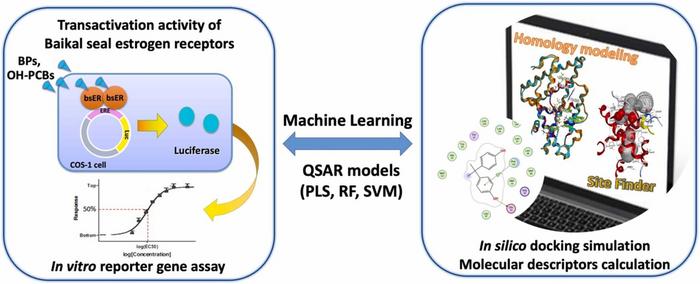
Hoa et al Graphic Abstract

Credit: Center for Marine Environmental Studies (CMES), Ehime University

In this study, the ability of bisphenols (BPs) and hydroxylated polychlorinated biphenyls (OH-PCBs) to activate estrogen receptor α and β subtypes (bsERα and bsERβ) in Baikal seals (Pusa sibirica) was evaluated by both in vitro (in vitro) and computer-based (in silico) experiments.

In vitro experiments revealed that most BPs and OH-PCBs exhibit estrogen-like activity against each bsER subtype. Among the BPs tested, bisphenol AF exhibited the strongest estrogen-like activity. Similarly, 4′-OH-CB50 and 4′-OH-CB30 showed the strongest activity among the tested OH-PCBs against bsERα and bsERβ, respectively.

In order to further investigate how these environmental contaminants bind to bsER, computer docking simulations were performed. Using the results of this computer simulation and the structural properties (molecular descriptors) of the environmental contaminants as explanatory variables and in vitro experimental data as objective variables, quantitative structure-activity relationship (QSAR) models for both bsER subtypes were developed. These models accurately predicted the activation potential of each environmental contaminant in in vitro experiments, distinguishing, with a high degree of accuracy, between compounds that activate and those that do not activate for both bsERα and bsERβ. From the QSAR model, we also succeeded in extracting important factors that influence the activation potential of environmental contaminants.
Furthermore, we succeeded in constructing a QSAR model that predicts the activation potential of mouse ERs using the same method, demonstrating the applicability of this method regardless of species-specific responses.


Journal

Ecotoxicology and Environmental Safety

DOI

10.1016/j.ecoenv.2023.115495

Share12Tweet8Share2ShareShareShare2

Related Posts

Ginsenosides Show Promise Against Neurodegenerative Diseases by Blocking Ferroptosis

Ginsenosides Show Promise Against Neurodegenerative Diseases by Blocking Ferroptosis

August 30, 2026
Immune gene diversity mapped in critically endangered disease-prone freshwater turtle

Immune gene diversity mapped in critically endangered disease-prone freshwater turtle

August 30, 2026

Marine chitinase BtChi attacks Candida cell walls, releasing antifungal chitooligosaccharides

August 30, 2026

Harnessing WRKY Genes to Boost Potato Stress Tolerance and Yield

August 30, 2026

POPULAR NEWS

  • Four-field quantum key distribution harnesses differential quadrature phase shifts for security

    29 shares
    Share 12 Tweet 7
  • Ginsenosides Show Promise Against Neurodegenerative Diseases by Blocking Ferroptosis

    29 shares
    Share 12 Tweet 7
  • Immune gene diversity mapped in critically endangered disease-prone freshwater turtle

    29 shares
    Share 12 Tweet 7
  • Marine chitinase BtChi attacks Candida cell walls, releasing antifungal chitooligosaccharides

    29 shares
    Share 12 Tweet 7

About

We bring you the latest biotechnology news from best research centers and universities around the world. Check our website.

Follow us

Recent News

Four-field quantum key distribution harnesses differential quadrature phase shifts for security

Ginsenosides Show Promise Against Neurodegenerative Diseases by Blocking Ferroptosis

Immune gene diversity mapped in critically endangered disease-prone freshwater turtle

Subscribe to Blog via Email

Enter your email address to subscribe to this blog and receive notifications of new posts by email.

Join 85 other subscribers
  • Contact Us

Bioengineer.org © Copyright 2023 All Rights Reserved.

Welcome Back!

Login to your account below

Forgotten Password?

Retrieve your password

Please enter your username or email address to reset your password.

Log In
No Result
View All Result
  • Homepages
    • Home Page 1
    • Home Page 2
  • News
  • National
  • Business
  • Health
  • Lifestyle
  • Science

Bioengineer.org © Copyright 2023 All Rights Reserved.