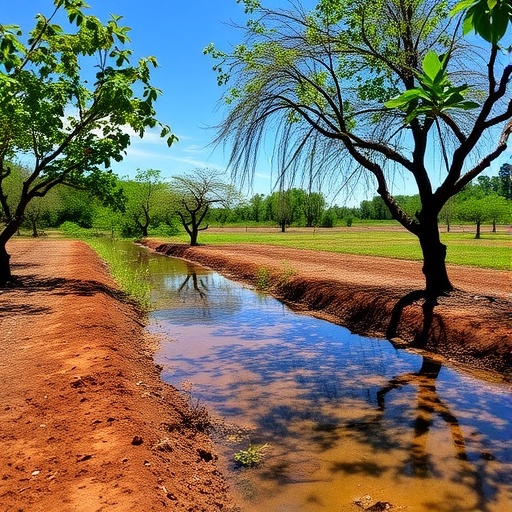
In the parched backlands of northeastern Brazil, the journey of a single drop of water—whether it begins on a rooftop, inside a tanker truck, or at the bottom of a murky reservoir—can determine whether a family stays well or spends the week battling diarrhea. That everyday drama has now been traced with rare scientific precision. A field study published in BMC Public Health followed three rural communities in the Brazilian Semiarid through the swings of the 2025 wet and dry seasons, sampling every source of household water and logging every episode of illness along the way. Led by first author Caroline E. Lourenço of the University for International Integration of the Afro-Brazilian Lusophony (UNILAB), with corresponding author Alexandre C. Costa and collaborators at Wageningen University in the Netherlands and Ceará’s Institute for Meteorology and Water Resources, the team found that the region’s celebrated rainwater cisterns—often the safest water available—were abandoned precisely when families needed them most, pushing households toward dirtier alternatives as the landscape dried.
The Brazilian Semiarid, or semiarido, is one of the most densely populated semi-arid regions on Earth, home to millions of people whose taps depend on erratic rains rather than reliable piped networks. Climate change is tightening that squeeze: rainfall arrives in fewer, more violent bursts, evaporation strips shallow reservoirs, and drought years arrive in punishing clusters. Wet seasons deliver most of the year’s water in a handful of months; the rest of the year becomes a slow negotiation with whatever remains. For households outside the public water supply network—the norm in the rural communities examined here—drinking and washing water is assembled from a shifting mosaic of sources. Rainfall cisterns store the wet season’s bounty beside the house; hand-dug wells and surface reservoirs supply bathing and cleaning; tanker trucks and the Integrated Rural Sanitation System, known locally as SISAR, fill the gaps. Each source carries its own chemical signature and its own microbial community, and each swells and fades with the seasons. That variability, the new study argues, is not merely an inconvenience of rural life. It is a public health mechanism—one that quietly converts water scarcity into sickness.
To capture that mechanism in action, the researchers conducted descriptive field research at three moments in 2025—February, April, and September—bracketing the transition from the rainy season into the depths of the dry. Working in communities made up entirely of households without access to the public water supply network, they administered structured questionnaires on water use, storage, and handling, and collected water samples from every domestic source then in service. In the laboratory, each sample was characterized physicochemically—temperature, oxidation-reduction potential, alkalinity, electrical conductivity, and related parameters—and screened microbiologically for total coliforms and E. coli, the classic indicator of fecal contamination. Hydroclimatic analysis framed the picture, characterizing the regional climate scenario against which household behavior unfolded. The team then pressed the data through a battery of statistical tests: the Kruskal-Wallis test with Dunn’s post-hoc comparisons for physicochemical measurements, Fisher’s exact test for microbiological findings, and Cochran’s Q and chi-square tests to evaluate the incidence of diarrhea across the three communities.
The hydroclimatic backdrop was stark. Cumulative precipitation in 2025 fell by 35.2 percent in Quixeramobim and 27.9 percent in Quixadá relative to 2024, a shortfall that rippled immediately through household decisions. Cisterns that had filled during the rainy months drained quickly, and the depletion was accelerated by a deeply rooted survival strategy: sharing. Families whose stores ran dry drew on the cisterns of neighbors and relatives, spreading the available water thinner but shortening its life for everyone. Rainfall cistern storage fluctuated sharply across the seasons, and the shared tanks emptied faster than any single household’s would have. As storage fell, the hierarchy of water use shifted in a predictable but consequential direction. Families continued to reserve cistern water for drinking whenever possible, but hygiene—bathing, washing dishes, laundering clothes—was pushed outward onto surface reservoirs and wells, sources that are typically more exposed to animals, sediment, and runoff.
Those behavioral adaptations matter because the physicochemical data reveal how different the fallback options really are. Across seasons and communities, the most striking discriminator was oxidation-reduction potential, or ORP—a measure of water’s tendency to accept or donate electrons, expressed in millivolts. In practical terms, ORP reflects the oxidative capacity of water: higher values generally indicate conditions hostile to microbial survival, often associated with freshly treated or well-aerated water, while lower values signal reducing environments where organic matter and microorganisms can persist. Because ORP responds quickly to disinfectants such as chlorine, it is often used as a rapid proxy for microbial safety in drinking-water systems. The analyses uncovered significant seasonal and inter-community variation in water quality, particularly in ORP, and significant differences across all physicochemical parameters between source types. Water delivered by tank trucks and through the SISAR system registered higher temperatures and higher ORP, while wells stood out for their higher alkalinity and electrical conductivity—a chemical fingerprint of long groundwater residence times, dissolved mineral loads, and, in many semiarid aquifers, progressive salinization under drought and intensive pumping.
Electrical conductivity and alkalinity deserve a closer look, because together they tell a story of geology meeting water stress. Conductivity climbs as dissolved ions—calcium, magnesium, sodium, bicarbonate, chloride—accumulate in water; the longer water lingers in contact with rock, the more dissolved material it picks up. In the Semiarid, where aquifers are often brackish and recharge is thin, wells frequently yield water that is chemically unpalatable long before it becomes biologically dangerous. High alkalinity buffers pH but also signals substantial dissolved mineral content. Neither property makes water unsafe on its own, yet both shape taste, discourage consumption, and interact with disinfection: chlorination, the backbone of treatment for trucked and SISAR supplies, behaves differently in high-alkalinity, high-temperature water, where the free chlorine that kills pathogens is consumed faster and works less predictably. The elevated temperatures and ORP recorded in trucked and SISAR water suggest supplies that have been recently treated but are also transported and stored in conditions that can erode that protection quickly.
The microbiological results cut through every comforting assumption. Total coliform contamination—a broad family of bacteria used as sentinels for environmental and fecal pollution—was widespread, and the persistent presence of E. coli, a definitive marker of fecal contamination, was observed across every source type. No category of water was consistently clean. Yet there was a clear gradient: rainfall cisterns demonstrated the lowest levels of E. coli contamination of any source, confirming their status as the best option available to these families. The finding carries a warning as well as a reassurance. Rainwater harvested from roofs is vulnerable at every step of its journey—dust, leaves, and animal droppings on catchment surfaces, the first flush of each storm washing months of accumulated debris into storage, and above all the hands, cups, ladles, and containers that move water from cistern to mouth. Cistern water arrives relatively clean; whether it stays that way depends entirely on storage conditions and domestic water handling, which the study identifies as likely contributors to the contamination it measured.
The health consequences were continuous rather than episodic. Diarrhea cases were reported in all three communities throughout the study period, and a quarter of all cases affected children—underscoring the heightened vulnerability of a group whose smaller bodies dehydrate faster and whose immune defenses are still under construction. Statistical evaluation of the illness data, using Cochran’s Q and chi-square tests, reinforced a pattern that clinicians in the region know well: diarrheal disease in the Semiarid is not a rare catastrophe triggered by a single spectacular contamination event. It is a chronic burden, ebbing and flowing with the seasons, sustained by the constant rotation of households through water sources of uneven quality. Every trade-down from a cistern to a well or a reservoir is a fresh roll of the dice, and over months the dice accumulate. A quarter of cases striking children is a signal that this burden falls hardest on those least equipped to bear it.
The study’s central conclusion is quietly subversive for water policy. Brazil’s semiarid region has spent decades building rainwater cisterns as the cornerstone of rural water security, and the new data validate that investment: cisterns are relatively safer sources. But the results also show that safety on paper evaporates in practice. During the dry season, cisterns are frequently replaced by less reliable alternatives—wells, surface reservoirs, tanker trucks—precisely because scarcity forces the swap, and the act of switching, sharing, and storing water under stress appears to raise microbiological contamination further. Storage conditions, domestic water handling, and adaptive strategies born of scarcity likely contribute to increased contamination, the authors conclude. In other words, the concrete infrastructure is only half of the water-safety system; the other half is the invisible household choreography of fetching, sharing, decanting, and rationing that determines what actually arrives in the cooking pot.
The implications reach well beyond the communities studied. The research, funded by Brazil’s National Council for Scientific and Technological Development and the Dutch Research Council, suggests that protecting rural health in a drying climate demands more than building cisterns: it requires safeguarding the water inside them through maintained gutters and first-flush systems, covered and regularly cleaned storage, point-of-use treatment such as chlorination or filtration during the high-risk months, and hygiene practices that travel with the water. It means treating tanker deliveries and small rural sanitation networks as water-quality infrastructure, not merely water-quantity infrastructure, and monitoring them with equal rigor. And it means planning explicitly for the dry season, because the study shows that the moment families are forced to trade down to riskier sources is the moment disease follows. In Brazil’s Semiarid, water scarcity and diarrheal disease are not separate problems to be solved by separate agencies. They are a single problem, moving together from source to sickness with every shift in the rain.
Subject of Research: Seasonal interrelationships between water scarcity, socio-environmental characteristics, water quality, and diarrheal disease outcomes in rural communities of the Brazilian Semiarid.
Subject of Research: Medicine
Article Title: From source to sickness: seasonal water risks in Brazil’s Semiarid
Article References: Lourenço, C. E., Costa, A. C., de Sousa, T. C., Silva, A. M., Pontes Filho, J. D., de Brito, C. A., Medeiros, P. H. A., Martins, E. S. P. R., Moreira, R. P., & van Oel, P. R. (2026). From source to sickness: seasonal water risks in Brazil’s Semiarid. BMC Public Health. https://doi.org/10.1186/s12889-026-29231-x
Image Credits: AI Generated
DOI: 10.1186/s12889-026-29231-x
Keywords: Water quality, Water scarcity, Waterborne diseases, Health vulnerability, Diarrheal disease, E. coli, Rainwater cisterns, Brazilian Semiarid, Rural sanitation, Water storage and handling, Seasonal variability, Public health
Cite Scienmag News
APA
MLA
Chicago
Phoebe Ingram. (August 30, 2026). Seasonal water changes drive disease risk in Brazil’s semiarid region. Scienmag. https://scienmag.com/seasonal-water-changes-drive-disease-risk-in-brazils-semiarid-region/
Phoebe Ingram. “Seasonal water changes drive disease risk in Brazil’s semiarid region.” Scienmag, 30 August 2026, https://scienmag.com/seasonal-water-changes-drive-disease-risk-in-brazils-semiarid-region/. Accessed 30 August 2026.
Phoebe Ingram. “Seasonal water changes drive disease risk in Brazil’s semiarid region.” Scienmag. August 30, 2026. https://scienmag.com/seasonal-water-changes-drive-disease-risk-in-brazils-semiarid-region/
Copy citation
Download RIS
Tags: Brazil semiarid regionclimate change effects on water accessClimate change impact on water sources in Brazil’s semi-arid regionscommunity adaptation to water scarcitydrought impact on healthdry and wet season health riskseffects of climate variability on waterborne illnesseseffects of rainwater cistern abandonment on public healthepidemiology of diarrhea in Brazilian semi-arid communitieshousehold water sourcespublic health in rural Brazilpublic health strategies for waterborne diseasesrainwater cisternsrole of water source monitoring in disease preventionseasonal water qualityseasonal water variability and disease riskwater infrastructure challengeswater quality and sanitation in rural Brazilwater resource management in semi-arid environmentswater scarcitywater supply challenges in drought-prone areaswaterborne diseaseswaterborne illness epidemiology