Credit: @Science China Press
Metallacages prepared via coordination-driven self-assembly have received extensive attention because of their three-dimensional layout and cavity-cored nature. The construction of light-emitting materials employing metallacages as a platform has also gained significant interest due to their good modularity in photophysical properties, which bring emerging applications in fields as diverse as sensing, biomedicine, and catalysis.
However, the luminescence efficiency of conventional luminophores significantly decreases in the aggregate state because they encounter unfavorable aggregation-caused quenching (ACQ). Therefore, it was quite a challenge to fabricate light-emitting metallacages with high luminescence efficiency in various physical states.
In 2001, Tang’s group discovered aggregation-induced emission (AIE) phenomenon that some nonluminous or weakly emissive materials in molecular state are highly emissive in aggregate state. The underlying mechanism accounting for the AIE effect was disclosed as restriction of intramolecular movements. So far, AIE has been a promising research field for more than 20 years, and brings a new opportunity to construct light-emitting metallacages with high luminescence efficiency.
In a recent review published in the Beijing-based National Science Review, scientists at the Shanghai Jiao Tong University in Shanghai, China, and at the University of Utah in Salt Lake City, United States, the latest advances in light-emitting self-assembled metallacages are summarized. The scientists presented the strategies for the rational design of light-emitting metallacages and highlighted the structural chemistry of AIE-active metallacages that display AIE, a novel photophysical phenomenon, as well as their emerging applications as chemical sensors, functional emissive materials, light-harvesting systems, and theranostic agents. These scientists likewise outline the potential future challenges in the development of light-emitting metallacages.
“The well-defined, highly tunable metallacage structures render them particularly attractive for investigating the properties of luminophores, as well as for inducing novel photophysical characters that enable widespread applications,” they state in an article titled “Light-emitting self-assembled metallacages.”
Studies on light-emitting metallacages stemmed from the use of rigid organic molecules as the building blocks for coordination-driven self-assembly. “Many of these molecules include large conjugated systems and are inherently photo-physically active, thus endowing the resulting SCCs with light-emitting properties,” they added. “To date, researchers have employed luminophores as donor or acceptor building blocks, or encapsulated guest molecules inside the cavity of the metallacages.”
“The almost limitless structural versatility of metallacages provides modularity over the photophysical profiles of the incorporated luminophore. These benefits are exemplified by studies on metallacages comprising luminophores with aggregation-induced emission (AIE) character,” the researchers stated.
The first attempt to explore the AIE behavior of self-assembled metallacages in 2015 has resulted in a new class of AIE-active metallacages with high luminescence efficiency in both dilute solutions and in the aggregated states, thereby bridging the gap between AIE and ACQ. These two photophysical phenomena are often considered to be diametrically opposed.
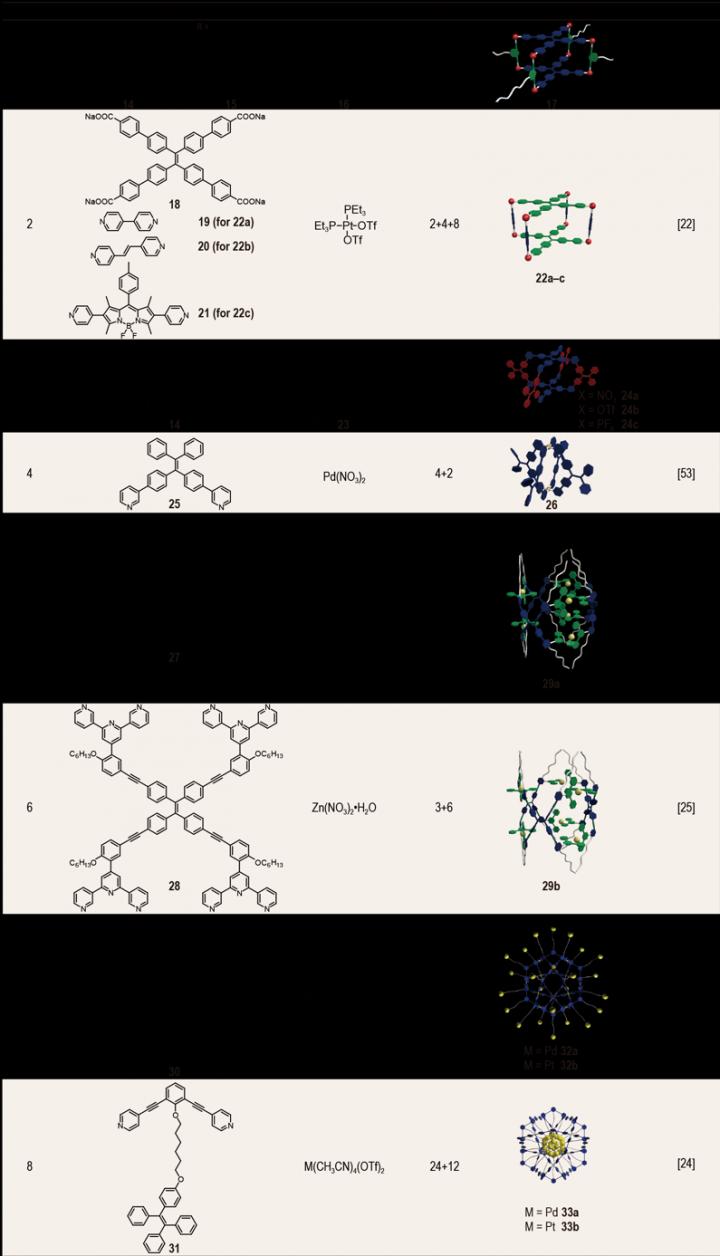
“Initial studies in this area focused on examining their “turn-on” luminescence in both solutions and aggregated states and their levels of responsiveness towards different solvents,” they stated. Advances of AIE-active metallacages based on tetraphenylethylene (TPE) and its derivatives (Table 1) have promoted investigations of factors that influence their emission properties and inspired applications utilizing this unique photophysical behavior. “Notably, combining metallacage chemistry with AIE has led to the development of AIE-active metallacages displaying favorable photophysical properties such as high luminescence efficiency and good modularity and having impressive relevance to a wide variety of areas such as sensing, energy conversion, and the development of theranostic agents,” they stated.
“The use of AIEgens with properties such as multiphoton absorption, red/near-infrared emission, enhanced solubility, and biocompatibility — that is, properties more desirable than those of the extensively studied based on TPE — is expected to result in the development of supramolecular luminophores with broader potentials,” the authors predicted. “Overall, with the rapid advances of both coordination-driven self-assembly and luminophores with favorable photophysical properties such as AIE, it is expected that research on light-emitting self-assembled metallacages will continue to flourish.”
###
This research received funding from the National Natural Science Foundation of China and the Natural Science Foundation of Shanghai.
See the article:
Jun Zhao†, Zhixuan Zhou†, Guangfeng Li, Peter J Stang*, Xuzhou Yan*
Light-emitting self-assembled metallacages
Natl Sci Rev: nwab045.
https:/
Media Contact
Xuzhou Yan
[email protected]
Original Source
http://doi.
Related Journal Article
http://dx.