

• HOME
  • NEWS
  • EXPLORE
    • CAREER
      • Companies
      • Jobs
    • EVENTS
    • iGEM
      • News
      • Team
    • PHOTOS
    • VIDEO
    • WIKI
  • BLOG
  • COMMUNITY
    • FACEBOOK
    • INSTAGRAM
    • TWITTER
Tuesday, May 12, 2026
BIOENGINEER.ORG
No Result
View All Result
  • Login
  • HOME
  • NEWS
  • EXPLORE
    • CAREER
      • Companies
      • Jobs
        • Lecturer
        • PhD Studentship
        • Postdoc
        • Research Assistant
    • EVENTS
    • iGEM
      • News
      • Team
    • PHOTOS
    • VIDEO
    • WIKI
  • BLOG
  • COMMUNITY
    • FACEBOOK
    • INSTAGRAM
    • TWITTER
  • HOME
  • NEWS
  • EXPLORE
    • CAREER
      • Companies
      • Jobs
        • Lecturer
        • PhD Studentship
        • Postdoc
        • Research Assistant
    • EVENTS
    • iGEM
      • News
      • Team
    • PHOTOS
    • VIDEO
    • WIKI
  • BLOG
  • COMMUNITY
    • FACEBOOK
    • INSTAGRAM
    • TWITTER
No Result
View All Result
Bioengineer.org
No Result
View All Result
Home NEWS Science News Biology

Emissions from human activity modify biogenic secondary organic aerosol formation

Bioengineer by Bioengineer
May 7, 2021
in Biology
Reading Time: 2 mins read
0
IMAGE
Share on FacebookShare on TwitterShare on LinkedinShare on RedditShare on Telegram

IMAGE

Credit: Li Xu

Despite their extremely small size, submicron atmospheric aerosols are critical pollutants with climate change, air quality, and human health implications. Of these particles, secondary organic aerosols (SOA) form when volatile organic compounds (VOCs) oxidize to lower volatility products that bond with and increase aerosol particle size, or in some cases, they may simply exist by themselves. SOA constitutes a significant fraction of the global aerosol mass. Scientists are attempting to improve future aerosol modeling, but several discrepancies still exist between model-simulated and field-observed SOA budgets.

”Large uncertainties in model assessments of SOA budgets and correspondingly, its climate effects, motivated extensive research to find out why these exist.” said Prof. Lin Du from the Environmental Research Institute, Shandong University. ”Biogenic volatile organic compounds (BVOCs) produced by terrestrial vegetation are globally major SOA precursors, and their SOA formation potential can be modified by anthropogenic emissions.”

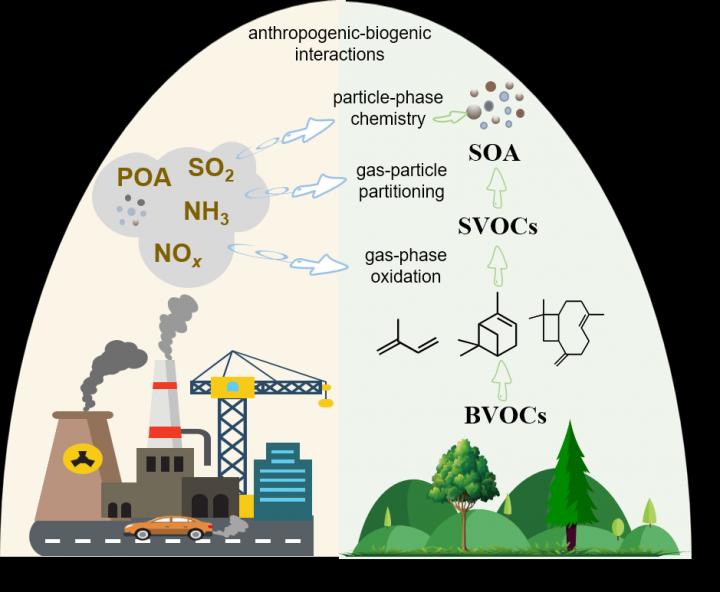
Prof. Du’s research group systematically summarized the field evidence and chemical processes behind SOA formation through anthropogenic-biogenic interactions. Advances in Atmospheric Sciences published their review work titled ”Anthropogenic Effects on Biogenic Secondary Organic Aerosol Formation.”

The predominant anthropogenic pollutants, including nitrogen oxides (NOx), aerosol particles, sulfur dioxide (SO2), ammonia (NH3), and other amines mediate SOA formation through both gas- and particle-phase reactions. The extent of these interactions is highly related to the BVOC precursors, pollutant levels, oxidants, and other atmospheric conditions.

”The nonlinear interactions between human and natural systems are far more complex than their current representation in atmospheric models.” said Prof. Du. “Meanwhile, the complexity and variability of the atmospheric environment itself makes the exploration of these interactions more challenging.”

Researchers have observed strong correlations between biogenic SOA formation and anthropogenic pollutants in many regions influenced by both anthropogenic and biogenic sources. Though BVOCs emitted from natural sources cannot be controlled directly, humans can mitigate a fraction of biogenic SOA by limiting anthropogenic pollutants. Shedding light on anthropogenic-biogenic interactions is necessary to improve estimates of how and to what extent anthropogenic emissions could modify global aerosol concentrations. These studies should help shape more effective pollution control measures as well as reduce uncertainties in the SOA budget and its associated climate effects.

”Based on comprehensive review of fundamental insights, future efforts, such as laboratory studies under more relevant atmospheric conditions, development of more authentic standards, field observations of the temporal and spatial distribution of both BVOCs, and anthropogenic pollutants, are recommended.” said Prof. Du. “With increasing studies on the qualitative and quantitative analysis of anthropogenic-biogenic interactions through laboratory explorations and field observations, better reproduction of SOA concentrations by atmospheric models would be expected.”

###

Media Contact
Ms. Zheng Lin
[email protected]

Related Journal Article

http://dx.doi.org/10.1007/s00376-020-0284-3

Tags: Atmospheric ChemistryAtmospheric ScienceChemistry/Physics/Materials SciencesPollution/Remediation
Share13Tweet8Share2ShareShareShare2

Related Posts

From Complexity to Clarity: Unraveling the “Topological Laws” Governing Cell Death — Biology

From Complexity to Clarity: Unraveling the “Topological Laws” Governing Cell Death

May 11, 2026
New Classification Framework Identifies Tumor-Associated Bacterial Effectors as Crucial Drivers of Tumor Biology and Immune Response — Biology

New Classification Framework Identifies Tumor-Associated Bacterial Effectors as Crucial Drivers of Tumor Biology and Immune Response

May 11, 2026

HIV-1 Strains Reveal Varied Paths to Antibody Escape

May 11, 2026

CRISPRi Screening Identifies Fungal-Specific Drug Targets

May 11, 2026
Please login to join discussion

POPULAR NEWS

  • Research Indicates Potential Connection Between Prenatal Medication Exposure and Elevated Autism Risk

    841 shares
    Share 336 Tweet 210
  • New Study Reveals Plants Can Detect the Sound of Rain

    728 shares
    Share 290 Tweet 182
  • Salmonella Haem Blocks Macrophages, Boosts Infection

    62 shares
    Share 25 Tweet 16
  • Breastmilk Balances E. coli and Beneficial Bacteria in Infant Gut Microbiomes

    57 shares
    Share 23 Tweet 14

About

We bring you the latest biotechnology news from best research centers and universities around the world. Check our website.

Follow us

Recent News

Humans and Zebra Finches Share Similar Speech Learning Techniques #ASA190

New Study Uncovers How Fungal Parasites Attack Strawberries and Raspberries

City of Hope Researchers to Present Groundbreaking Immunotherapy and Precision Medicine Advances Across Multiple Cancer Types at ASCO 2026

Subscribe to Blog via Email

Enter your email address to subscribe to this blog and receive notifications of new posts by email.

Join 82 other subscribers
  • Contact Us

Bioengineer.org © Copyright 2023 All Rights Reserved.

Welcome Back!

Login to your account below

Forgotten Password?

Retrieve your password

Please enter your username or email address to reset your password.

Log In
No Result
View All Result
  • Homepages
    • Home Page 1
    • Home Page 2
  • News
  • National
  • Business
  • Health
  • Lifestyle
  • Science

Bioengineer.org © Copyright 2023 All Rights Reserved.

