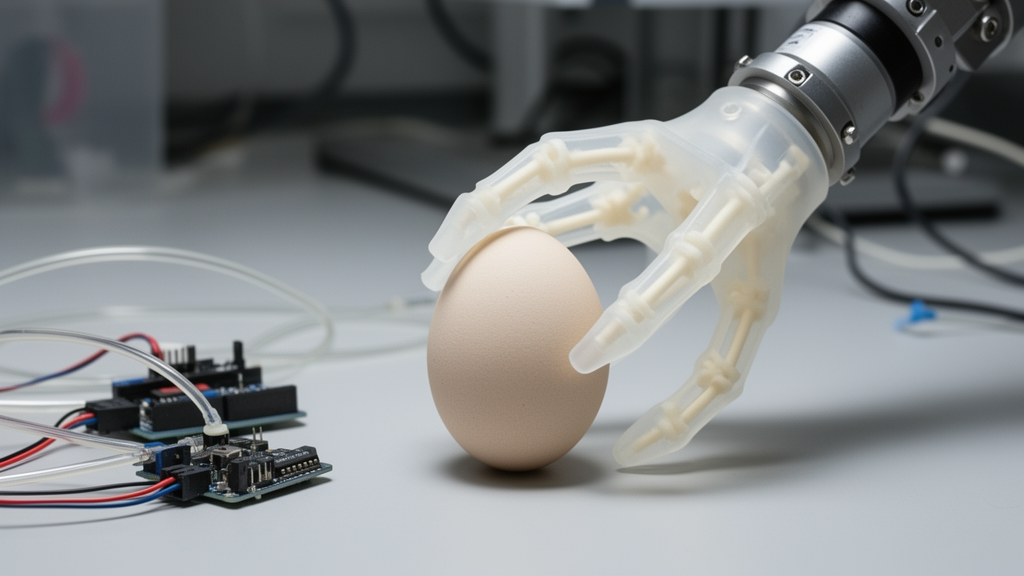
Soft pneumatic grippers promise gentle handling of delicate objects, but a common design flaw has long limited their usefulness: fingers made purely of multi-chamber silicone tend to stretch along their axis, twist sideways under load, and deliver too little force at the fingertip. A new research paper from Minnan University of Science and Technology in Quanzhou, China, reports a structural and control redesign that tackles these problems directly.
The study, authored by Kunhuang Ye and Wenwu Wang and published in Frontiers in Mechanical Engineering, describes an optimized pneumatic flexible manipulator built around an embedded segmented hinge skeleton made of polylactic acid (PLA), a rigid bioplastic placed inside the soft finger. The team paired this endoskeleton design with an incremental proportional-integral-derivative (PID) closed-loop control strategy, replacing the conventional open-loop constant-value pneumatic control used with traditional multi-chamber pure silicone fingers.
The motivation came from a systematic analysis of the structural defects of traditional flexible fingers. In conventional designs, pressurizing the silicone chambers produces bending, but the same pressure also drives axial stretching and significant lateral torsional deformation. These unwanted motions, combined with insufficient end-output force, translate into poor grasping stability when the manipulator handles real workpieces.
To address these issues, the researchers first carried out the structural design and sample preparation of the endoskeleton fingers, clarifying the material parameters and establishing standardized processing procedures. The embedded segmented hinge skeleton is intended to reinforce the finger from within, constraining deformation modes that interfere with grasping while leaving the desired bending motion intact.
On the control side, the paper compares the working principles of traditional open-loop constant-value pneumatic control with PID closed-loop control to determine the overall control scheme.
The team then ran four types of control tests: bending performance, end force, cycle durability, and whole-machine grasping. According to the reported results, the embedded skeletal structure significantly suppressed tensile and torsional deformation without affecting the normal bending of the fingers. In the full air pressure range, the structure increased the output force at the end of the fingers by more than 60 percent, and the design also demonstrated sufficient cycle durability in repeated testing.
The whole-machine grasping tests brought the two strands of the work together. A four-finger endoskeleton manipulator, operating in combination with PID closed-loop control, achieved a 100 percent success rate in grasping fragile, spherical, and columnar workpieces in the reported tests. The authors state that, compared with the traditional structure and open-loop control scheme, the proposed method significantly improved anti-interference performance and workpiece protection.
The combination of a mechanical fix and a control fix is what distinguishes the approach. The PLA skeleton addresses deformation and force output at the structural level, while the incremental PID controller addresses stability at the system level. Together, they target the same practical goal: a soft gripper that can hold fragile items without dropping or crushing them, even when conditions deviate from the nominal setup.
As with any engineering study, the findings describe performance in the tests the authors conducted, and the paper reports the results of its own controlled comparisons rather than field deployment across untested environments. The final, formatted version of the article will be published soon, according to the journal’s listing. Within that scope, the work offers a concrete recipe for soft gripper designers: embed a segmented hinge skeleton to suppress stretching and twisting, close the control loop with incremental PID, and verify the result against bending, force, durability, and whole-machine grasping tests.
Subject of Research: Structural optimization and PID closed-loop control of a pneumatic flexible manipulator with an embedded PLA endoskeleton for stable grasping
Article Title: Research on structural optimization and stable grasping control of flexible manipulators
Article References: Ye, K., & Wang, W. (2026). Research on structural optimization and stable grasping control of flexible manipulators. Frontiers in Mechanical Engineering, 12, 1943821. https://doi.org/10.3389/fmech.2026.1943821
Image Credits: AI Generated
DOI: 10.3389/fmech.2026.1943821
Keywords: pneumatic flexible manipulator, soft robotics, endoskeleton, PLA, PID closed-loop control, grasping stability, structural optimization, silicone fingers, end-output force, cycle durability, workpiece protection, Research
News Source: Denise Maddox. (October 28, 2026). Embedded PLA Skeleton and PID Control Boost Grasping Reliability of Pneumatic Soft Fingers. Scienmag.