• HOME
  • NEWS
  • EXPLORE
    • CAREER
      • Companies
      • Jobs
    • EVENTS
    • iGEM
      • News
      • Team
    • PHOTOS
    • VIDEO
    • WIKI
  • BLOG
  • COMMUNITY
    • FACEBOOK
    • INSTAGRAM
    • TWITTER
Monday, September 28, 2026
BIOENGINEER.ORG
No Result
View All Result
  • Login
  • HOME
  • NEWS
  • EXPLORE
    • CAREER
      • Companies
      • Jobs
        • Lecturer
        • PhD Studentship
        • Postdoc
        • Research Assistant
    • EVENTS
    • iGEM
      • News
      • Team
    • PHOTOS
    • VIDEO
    • WIKI
  • BLOG
  • COMMUNITY
    • FACEBOOK
    • INSTAGRAM
    • TWITTER
  • HOME
  • NEWS
  • EXPLORE
    • CAREER
      • Companies
      • Jobs
        • Lecturer
        • PhD Studentship
        • Postdoc
        • Research Assistant
    • EVENTS
    • iGEM
      • News
      • Team
    • PHOTOS
    • VIDEO
    • WIKI
  • BLOG
  • COMMUNITY
    • FACEBOOK
    • INSTAGRAM
    • TWITTER
No Result
View All Result
Bioengineer.org
No Result
View All Result
Home NEWS Science News Cancer

Elegant antibody nanoparticles override immunological tolerance of tumors

Bioengineer by Bioengineer
July 12, 2019
in Cancer
Reading Time: 2 mins read
0
IMAGE
Share on FacebookShare on TwitterShare on LinkedinShare on RedditShare on Telegram

IMAGE

Credit: Image by WANG Dangge

Immune checkpoint blockade (ICB) therapy using the antibody that combats the programmed cell death ligand 1 (PD-L1) shows great potential and is causing a revolution in clinical cancer management. Unfortunately, only a subset of treated patients responds to current ICB therapies, likely due to the immunological tolerance of tumors. Therefore, developing a practical strategy to combat this immunological tolerance and amplify ICB therapies has become a priority.

To meet this challenge, scientists from the Shanghai Institute of Materia Medica (SIMM) of the Chinese Academy of Sciences have developed a tumor enzymatic microenvironment-activatable antibody nanoparticle for robust cancer immunotherapy. This research was published online in Science Immunology.

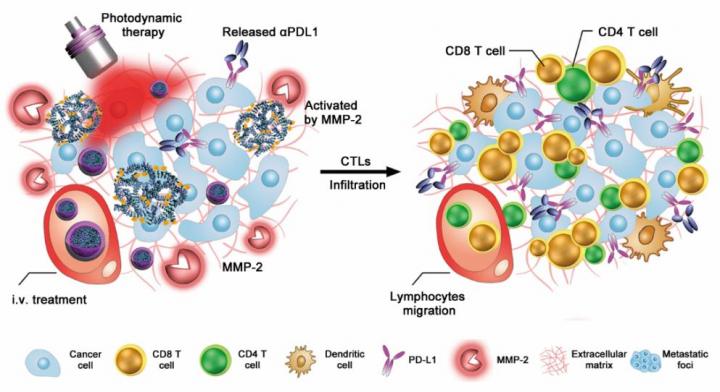
In this study, Prof. YU Haijun, Prof. LI Yaping and their colleagues engineered the antibody nanoparticles by integrating anti-PD-L1 antibody (αPDL1) and indocyanine green (ICG) into one single nanoplatform. ICG is a clinically approved fluorophore for fluorescence imaging in live surgery and photosensitizer for photodynamic therapy (PDT). The antibody nanoparticles remain inert in blood circulation and protect αPDL1 from binding with normal tissues. Once accumulated at the tumor site through the enhanced permeability and retention (EPR) effect, the antibody nanoparticles become activated to release αPDL1 for tumor-specific PD-L1 blockading.

Moreover, the scientists revealed that the antibody nanoparticles triggered the release of tumor antigens and promoted intratumoral infiltration of cytotoxic T lymphocytes (CTLs) through the ICG-based PDT effect. “This is crucial for cancer immunotherapy since CTLs have been well-identified as the killer of tumor cells,” explained Prof. YU, co-corresponding author of the study.

Finally, they showed that the antibody nanoparticles not only boost antitumor immunity with great efficiency, but also elicit long-term immune memory effects in BALB/c mice, thus leading to remarkable tumor regression.

In particular, the antibody nanoparticle-mediated combination of ICB and PDT therapy effectively suppressed tumor growth and metastasis to the lung and lymph nodes when using a 4T1 tumor-bearing BALB/C mouse model, which resulted in survival for >70% of the mice for more than 65 days, compared to complete mouse death in 42 days for the free αPDL1 group.

“We provided a robust antibody nanoplatform for priming the antitumor immunity and inhibiting the immune checkpoint, which could be readily adapted to other immune checkpoint inhibitors for enhanced ICB therapies. Given the simplicity of the nanostructures, our study has the potential of being translated into future generations of cancer immunotherapy,” Prof. YU said.

###

Media Contact
YU Haijun
[email protected]

Original Source

http://english.cas.cn/

Tags: cancerMedicine/Health
Share12Tweet8Share2ShareShareShare2

Related Posts

Low-Dose Radiation Shows Promise for Slowing Knee Osteoarthritis in Long-Term Trial

September 27, 2026

Gold Nanorods and Laser Light Strike at Cancer Stem Cells in Cats With Breast Tumors

September 27, 2026

Proton Beam Therapy Shows Durable Tumor Control in Rare Adult Brain Tumors

September 27, 2026

Radiation Oncology Takes Center Stage as Mayo Clinic Unveils Research at ASTRO 2026

September 26, 2026
Please login to join discussion

POPULAR NEWS

  • Trunk Control May Hold a Key to Balance and Fall Risk in Older Adults

    29 shares
    Share 12 Tweet 7
  • AI Tells Doctors When It Is Unsure About Cancer Treatment Success

    29 shares
    Share 12 Tweet 7
  • Engineered mini CRISPR enzyme gets a 60-fold power boost for gene editing

    29 shares
    Share 12 Tweet 7
  • When Autism Diagnoses Fade: Early Intervention and Milder Symptoms Mark Children Who Lose the Label

    29 shares
    Share 12 Tweet 7

About

We bring you the latest biotechnology news from best research centers and universities around the world. Check our website.

Follow us

Recent News

Trunk Control May Hold a Key to Balance and Fall Risk in Older Adults

AI Tells Doctors When It Is Unsure About Cancer Treatment Success

Engineered mini CRISPR enzyme gets a 60-fold power boost for gene editing

Subscribe to Blog via Email

Enter your email address to subscribe to this blog and receive notifications of new posts by email.

Join 85 other subscribers
  • Contact Us

Bioengineer.org © Copyright 2023 All Rights Reserved.

Welcome Back!

Login to your account below

Forgotten Password?

Retrieve your password

Please enter your username or email address to reset your password.

Log In
No Result
View All Result
  • Homepages
    • Home Page 1
    • Home Page 2
  • News
  • National
  • Business
  • Health
  • Lifestyle
  • Science

Bioengineer.org © Copyright 2023 All Rights Reserved.