Credit: Kobe University
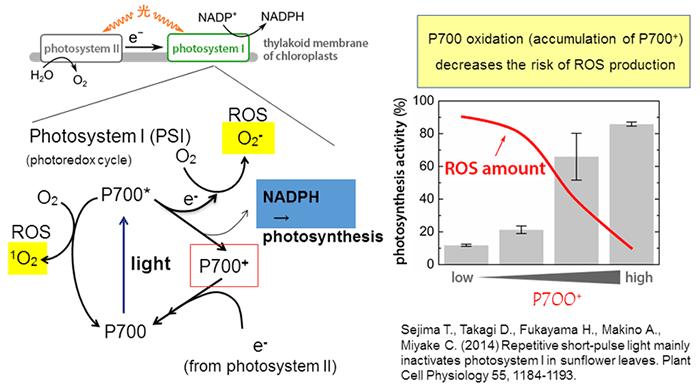
Plants are susceptible to stress, and with the global impact of climate change and humanity’s growing demand for food, it’s crucial to understand what causes plant stress and stress tolerance. When plants absorb excess light energy during photosynthesis, reactive oxygen species are produced, potentially causing oxidative stress that damages important structures. Plants can suppress the production of reactive oxygen species by oxidizing P700 (the reaction center chlorophyll in photosystem I). A new study has revealed more about this vital process: the cyclic electron flow induced by P700 oxidation is an electric charge recombination occurring in photosystem I. These findings were published on June 5 in Plants.
The research was led by Professor Chikahiro Miyake, Assistant Professor Shinya Wada, and Kanae Kadota (Kobe University), in collaboration with Professor Amane Makino (Tohoku University) and Associate Professor Yuji Suzuki (Iwate University).
Professor Miyake’s team revealed in previous studies that all oxygen-producing photosynthetic species use the P700 oxidation system to deal with oxidative stress. Professor Miyake and Dr Giles Johnson (Senior Lecturer at the University of Manchester) discovered that P700 oxidation is accompanied by a cyclic electron flow (CEF) in photosystem I (PSI). This cyclic flow is not necessary for the linear electron flow that forms part of photosynthesis, so what is it doing? To find out more about this alternative flow, the team analyzed the interaction between the electron carriers linked to the reaction in the PSI complex and the PSII quantum yield [Y(II)] that evaluates the activity levels of the linear electron flow. They used a major crop: wheat leaves.
The results showed that in the electron flow from P700* (excited P700) to ferredoxin (Fd), electron carriers A0, A1, FX, FA/FB are present, and when P700?(oxidized P700) accumulates, a charge recombination occurs in which electrons flow in from the electron carriers (Figure 2). In P700* charge separation occurs, passing electrons to the electron carrier A0 and oxidizing to form P700+. P700+ receives electrons from PSII and is reduced to its ground state. Meanwhile, the electrons accepted by A0 are passed to A1, FX, and FA/FB and flow to NADP+ via Fd, ultimately producing NADPH (chemical energy used in photosynthesis). From observing the reaction speed in leaf samples, the charge recombination between FX and P700+ can be considered the dominant pathway.
The existence of the charge recombination had already been revealed on a cellular level in biochemically isolated PSI complexes, cyanobacteria and green alga. However, until now its role in photosynthesis was unclear. This finding suggests that electrons flow from FX to P700+ based on the reactivity of P700+.
As a secondary result, the team also revealed the mechanism for suppressing the production of reactive oxygen species based on the charge recombination. The electron carriers A0, A1, FX, FA/FB have a very low reduction potential compared to that of oxygen. This suggests that they can easily pass electrons to oxygen and produce reactive oxygen species. The charge recombination revealed in this study plays the role of suppressing the interaction between these electron carriers and oxygen.
This study proposes that the cyclic electron flow induced by P700 oxidation is characterized by a charge recombination reaction that occurs within the PSI complex, including the necessary conditions and the cyclic electron carrier speed. The next step is to investigate the universality of the role of charge recombination within PSI complexes.
###
Media Contact
Eleanor Wyllie
[email protected]
Original Source
http://www.
Related Journal Article
http://dx.