Advances in electrochromic coatings may bring us closer to environmentally friendly ways to keep inside spaces cool. Like eyeglasses that darken to provide sun protection, the optical properties of these transparent films can be tuned with electricity to block out solar heat and light. Now, researchers in ACS Energy Letters report demonstrating a new electrochromic film design based on metal-organic frameworks (MOFs) that quickly and reliably switch from transparent to glare-diminishing green to thermal-insulating red.
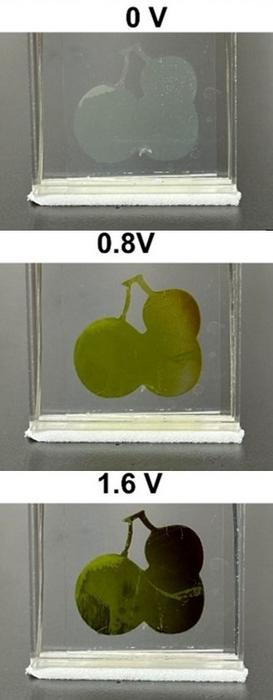
Credit: Adapted from ACS Energy Letters 2024, DOI: 10.1021/acsenergylett.4c00492
Advances in electrochromic coatings may bring us closer to environmentally friendly ways to keep inside spaces cool. Like eyeglasses that darken to provide sun protection, the optical properties of these transparent films can be tuned with electricity to block out solar heat and light. Now, researchers in ACS Energy Letters report demonstrating a new electrochromic film design based on metal-organic frameworks (MOFs) that quickly and reliably switch from transparent to glare-diminishing green to thermal-insulating red.
Hongbo Xu and colleagues used MOFs in their electrochromic film because of the crystalline substances’ abilities to form thin films with pore sizes that can be customized by changing the length of the organic ligand that binds to the metal ion. These features enable improved current flow, more precise control over colors and durability. In demonstrations, Xu’s MOF electrochromic film took 2 seconds to switch from colorless to green with an electric potential of 0.8 volts, and 2 seconds to switch to dark red with 1.6 V. The film maintained the green or red color for 40 hours when the potential dropped, unless a reverse voltage was applied to return the film to its transparent state. The film also performed reliably through 4,500 cycles of switching from colored to clear. With further optimization, the researchers say their tunable coatings could be used in smart windows that regulate indoor temperatures, as well as in smaller scale intelligent optical devices and sensors.
In addition to Xu’s MOF-based electrochromic film, several other research groups have reported electrochromic coating designs, including a UV-blocking but visually transparent radiative cooling film, a colorful plant-based film that gets cooler when exposed to sunlight, and a temperature-responsive film that turns darker in cold weather and lighter when it’s hot.
The authors acknowledge funding from the National Natural Science Foundation of China, Natural Science Foundation of Heilongjiang Province and the Scientific Research Startup Project of Quzhou University.
The paper will be available on May 29 at 8 a.m. Eastern time here: http://pubs.acs.org/doi/abs/10.1021/acsenergylett.4c00492
###
The American Chemical Society (ACS) is a nonprofit organization chartered by the U.S. Congress. ACS’ mission is to advance the broader chemistry enterprise and its practitioners for the benefit of Earth and all its people. The Society is a global leader in promoting excellence in science education and providing access to chemistry-related information and research through its multiple research solutions, peer-reviewed journals, scientific conferences, eBooks and weekly news periodical Chemical & Engineering News. ACS journals are among the most cited, most trusted and most read within the scientific literature; however, ACS itself does not conduct chemical research. As a leader in scientific information solutions, its CAS division partners with global innovators to accelerate breakthroughs by curating, connecting and analyzing the world’s scientific knowledge. ACS’ main offices are in Washington, D.C., and Columbus, Ohio.
To automatically receive news releases from the American Chemical Society, contact [email protected].
Note: ACS does not conduct research, but publishes and publicizes peer-reviewed scientific studies.
Follow us: X, formerly Twitter | Facebook | LinkedIn | Instagram
Journal
ACS Energy Letters
DOI
10.1021/acsenergylett.4c00492
Article Title
Biphenyl Dicarboxylic-Based Ni-IRMOF-74 Film for Fast-Switching and High-Stability Electrochromism
Article Publication Date
29-May-2024