• HOME
  • NEWS
  • EXPLORE
    • CAREER
      • Companies
      • Jobs
    • EVENTS
    • iGEM
      • News
      • Team
    • PHOTOS
    • VIDEO
    • WIKI
  • BLOG
  • COMMUNITY
    • FACEBOOK
    • INSTAGRAM
    • TWITTER
Sunday, July 12, 2026
BIOENGINEER.ORG
No Result
View All Result
  • Login
  • HOME
  • NEWS
  • EXPLORE
    • CAREER
      • Companies
      • Jobs
        • Lecturer
        • PhD Studentship
        • Postdoc
        • Research Assistant
    • EVENTS
    • iGEM
      • News
      • Team
    • PHOTOS
    • VIDEO
    • WIKI
  • BLOG
  • COMMUNITY
    • FACEBOOK
    • INSTAGRAM
    • TWITTER
  • HOME
  • NEWS
  • EXPLORE
    • CAREER
      • Companies
      • Jobs
        • Lecturer
        • PhD Studentship
        • Postdoc
        • Research Assistant
    • EVENTS
    • iGEM
      • News
      • Team
    • PHOTOS
    • VIDEO
    • WIKI
  • BLOG
  • COMMUNITY
    • FACEBOOK
    • INSTAGRAM
    • TWITTER
No Result
View All Result
Bioengineer.org
No Result
View All Result
Home NEWS Science News Chemistry

Electric signals between individual cardiac cells regulate heartbeat

Bioengineer by Bioengineer
July 13, 2021
in Chemistry
Reading Time: 3 mins read
0
IMAGE
Share on FacebookShare on TwitterShare on LinkedinShare on RedditShare on Telegram

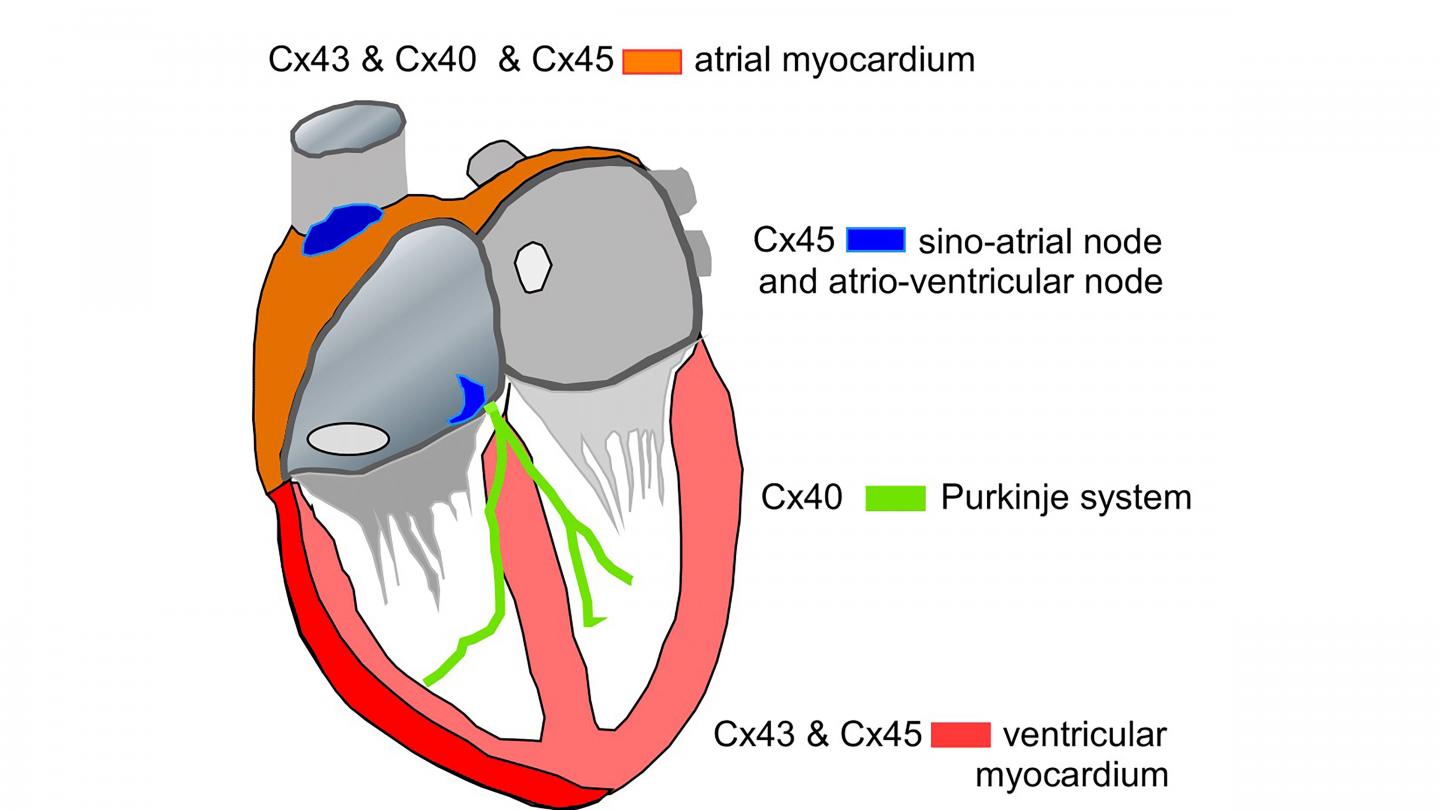
Cells are connected by gap junctions, which are vital for a healthy heart.
IMAGE

Credit: André G. Kléber

WASHINGTON, July 13, 2021 — The rhythm in a working heart is regulated by electrical impulses. Disturbances of this bioelectrical process can result in cardiac arrhythmias, or irregularities in heartbeat — a common ailment that can lead to illness and death.

In Biophysics Reviews, by AIP Publishing, researchers from Harvard Medical School provide a state-of-the-art update on how electrical impulses in the heart travel from cell to cell.

A functioning heart contracts to pump blood to the body and the lungs. Within the heart, a pacemaker acts as an electrical clock, sending out a signal that tells the heart when to contract. The whole muscle moves together, because each individual cell inside of it contracts in a coordinated manner and within a short time interval.

In order to do so, the initial electrical impulse, sent by the pacemaker, rapidly spreads through cells across the heart.

“If one cell is excited electrically and the other is not, the excited cell becomes positively charged inside, and the resting cell is still negatively charged inside. As a consequence, a voltage gradient builds up between the cells,” said author André Kléber. “If you have a voltage gradient and a pathway with a low electrical resistance, a local current will flow.”

The connections between cells forming the low resistance pathway and facilitating the current flow are called gap junctions. Each consists of many channels, which are formed when specific proteins from one cell dock and fuse to the proteins from another cell. Kléber said the fusing proteins look like placing the tips of your fingers on one hand to the fingers on the other hand.

The scientists delve into the properties of gap junctions and their constituent proteins, the so-called connexins. Kléber said one reason gap junction channels are interesting is because they are a highly dynamic system in equilibrium. The creation, or synthesis, of the channels equals the destruction.

“The turnover is very short,” he said. “On one hand, the system is very stable during your whole life. On the other hand, if you measure it, it is constantly cycling in periods of a few hours.”

The proteins found in gap junctions are important for processes not directly related to cell-cell connections, like mitochondrial function, which creates energy, and trafficking, which transports molecules from the site of synthesis to their site of action in the cell interior.

“You have to refrain from the idea that if you define the role of a protein in the body, that it has only a single function,” said Kléber. “Nature is much, much smarter than human beings.”

###

The article “Coupling between cardiac cells – an important determinant of electrical impulse propagation and arrhythmogenesis” is authored by André G. Kléber and Qianru Jin. The article will appear in Biophysics Reviews on July 13, 2021 (DOI: 10.1063/5.0050192). After that date, it can be accessed at https://aip.scitation.org/doi/10.1063/5.0050192.

ABOUT THE JOURNAL

Biophysics Reviews publishes research studies and comprehensive review articles of new and emerging areas of interest to the biophysics community. The journal’s focus includes experimental and theoretical research of fundamental issues in biophysics in addition to the application of biophysics in other branches of science, medicine, and engineering. See https://aip.scitation.org/journal/bpr.

Media Contact
Larry Frum
[email protected]

Related Journal Article

http://dx.doi.org/10.1063/5.0050192

Tags: BiologyBiomechanics/BiophysicsCardiologyChemistry/Physics/Materials SciencesMedicine/Health
Share12Tweet8Share2ShareShareShare2

Related Posts

Blue Light and Chemistry Simplify Complex Drug Production Steps

Blue Light and Chemistry Simplify Complex Drug Production Steps

July 10, 2026
New Discovery Promises Brighter, More Energy-Efficient Digital Displays

New Discovery Promises Brighter, More Energy-Efficient Digital Displays

July 10, 2026

New Crystalline 3D Frameworks Linked by Spiroborates Developed

July 10, 2026

IBEC Joins Major European Grant on Living Matter Physics

July 10, 2026
Please login to join discussion

POPULAR NEWS

  • Detection of EDCs in Breast Milk and Infant Urine Up to Six Months Highlights Early Exposure Risks

    77 shares
    Share 31 Tweet 19
  • New Drug Candidate Developed at McMaster Shows Potential for Treating Brain Cancer

    58 shares
    Share 23 Tweet 15
  • KTU Researchers Explore Ultrasound’s Role in Enhancing Blood Flow Beyond Diagnostics

    53 shares
    Share 21 Tweet 13
  • 高齢者の骨粗鬆症治療の持続性比較

    51 shares
    Share 20 Tweet 13

About

We bring you the latest biotechnology news from best research centers and universities around the world. Check our website.

Follow us

Recent News

TP53 Mutation Triggers CD8+ T Cell Exhaustion Causing Therapy-Resistant Urothelial Cancer

Transient Simulation Advances in Bioresorbable Flexible Electronic Circuits

Evaluating Geriatric Assessment and Interventions for Prostate Cancer Patients on ADT

Subscribe to Blog via Email

Success! An email was just sent to confirm your subscription. Please find the email now and click 'Confirm' to start subscribing.

Join 85 other subscribers
  • Contact Us

Bioengineer.org © Copyright 2023 All Rights Reserved.

Welcome Back!

Login to your account below

Forgotten Password?

Retrieve your password

Please enter your username or email address to reset your password.

Log In
No Result
View All Result
  • Homepages
    • Home Page 1
    • Home Page 2
  • News
  • National
  • Business
  • Health
  • Lifestyle
  • Science

Bioengineer.org © Copyright 2023 All Rights Reserved.