Gadgets that emit small electrical pulses can drastically cut the number of sharks and stingrays caught accidentally on fishing lines, new research shows.
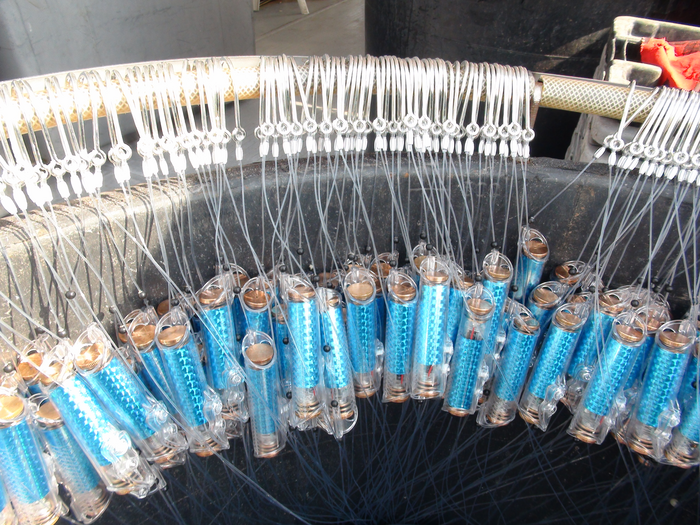
Credit: Fishtek Marine
Gadgets that emit small electrical pulses can drastically cut the number of sharks and stingrays caught accidentally on fishing lines, new research shows.
A new device called SharkGuard attaches to longline fishing rigs to scare off sharks and rays.
In the study, carried out on French boats fishing for tuna, lines fitted with SharkGuard reduced bycatch (accidental catching) of blue sharks by 91% and stingrays by 71%.
Catch of the target species, bluefin tuna, also appeared to decline, but further testing is needed to fully understand the effects of the device on target species.
SharkGuard was developed by conservation engineers Fishtek Marine, and tested by researchers at the University of Exeter.
“Many shark and ray populations are declining due to overfishing – particularly oceanic species such as blue sharks and pelagic stingrays that are commonly caught on longlines globally,” said Dr Phil Doherty, of the Centre for Ecology and Conservation on Exeter’s Penryn Campus in Cornwall.
“There is an urgent need to reduce bycatch, which not only kills millions of sharks and rays each year but also costs fishers time and money.
“Our study suggests SharkGuard is remarkably effective at keeping blue sharks and pelagic stingrays off fishing hooks.”
Commenting on the reduced catch of bluefin tuna (42%), Dr Doherty said the total number caught in the test period (on both lines with and without SharkGuard) was low, so further trials are needed to fully explore the results.
“On the back of these exciting results, the engineers at Fishtek Marine are modifying SharkGuard so it is smaller and self-charging after every haul,” said Dr Doherty.
“Research will continue at Exeter, where we test SharkGuard’s effectiveness at sea across multiple species and fisheries”.
Pete Kibel, co-founder and director of Fishtek Marine, said “When SharkGuard is used, sharks do not take the bait and do not get caught on the hooks, and that gives us a huge sense of hope.
“Against the relentless backdrop of stories of dramatic population declines occurring across all of our marine species, it is important to remember that there are people working hard to find solutions.
“SharkGuard is an example of where, given the appropriate backing, it is possible to roll the solution out on a sufficient scale to reverse the current decline in global shark populations.”
SharkGuard, which is powered by a small battery, works by targeting the area around a shark’s nose and mouth which is packed with electrical sensors called the ampullae of Lorenzini.
These sensory organs get overstimulated by the electric field generated by SharkGuard, which makes the sharks swim away from the danger of the baited fishing hooks.
Professor Brendan Godley, who leads the Exeter Marine research group, said: “Working with partners like Fishtek Marine allows us to combine Exeter’s expertise in marine research with their brilliant engineering, to address major challenges such as bycatch.
“We need further testing and development of SharkGuard, but it has the potential to be a global game-changer for the sustainability of longline fishing.”
The paper, published in the journal Current Biology, is entitled: “Efficacy of a novel shark bycatch mitigation device in a tuna longline fishery.”
Journal
Current Biology
DOI
10.1016/j.cub.2022.09.003
Method of Research
Observational study
Subject of Research
Animals
Article Title
Efficacy of a novel shark bycatch mitigation device in a tuna longline fishery
Article Publication Date
21-Nov-2022