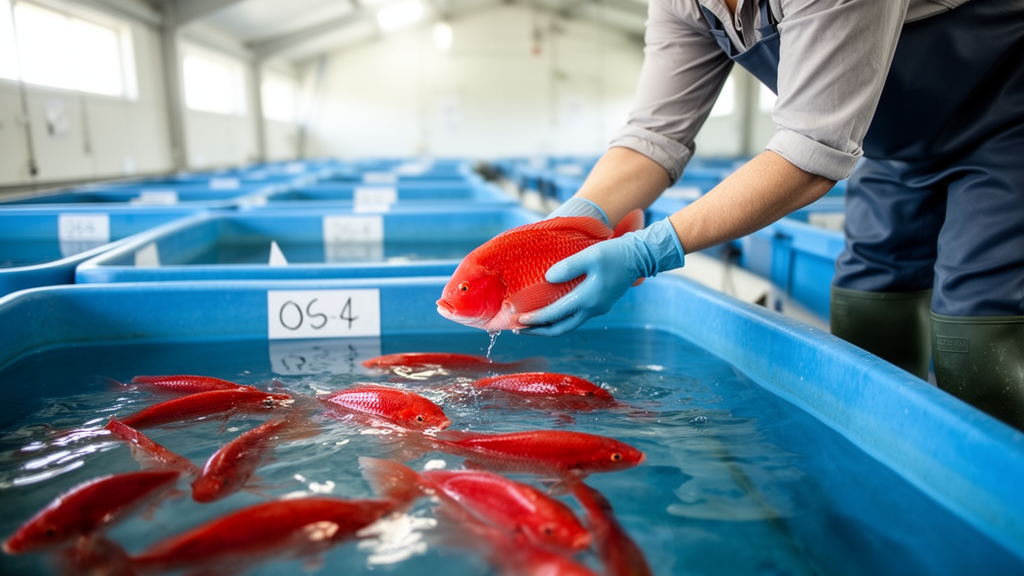
A breeding programme in Vietnam has managed to keep inbreeding under control in a closed nucleus population of red tilapia across eight generations of selection, according to a new study published in Discover Genetics and Evolution. The research team, led by Nguyen Hong Nguyen and colleagues, traced the complete pedigree of 75,950 fish descended from 608 sires and 1,203 dams, and found that pedigree-based inbreeding rose at an average rate of only 0.65 percent per generation between 2016 and 2023. The findings offer a rare, detailed accounting of how a selectively bred aquaculture population has fared genetically over nearly a decade of intense selection for faster growth.
The Vietnamese population examined in this study began with founder stocks collected in 2014 and a base population of 86 families established in 2015. From 2016 onward, successive generations were produced by single-pair mating, and their progeny were tested for growth in both freshwater and saline-water ponds. Each generation, the number of sires producing offspring ranged from 54 to 114 and the number of dams from 92 to 241, giving the researchers a deep pedigree to work with.
The team measured inbreeding using four complementary methods: Wright’s conventional inbreeding coefficient, the ancestral inbreeding coefficient that captures historical inbreeding, the purged inbreeding coefficient that accounts for the selective removal of deleterious recessive alleles, and the coefficient of coancestry, which reflects the proportion of alleles two individuals share through common ancestry. The authors argue that using all four approaches together provides a more comprehensive picture than any single measure, capturing current inbreeding, historical inbreeding, expected fitness effects and future genetic risk simultaneously.
The results show that the programme kept inbreeding at zero during the first two generations, after which levels climbed to 3.96 percent in the most recent generation in 2023. Averaged across the four estimation methods, inbreeding levels ranged from 0.60 to 1.46 percent. The rates of inbreeding per generation generally stayed below 1 percent, with average values ranging from 0.074 to 1.467 percent per generation over the study period. Correlations among the different methods were close to one, between 0.92 and 0.99, suggesting the estimates were robust regardless of the statistical approach used.
Effective population size, a key indicator of a population’s genetic health, was estimated from the rates of inbreeding between successive generations. Values ranged from 35 to 275 depending on the method and generation, with an average of 145 when calculated from average coancestry. The estimate derived from conventional inbreeding showed a declining trend, reaching 93 in the latest generation, while the coancestry-based estimate fell from 275 in the second generation to 35 in 2023. All estimates carried low standard errors between 0.29 and 5.31, and a regression of coancestry on birth years confirmed the average figure of 145. The authors attribute the generational variation partly to mortality of selected breeders during severe weather events, particularly in the most recent year, when inbreeding reached roughly 4 percent and effective population size dropped to about 35.
Genetic diversity, assessed through the effective number of founders and ancestors, remained largely intact. The loss of genetic diversity relative to the base population was approximately 3.03 percent, of which about 1.72 percent was attributable to random genetic drift, the primary contributor to diversity loss in closed nucleus populations. A ratio of effective founders to actual founders of 0.41 pointed to high selection intensity and unequal founder contributions, while a ratio of effective founders to effective ancestors of 1.01 indicated no evidence of population bottlenecks. A founder genome equivalent ratio of 0.57 suggested some erosion of diversity through drift and allele loss over the non-founder generations.
The study also quantified inbreeding depression, the reduction in performance caused by mating among relatives. Using linear mixed models that accounted for generation, line, sex, environment, age and additive genetic effects, the researchers found statistically significant but small effects on growth traits. Body weight declined by 4.017 grams for every 1 percent increase in the inbreeding coefficient, equivalent to a 1.61 percent decline relative to the trait mean. Total length decreased by 0.41 centimetres. In contrast, inbreeding had no statistically significant effect on survival or on the presence of black spotting in body colour, though the authors caution that such effects may emerge in future generations as selection continues.
The relatively favourable genetic profile of this population contrasts with patterns reported in other farmed species. Synthesised literature results indicate that inbreeding can accumulate rapidly in closed herds, sometimes reaching levels as high as 50 percent, and effective population sizes as low as 50 have been recorded in dairy cattle and in rainbow trout, with 88 reported for the GIFT strain of Nile tilapia after ten generations of selection. A recent meta-analysis of 154 studies across seven livestock species found that a 1 percent increase in pedigree inbreeding was associated with a median decrease in phenotypic value of 0.13 percent of a trait’s mean. The red tilapia population’s average inbreeding rate of 0.65 percent per generation and effective population size averaging 145 sit at the healthier end of this spectrum, which the authors attribute to systematic mate selection that avoided closely related pairings and limited the number of selected individuals per family.
Despite the overall positive picture, the researchers warn that the declining effective population size in recent generations may increase the risk of future inbreeding accumulation, loss of genetic diversity and reduced adaptive potential. They propose several strategies to strengthen the programme, including the application of Optimal Genetic Contribution theory, which computer simulations suggest can increase genetic gain by 20 to 60 percent while holding inbreeding constant, or reduce inbreeding by 20 percent compared with conventional BLUP selection. In an unpublished Nile tilapia programme in Bangladesh, this approach reportedly improved harvest body weight by an average of 2.60 genetic standard deviation units per generation while keeping the inbreeding rate at 0.81 percent over ten generations. The full pedigree records of the red tilapia population make such mate allocation based on estimated breeding values feasible.
The authors also point to genomic tools as the next step. Genomic relationship matrices can estimate inbreeding, though they may reflect shared ancestral admixture rather than recent common ancestry and depend on marker density and quality. Runs of homozygosity offer an alternative that can distinguish recent from ancient inbreeding by segment length, and recent studies indicate that both long and short segments contribute to inbreeding depression. Expanding breeding objectives to include measures of genetic diversity or genetic load, defining a reference level of inbreeding rather than a base year, maintaining separate genetic lines with regular exchanges with satellite populations, and even gene editing to artificially purge deleterious alleles are among the options discussed. The team concludes that the population retains ample genetic diversity to keep responding to selection, but that enlarging the population and adopting more robust diversity management will be essential to sustain genetic progress and resilience in the face of environmental change.
Subject of Research: Inbreeding, effective population size and genetic diversity in a selectively bred red tilapia population
Article Title: Inbreeding and its genetic and evolutionary consequences in red tilapia (Oreochromis spp.)
Article References: Nguyen, N. H., Phuc, T. H., Dang, N. T., Khoa, P. D., Lien, H. T. B., Tham, V. T. H., Duy, N. H., Ky, N. T., & Huong, T. T. M. (2026). Inbreeding and its genetic and evolutionary consequences in red tilapia (Oreochromis spp.). Discover Genetics and Evolution, 72(1), Article 2. https://doi.org/10.1007/s00294-026-01337-0
Image Credits: AI Generated
DOI: 10.1007/s00294-026-01337-0
Keywords: red tilapia, inbreeding, effective population size, genetic diversity, selective breeding, aquaculture, inbreeding depression, pedigree analysis, coancestry, genetic drift, Oreochromis, closed nucleus breeding
News Source: Juliet Wilcox. (October 28, 2026). Eight Generations of Selective Breeding Keep Inbreeding Low in Red Tilapia. Scienmag.