• HOME
  • NEWS
  • EXPLORE
    • CAREER
      • Companies
      • Jobs
    • EVENTS
    • iGEM
      • News
      • Team
    • PHOTOS
    • VIDEO
    • WIKI
  • BLOG
  • COMMUNITY
    • FACEBOOK
    • INSTAGRAM
    • TWITTER
Sunday, October 4, 2026
BIOENGINEER.ORG
No Result
View All Result
  • Login
  • HOME
  • NEWS
  • EXPLORE
    • CAREER
      • Companies
      • Jobs
        • Lecturer
        • PhD Studentship
        • Postdoc
        • Research Assistant
    • EVENTS
    • iGEM
      • News
      • Team
    • PHOTOS
    • VIDEO
    • WIKI
  • BLOG
  • COMMUNITY
    • FACEBOOK
    • INSTAGRAM
    • TWITTER
  • HOME
  • NEWS
  • EXPLORE
    • CAREER
      • Companies
      • Jobs
        • Lecturer
        • PhD Studentship
        • Postdoc
        • Research Assistant
    • EVENTS
    • iGEM
      • News
      • Team
    • PHOTOS
    • VIDEO
    • WIKI
  • BLOG
  • COMMUNITY
    • FACEBOOK
    • INSTAGRAM
    • TWITTER
No Result
View All Result
Bioengineer.org
No Result
View All Result
Home NEWS Science News Chemistry

Efficient valves for electron spins

Bioengineer by Bioengineer
August 12, 2020
in Chemistry
Reading Time: 3 mins read
0
IMAGE
Share on FacebookShare on TwitterShare on LinkedinShare on RedditShare on Telegram

IMAGE

Credit: University of Basel, Department of Physics

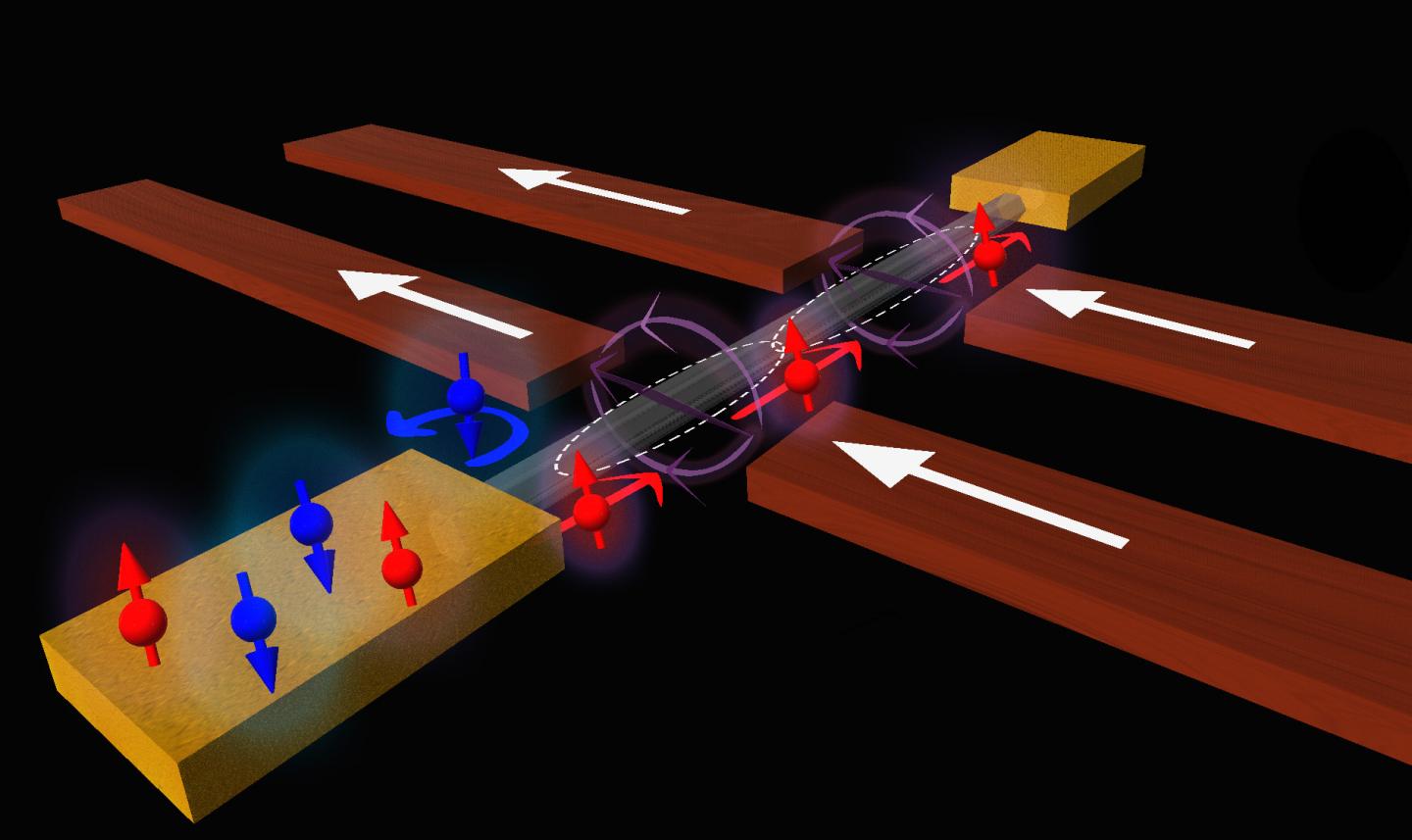
Researchers at the University of Basel in collaboration with colleagues from Pisa have developed a new concept that uses the electron spin to switch an electrical current. In addition to fundamental research, such spin valves are also the key elements in spintronics – a type of electronics that exploits the spin instead of the charge of electrons. The results were published in the scientific journal Communications Physics.

At some point, spintronics might become a buzzword that is as much a part of our vocabulary as electronics. The idea behind it is to use the angular momentum (spin) of an electron instead of the electrical charge. Researchers around the world have been pursuing this goal for many years. Spintronics promises numerous applications in information storage and processing, and could improve the energy efficiency of electronic devices. An important prerequisite is the efficient control and detection of electron spins.

A team of physicists around Professor Christian Schönenberger and Dr. Andreas Baumgartner from the Swiss Nanoscience Institute and the Department of Physics at the University of Basel has now developed a new technique for spintronics in semiconductor devices. Researchers from the Instituto Nanoscienze-CNR in Pisa were also involved.

Nanomagnets are the key

For this purpose, the scientists form two small semiconductor islands (quantum dots) behind each other on a nanowire and generate magnetic fields in the quantum dots using nanomagnets. Using an external field, they are able to control these magnets individually and thus can determine whether a quantum dot allows electrons to pass with a spin directed upward (up) or downward (down). When two quantum dots are connected in series, a current only flows if both are set to “up” or both to “down”. Ideally, no current flows if they are oriented in opposite directions.

Arunav Bordoloi, first author of the publication and PhD student in the Schönenberger team, found that this method produced a spin polarization close to the theoretical maximum. “With this technique, we can choose whether a single electron in a given spin state is allowed to enter or leave a quantum system – with an efficiency far greater than in conventional spin valves,” he says.

“In recent years, researchers around the world found it a hard nut to crack to fabricate spin valves useful for nano- and quantum-electronic devices,” says Dr. Andreas Baumgartner, who is supervising the project. “We have now succeeded in producing one.”

Exploring new phenomena

The physicists were also able to show that the magnetic fields are localized to specific locations on the nanowire. “This technique should therefore allow us to study the spin properties of new phenomena typically too sensitive to magnetic fields, such as novel states at the ends of special superconductors,” comments Dr. Baumgartner.

This new approach to spintronics should now enable direct measurements of spin correlations and spin entanglement and shed new light on many old and new physical phenomena. In the future, the concept could even prove useful in the quest to use electron spins as the smallest information unit (quantum bit) in a quantum computer.

###

Media Contact
Dr. Andreas Baumgartner
[email protected]

Original Source

https://www.unibas.ch/en/News-Events/News/Uni-Research/Efficient-valves-for-electron-spins.html

Related Journal Article

http://dx.doi.org/10.1038/s42005-020-00405-2

Tags: Atomic/Molecular/Particle PhysicsChemistry/Physics/Materials SciencesElectrical Engineering/ElectronicsMaterialsNanotechnology/MicromachinesSuperconductors/Semiconductors
Share12Tweet8Share2ShareShareShare2

Related Posts

Banana Peels Turn Into Catalysts That Boost Bio-Oil From Sewage Sludge

Banana Peels Turn Into Catalysts That Boost Bio-Oil From Sewage Sludge

October 4, 2026
Squeezing Polypropylene Flips Its Insulation From Rubbery to Glassy Conduction

Squeezing Polypropylene Flips Its Insulation From Rubbery to Glassy Conduction

October 4, 2026

Sulfated Seaweed Polymer Helps Gels Protect Anthocyanins Until the Gut

October 4, 2026

Nickel and Lithium Doping Face Off in Zinc Oxide Films for Supercapacitors

October 4, 2026
Please login to join discussion

POPULAR NEWS

  • Alloys That Shrink Their Own Grains: New PIX Mechanism Refines Metals With Heat Alone

    Alloys That Shrink Their Own Grains: New PIX Mechanism Refines Metals With Heat Alone

    29 shares
    Share 12 Tweet 7
  • Endurance Exercise Reshapes the Liver in Males and Females Through Distinct Molecular Routes

    29 shares
    Share 12 Tweet 7
  • Single Transcription Factor PU.1 Rapidly Converts Fibroblasts into Macrophage-Lineage Cells

    29 shares
    Share 12 Tweet 7
  • New Scale Measures How Ready Nurse Educators Really Are for the AI Era

    29 shares
    Share 12 Tweet 7

About

We bring you the latest biotechnology news from best research centers and universities around the world. Check our website.

Follow us

Recent News

Alloys That Shrink Their Own Grains: New PIX Mechanism Refines Metals With Heat Alone

Endurance Exercise Reshapes the Liver in Males and Females Through Distinct Molecular Routes

Single Transcription Factor PU.1 Rapidly Converts Fibroblasts into Macrophage-Lineage Cells

Subscribe to Blog via Email

Success! An email was just sent to confirm your subscription. Please find the email now and click 'Confirm' to start subscribing.

Join 85 other subscribers
  • Contact Us

Bioengineer.org © Copyright 2023 All Rights Reserved.

Welcome Back!

Login to your account below

Forgotten Password?

Retrieve your password

Please enter your username or email address to reset your password.

Log In
No Result
View All Result
  • Homepages
    • Home Page 1
    • Home Page 2
  • News
  • National
  • Business
  • Health
  • Lifestyle
  • Science

Bioengineer.org © Copyright 2023 All Rights Reserved.