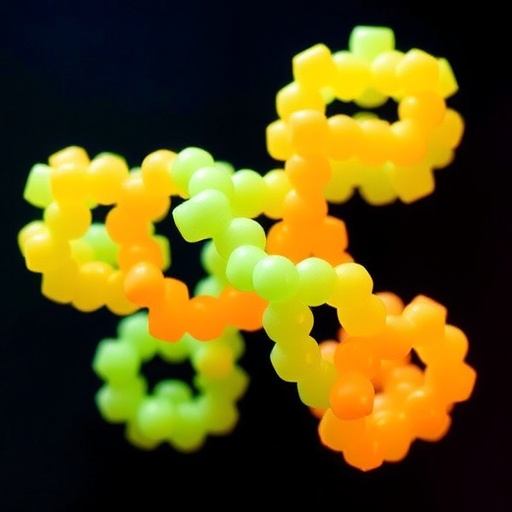
A new class of organic semiconducting polymers could give electronics a powerful new way to control electron spin—without relying on bulky magnets or rare magnetic materials. Researchers at the University of Osaka have developed chiral “ladder” polymers whose twisted molecular structures preferentially transmit electrons with one spin orientation. In experimental devices, the materials produced spin-polarized currents with polarization values of 70% or higher, placing them among the strongest-performing organic materials reported for this purpose. The finding could advance research into lightweight spintronic devices and more efficient energy-conversion technologies.
The work addresses one of the central challenges in spintronics: generating and manipulating spin-polarized electrical currents using materials that are practical, stable, and compatible with existing manufacturing methods. Conventional electronics primarily process the charge carried by electrons, while spintronic technologies also exploit the quantum-mechanical property known as spin. Because spin can encode information without requiring the same movement of charge as conventional current-based technologies, it is being investigated as a possible route to lower-power memory, logic, sensing, and energy-harvesting systems. The difficulty is producing a strong and controllable spin imbalance without introducing complex magnetic components.
The Osaka team approached the problem through chirality, a form of molecular handedness found throughout nature. A chiral object cannot be perfectly superimposed on its mirror image, much like a left hand and a right hand. At the molecular scale, this handedness can influence how electrons move through a material. The phenomenon is known as chirality-induced spin selectivity, or CISS. It describes the tendency of chiral systems to transmit electrons of one spin orientation more efficiently than electrons of the opposite orientation. Although the precise microscopic mechanisms behind CISS remain an active area of research, the effect has attracted intense interest because it could allow organic materials to act as spin filters.
To exploit this effect, the researchers designed polymers containing a rigid, bifacial ladder-like molecular framework. Unlike flexible polymer chains that can adopt many different shapes, ladder polymers contain chemically linked structures that restrict their motion and help maintain a defined geometry. In the new materials, the architecture was designed to support the formation of ordered helical arrangements, giving the polymer chains a controlled right- or left-handed character. The term “bifacial” refers to the two-sided nature of the ladder framework, which helps the molecular units assemble in a coordinated fashion rather than behaving as isolated, randomly oriented segments.
Molecular organization was critical to the material’s performance. When polymer chains assemble into ordered helical structures, their collective electronic properties can differ substantially from those of disordered chains. The rigid framework helps preserve conjugation—the delocalization of electrons across connected chemical bonds—which is essential for electrical conduction in many organic semiconductors. At the same time, the twisted arrangement introduces chirality into the pathways through which electrons travel. The combination of electronic conjugation, structural rigidity, and helical order created a material capable of transporting charge while selectively favoring one spin state.
The resulting polymers were incorporated into electronic devices to test whether their molecular chirality translated into measurable spin selectivity. According to the research team, the devices generated currents with spin polarization values of 70% and higher. Spin polarization describes the proportion of current associated with a preferred spin orientation; a value of 70% means that the current is strongly weighted toward one spin state rather than containing an equal mixture. Such performance is significant for organic electronics, where achieving high spin selectivity can be difficult because charge transport is often affected by structural disorder, molecular motion, impurities, and interfaces between different materials.
The polymers also offer practical advantages over many established spin-selective systems. They are carbon-based, lightweight, and designed to form thin films using processing approaches already used in organic electronics. Their high thermal stability is another important feature, because electronic materials must retain their structure and function during fabrication and operation. Organic semiconductors can often be deposited over large areas and onto flexible substrates, potentially enabling applications that are difficult to achieve with rigid inorganic materials. However, the researchers emphasize that the present result is a materials and device demonstration rather than a finished commercial technology.
The discovery could eventually influence several fields where controlling spin and charge simultaneously is useful. In spintronic memory and logic, a highly spin-polarized current could reduce the need for energy-intensive magnetic operations. In solar cells and other energy-harvesting devices, spin-selective transport might help manage how electrons and holes move after light or heat creates charge carriers. Chiral polymers could also be integrated with other organic components to produce flexible sensors or optoelectronic systems. These possibilities remain prospective: additional studies will be needed to evaluate long-term durability, scalability, operating speed, performance under different temperatures, and how efficiently the polymers can be integrated with conventional device architectures.
The researchers describe the work as evidence that molecular design can provide a direct route to controlling electron spin. Rather than treating chirality as a purely structural characteristic, the study uses it as an electronic function—turning the handedness of a molecule into a filter for quantum information carried by electrons. The team is continuing to investigate how the polymers assemble, how their chemical structures determine spin selectivity, and how the materials can be adapted for sustainable technologies. If those efforts succeed, nature’s familiar spirals could become more than an inspiration: they could form the molecular foundation of a new generation of lightweight, energy-efficient electronics.
Subject of Research: Not applicable
Article Title: Bifacial ladder polymers enabled by chirality-assisted synthesis that exhibit self-assembly and chirality-induced spin selectivity
News Publication Date: 3-Aug-2026
Web References: https://doi.org/10.1038/s41467-026-76059-5
References: Nature Communications, DOI: 10.1038/s41467-026-76059-5
Image Credits: Fumitaka Ishiwari — All Rights Reserved
Keywords
Chiral polymers, ladder polymers, chirality-induced spin selectivity, CISS, spintronics, organic semiconductors, molecular electronics, materials science, nanotechnology, polymer engineering, quantum mechanics, sustainable energy, energy harvesting, University of Osaka
Tags: advances in organic electronicschiral ladder polymerselectron spin controllightweight energy-conversion technologiesmolecular handedness in electronicsOrganic semiconducting polymerspractical spin manipulation methodsquantum properties of electron spinspin polarization efficiencyspin-polarized currentsspintronic device developmentstable organic materials for spintronics